




Rubber Paper Scissors Deep Dive
What the Community Thinks About Rubber Paper Scissors
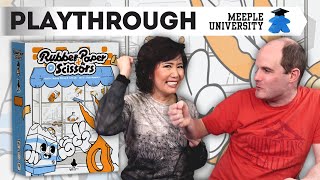
Rubber Paper Scissors has emerged as an unexpected delight in the two-player board game landscape. The core concept sounds deliberately absurd: combine tic-tac-toe, rock paper scissors, and set collection into a single game. Yet reviewers across multiple channels consistently find themselves charmed by the execution. The consensus is that Rubber Paper Scissors is a masterclass in taking familiar, universally-understood mechanics and weaving them into something surprisingly engaging. Its greatest strength lies in its accessibility paired with hidden depth, making it equally enjoyable as a quick ice-breaker and as a tactical duel between familiar opponents. Meeple University highlighted its clever strategic layer despite its lightweight presentation, while The Dice Tower praised it as genuinely shockingly fun, and Board Game Animal celebrated its ability to deliver substantial engagement from a minimal footprint.
Core Mechanics That Define Rubber Paper Scissors
Rock Paper Scissors Auction
At the heart of Rubber Paper Scissors lies a deceptively elegant application of rock paper scissors as a decision-making mechanism. Rather than serving as a novelty, the hidden guessing game becomes the engine that drives every critical choice across nine rounds. Each turn, players play rock paper scissors to determine pick order. The winner selects first from three options; the loser picks second; the winner is forced to take whatever remains. This creates a beautiful tension: winning gives you first pick but leaves you vulnerable to a poor third choice, while losing lets you react to the winner's pick but requires accepting a forced option. The rock paper scissors mechanic prevents any single dominant strategy from emerging, keeping both players perpetually guessing what their opponent will attempt next, making every round a miniature mind game.
Compound Scoring Through Multiple Tracks
Rubber Paper Scissors creates multiple avenues to victory, each with distinct strategic weight. Players accumulate points from set collection of stationery-themed tokens (glue guns, rulers, tape dispenser helmets), with a deliberately asymmetric scoring curve: the first and second tokens in a set yield modest points, the third represents a significant leap in value, but the fourth token actually costs players points, incentivizing strategic forcing of unwanted items onto opponents. The fourth token trap becomes a central tactical consideration. Simultaneously, players can score points through tic-tac-toe area control, earning three points for completing horizontal, vertical, or diagonal lines on the shared board. An instant-win condition exists via paperclip crown tokens: collecting all three ends the game immediately. The multiple scoring channels mean diverse strategies remain viable, and players must constantly weigh whether to pursue set completion, board control, or gamble on finding the elusive third crown.
The Rubber Paper Scissors Experience
Disarming Accessibility Masking Strategic Depth
Rubber Paper Scissors achieves something rare: it genuinely welcomes newcomers while satisfying players who return repeatedly. Because every player already understands rock paper scissors and tic-tac-toe, the learning curve flattens to near nothing. Yet within that familiar framework, meaningful decisions emerge from the moment pick order is decided. The game operates at a deceptive weight level, accessible enough that a casual player can teach it in under a minute, but sufficiently layered that experienced players discover reads, long-term forcing sequences, and subtle positional play. This accessibility does not dilute the game's appeal; rather, it becomes its strength, allowing players to focus immediately on head-to-head interaction rather than parsing rulebooks. Reviewers specifically noted the five-to-ten minute playtime preserves the lightweight feel while still delivering a complete strategic arc.
Charming Thematic Cohesion Through Stationery
The game's aesthetic choice to anchor the competition in a stationery shop gives Rubber Paper Scissors an undeniable charm that elevates it beyond mechanical abstraction. Rather than generic tokens, players collect rubber glue guns, finger skateboard rulers, tape dispenser helmets, and paperclip crowns, each rendered in a classic rubber hose cartoon art style. This thematic specificity creates endearing visual moments during play; items have quirky, memorable identities that make scoring progression feel less like number accumulation and more like a playful shop grab. The artwork and box design communicate that the game does not take itself seriously, setting a tone where winning through clever reads feels lighthearted rather than cutthroat. The charming design extends the game's reach beyond hardcore strategists to players who value aesthetic and whimsy alongside mechanical substance.
What Makes Rubber Paper Scissors Stand Out
Elegant Mashup of Universally Familiar Concepts
Rubber Paper Scissors could have failed spectacularly. Combining three established game concepts into a compact box risks dilution and confusion. Instead, the designers honored what makes each mechanic valuable: rock paper scissors provides hidden information and dynamic interaction, tic-tac-toe delivers familiar spatial control, and set collection creates long-term scoring incentives. No single element dominates; instead they interlock. Reviewers consistently emphasized surprise at how naturally these pieces coexist. The Dice Tower captured the feeling perfectly: the game basically asks whether you want to play tic-tac-toe and rock paper scissors together, and the answer, surprisingly, is an emphatic yes. This mashup works because each mechanic fills a different tactical niche without crowding the others out. The design philosophy respects player intelligence, assuming that familiar concepts need no lengthy explanation and can be immediately deployed in novel combinations.
Replayable Depth From Minimal Components
Rubber Paper Scissors achieves remarkable replayability through elegant constraint. The game is genuinely tiny: nine tokens, one three-by-three grid, and the rock paper scissors loop. Yet from these minimal components, each session generates a distinct game state. The asymmetric point values for set collection quantities create a moving target; the instant-win condition via crowns injects gambling and bluffing (a player holding two crowns becomes a perpetual threat, encouraging opponent focus). Variant rules further extend the game's life: multiplier tokens increase crown value without changing the base system, while binocular tokens permit peek-ahead, reducing randomness for players who prefer certainty. This economy of design means the game leaves the table feeling tight and resolved rather than bloated. Portability becomes an unexpected asset; the small footprint makes Rubber Paper Scissors a natural fit for pockets, travel bags, and spontaneous game nights where heavier titles would feel cumbersome.
Potential Drawbacks
Randomness From Face-Down Tile Acquisition
The core loop places face-up and face-down tokens on the grid each round. Rock paper scissors determines pick order, but the specific items available remain hidden until revealed. This introduces variance that some players may experience as punitive. A player could win a critical round only to discover the face-down token is a fourth glue gun, costing them points on a forced acquisition. While randomness can add narrative tension and memorable moments, players who prefer pure strategy without blind luck may find the mechanic frustrating over multiple plays. The game includes a variant using binocular tokens to peek at face-down tiles, directly addressing this concern, but the base game embraces the uncertainty as integral to its personality.
Limited Emergent Narrative After Repeated Play
Rubber Paper Scissors excels as a quick, repeatable experience but lacks the emergent storytelling or escalating complexity that sustains engagement in heavier games over extended campaigns. The token pool remains consistent, the board size fixed at three-by-three, and the scoring system unchanging across plays. While players will develop reads and strategy refinements, the game's tactical language remains fundamentally the same after five plays as it did after one. Some players who seek games that reveal new layers through expansions, evolving player cards, or narrative progressions may find Rubber Paper Scissors satisfying as a palette cleanser or warm-up but incomplete as a primary title. This is not a flaw but rather a design choice that reinforces its identity as an elegant, complete microgame rather than an evolving campaign experience.
If You Enjoy Rubber Paper Scissors
Players drawn to Rubber Paper Scissors should explore other games built on elegant constraint and rapid replayability. Lost Cities offers similar hand management tension and brinkmanship on a larger board but in equally quick playtime. Mandala shares the aesthetic of accessible design masking positional depth and also employs unique scoring systems that reward timing. For players specifically captivated by the rock paper scissors guessing dynamic, Donut (the abstract two-player variant using reversi-style flipping) layers the guessing game onto territorial control. Kingdomino appeals to those who enjoy light set collection with tactical board-building. Jaipur provides set collection and trading on a similar footprint, though without the rock paper scissors element. Toy Battle matches Rubber Paper Scissors in both complexity profile and the delight of surprisingly deep two-player tactics emerging from minimal rules.
What Reviewers Are Saying
"Rubber paper scissors basically asks you, do you want to play tic-tac-toe and rock, paper, scissors together? No, of course not. Surprisingly, actually yes with this game. It's so silly, it's so easy, and it's great. It's really shockingly fun rubber paper scissors."
— The Dice Tower
"It has such a small footprint but actually delivers quite a bit of fun, a little bit of variability and a way to spice up something that everyone already knows how to play. It's a great little addition to keep on the shelf, put in your pocket, put in a bag, introduce to people when you get a chance."
— Board Game Animal
"There's just enough of these little clever ways that you can lose points by getting forced into something you don't want to make it a really clever little game. It plays in five to ten minutes, very portable, very clever."
— Meeple University