

















Sand Deep Dive
What the Community Thinks About Sand
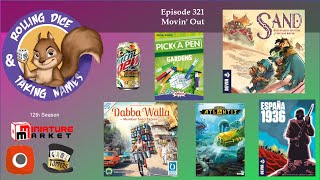
Sand presents a paradox: a mechanically inventive pickup-and-delivery game that divides the gaming community. Channels like Our Family Plays Games found genuine engagement with its unique dice-color system and desert theme, while Tabletop Turtle came away critical after many plays and The Broken Meeple and Rahdo Runs Through landed somewhere in between. Reactions range from lukewarm acknowledgment of its competence to cautious appreciation of specific elements, making Sand a title that needs to find its precise audience rather than appeal universally.
Core Mechanics That Define Sand
The Dice-Color Selection System
Sand's most distinctive contribution is its action selection through dice and color. Each round, colored dice are rolled, and rather than simply taking actions based on die values, players declare which colored dice they intend to use, then execute them in an order they choose to power different actions. Some actions care about the number on the die, others about its color, and some about neither, creating genuine decisions around which dice to reserve. This injects a layer of planning and flexibility uncommon in pickup-and-delivery games, giving players some control over the inherent randomness of dice.
The Delivery and Scaling Engine
As players pick up goods and deliver them, they unlock new abilities and improvements to their worker piece. Early deliveries unlock helper companions with special powers, while later deliveries improve the core worker's efficiency. This creates a dramatic power curve: players begin weak, barely moving their sandworm meeples across sparse desert routes, but gradually accelerate into satisfying turns that accomplish several objectives in sequence. The tension between needing deliveries to unlock power and the slow tedium of early turns is the game's most documented design challenge.
The Sand Experience
A Desert Trading Caravan Adventure
Sand grounds itself in a coherent world: you are a traveler guiding a sandworm across a desert, picking up goods from towns and delivering them to other settlements. The parallels to Dune are intentional, but the tone stays lighter and more whimsical. Villages dot the desert, connected by roads of varying difficulty: easy routes are slower but safer, while dangerous shortcuts risk damage to your worm. These decision points feel thematic rather than purely mechanical, and the components and artwork make the delivery loop feel like an expedition rather than abstract logistics.
The Scaling Rhythm and Pacing
Sand embraces a power-scaling structure that creates narrative momentum. The first third feels slow and constrained, a solo journey across empty dunes with limited options. As deliveries accumulate and helpers join, the game accelerates and opens up. By the midpoint, complex multi-delivery chains become possible; by the endgame, multiple objectives can be pursued in a single turn. This means Sand requires patience, since the most enjoyable turns arrive gradually and the early phase is deliberately restrained to make later turns feel powerful by comparison.
What Makes Sand Stand Out
Mechanical Innovation in a Familiar Genre
Pickup-and-delivery games stretch back decades with few radical innovations. Sand's dice-color declaration system is genuinely creative, offering decisions that feel both tactically relevant and strategically meaningful. Unlike games where higher die values are always superior, Sand ensures that values and colors have varied utility, so even low rolls can be optimal in the right situation. Companion abilities also show design care: each helper introduces distinct powers, so strategies evolve naturally rather than remaining static.
Visual and Thematic Cohesion
Sand commits fully to its desert setting. The sandworm meeples, varied terrain, trading villages, and overall aesthetic create an immersive tableau, and the theming directly informs the mechanics. Choosing safe roads versus dangerous ones, healing and feeding your worm, upgrading it for better performance, and accumulating prestige through deliveries all reinforce the fantasy of leading a trading expedition rather than solving a logistics puzzle.
Potential Drawbacks
Early-Game Tedium and Pacing
Sand's power-scaling structure creates a pacing problem for some players: the first third is mechanically restrained by design, so turn options are limited and efficiency matters less. This feels slow to players eager to optimize, and reviewers note that replays suffer because the early phase becomes repetitive. A common community suggestion is a variant that starts players with a helper already unlocked to shorten the ramp. For players who prefer immediate engagement and varied early decisions, Sand's deliberate climb to power can feel like a marathon.
Randomness and Companion Imbalance
The dice mechanic, while interesting, introduces randomness that can frustrate when it misaligns with goals. More pointedly, the companion abilities vary significantly in power. One companion can enable a strategy of staying put and letting others effectively deliver to its location, creating a dominant but unsatisfying approach that forces opponents to adjust their whole plan to counter it. Even when technically balanced, its presence creates tension between mechanical elegance and practical fun.
If You Enjoy Sand
Players drawn to Sand should explore Steam, a railroad pickup-and-delivery game with more player interaction through route blocking and network effects. Istanbul offers a similar delivery-driven economy with a different movement system and more variability. For a lighter alternative that removes the randomness, Broom Service delivers pickup-and-delivery through a clever card-play system. And fans of the power-scaling fantasy should try The White Castle, which builds escalating engines in a tighter, shorter package.
What Reviewers Are Saying
"I like the imagery with traveling across the desert on these little worms. It kind of feels a bit like a Dune, if it was a pickup-and-delivery game with a bit more comedy involved."
— The Broken Meeple
"I do like the way you scale your power in this game. When you first start moving you feel really weak, like you're moving a little worm around doing almost nothing, but you get that powerful feeling as you progress, because as you start delivering goods you get stronger, and all of a sudden you're able to do tons of different things."
— Tabletop Turtle
"This is a long game, with the first third of the game being really full of very unengaging, simple little baby turns while we're slowly building our way up to where we can get powerful and pull off really cool things. I think the developers missed a trick here."
— Rahdo Runs Through