

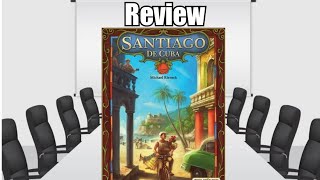



Santiago de Cuba Deep Dive
What the Community Thinks About Santiago de Cuba
Santiago de Cuba is a quiet favorite in the reviews that reach it, and most of the coverage comes from a single channel, Chairman of the Board. Across four videos the reviewer treats the game as a warm endorsement with a few reservations. The channel places it at the light end of the euro spectrum, roughly the lower end of medium-light, with rules overhead low enough that a turn reads as move, collect, and use. The same reviewer returns to it in a top ten list of relaxing board games, in a countdown of entry-level euros, and in a video about games that have left the reviewer's collection. The agreement across those episodes is consistent: the flow is smooth, the game finishes in under an hour, and it teaches well. The disagreement is about staying power. The reviewer praises the balance and the tight margins between players, but also says the game is unlikely to hold a permanent place on a shelf.
Core Mechanics That Define Santiago de Cuba
Worker Placement on Colored Buildings
The central system is a shared car that travels around the port. Every player controls the same car, so each move changes the options for the whole table. When the car stops at a local, the player collects the reward printed there, and the stop's color opens a matching section of buildings for that turn. Placing a worker on one of those buildings lets the player use it, and a building already occupied cannot be used by anyone else until the worker leaves. Michael Arenak's design keeps this placement deliberately simple, which is why the reviewers describe the turns as quick and uncluttered. Some buildings convert goods, some let a player steer the port's demand, and one lets a player mark a building so that a point is earned whenever someone else uses it. The first video sees that last building as a small touch of engine building rather than a full engine.
Commodity Collection and Port Delivery
The second system is a collection loop in which players gather commodities across the city and cash them in at the port. Reviewers focus on timing more than on pure accumulation. Goods are worth a base amount, and players can push the port's value higher by letting the car skip past it, so a stockpile becomes a bet on future demand. Demand is set by dice each round, so a good may have no buyers at all. The first video notes that goods left unsold at the end are worth far less than goods sold at the port, which keeps pressure on every player to deliver before the final ships sail. This is set-collection-style gathering rather than scoring by complete sets, but the same logic of collecting in order to cash in drives the middle of the game.
The Santiago de Cuba Experience
A Light, Chilled-Out Euro
Reviewers describe the feel as lighter than most euros, and the words they reach for are relaxed, punchy, and charming. The Chairman of the Board reviewer says the game moves quickly, with a lot of small considerations but nothing overwhelming. The turn structure is so compact that it is easy to hold in mind from start to finish, and that gives the table a calm rhythm even when the competition is real. The game sits comfortably on a list of relaxing titles because the decisions are present without demanding the kind of sustained concentration that heavier euros require.
Charm Without Meanness
The second constant is the interaction. Reviewers say the game is competitive without being cruel. A player can crash the market, flip a local over, or take a spot an opponent badly needs, yet nothing feels personal. The first video describes the competition as a matter of wanting to reach the port before rivals, not as an attack. That distinction matters to people who enjoy euros but dislike the sting of direct conflict, and it is the reason the game gets recommended to newcomers and gamers who want a gentle table.
What Makes Santiago de Cuba Stand Out
A Shared Car That Keeps Everyone Involved
Because the car is communal, a single move can cost the next player a long detour, and that is where the game gets its economy. Players pay coins for each extra space beyond the first, so the decision to skip ahead is both a positioning choice and a financial one. Reviewers single out this speculation as the feature that makes the game more than a route puzzle. It is the reason the reviewer on the entry-level list calls the game a solid introduction that does not get enough credit.
Variable Setup and a Striking Port
The people tiles and buildings are shuffled and placed at random each game, and the reviewer argues that this changes which moves are worth prioritizing even though the basic vein of play stays the same. The board itself is repeatedly praised. The port illustration is described as lovely and muted, the buildings are called basic but fine, and the components, including the wooden commodities, car, and tiles, draw no complaints. Reviewers say the look suits the theme well for a euro, which is unusual for a game of this weight.
Potential Drawbacks
Limited Replayability
The most direct criticism comes from the first video. The game does not have huge legs, and the reviewer expects five or six plays before it needs a long rest. The small box keeps it easy to store, so it can return to the table later, but the variable setup does not fully offset the sense that the core loop is familiar after a few sessions. Anyone buying Santiago de Cuba for a long-term group should expect it to be a regular opener or a teaching game rather than a centerpiece.
Basic Buildings and Tight Competition
The buildings are the weakest visual element. Reviewers call them pretty basic, and some of their effects are simple exchanges rather than rich abilities. The competition can also feel tight, because the spread between the winner and the runners-up is often very small. The reviewer on the relaxing games list says some players will want more interaction than the game offers, since the conflict is gentle by design. Players who want a sharper fight with stronger personal engines will find the game too restrained.
If You Enjoy Santiago de Cuba
Players who enjoy the quick, flowing turns and the rondel-style movement will find Istanbul a natural next step. Chairman of the Board ranks it first on the entry-level euro countdown for its breezy pick-up-and-deliver flow and for how its tiles work in similar ways, which keeps the teaching load low while still offering plenty to try. Players who like claiming worker placement spots will find Architects of the West Kingdom familiar territory, since the same reviewer describes it as a quick entry-level worker placement game where the rules overhead stays digestible. For the trading and collection side of the game, Coliseum is another easy-to-explain euro with auctions and a clear progression, which the reviewer describes as simple to learn while still giving players a lot to sink their teeth into.
What Reviewers Are Saying
"This is pretty interesting because it's not mean in any way shape or form but it's pretty meaningful because I said you can go to places where you know other people want to go. You can as I said you can manipulate that market to suit you and not suit your opponent."
— Chairman of the Board
"You can also claim some of those worker placement spots as your own basically buy them and then when other other people visit those workers you're going to get money as well so I love those different things."
— Chairman of the Board
"I used to use this game as a as a teaching tool for like my mom for example who isn't into games. And this was a game that really did bridge that gap for her to play more involved games."
— Chairman of the Board