



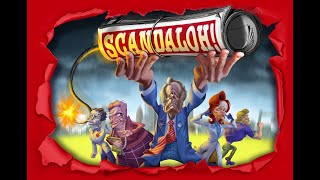


ScandalOh! Deep Dive
What the Community Thinks About ScandalOh!
Reviewers agree that ScandalOh! is a substantial deduction game with a theme that sets it apart from its peers. Grant Lyon, Grant's Gamerex, presents it as the follow-up to Awkward Guests from Mega Corpin, a game Grant Lyon says plays very similarly. Where Awkward Guests casts players as guests investigating a murder in a mansion, ScandalOh! casts them as journalists chasing a tabloid story. Grant praises the deck design in strong terms and says the "brilliant deck system" branding is earned. Grant also calls the game fairly difficult and says it demands real concentration, which Grant counts among its strengths.
BoardGameTeacher takes a walkthrough approach rather than offering a verdict. The video is a setup and rules tour of a three-player prototype, ahead of a planned Kickstarter campaign, and it describes the game as a hand management and deduction title for one to six players. Its value lies in showing how the inquiry, offer, exchange, and solution phases fit together over a round.
The Chairman of the Board, Chairman of the Board, mentions ScandalOh! only briefly. The video is an ethics-focused Q&A about creators and publisher relationships, and the Chairman notes that Mega Corpin sent the game after the Chairman praised Awkward Guests. The Chairman says the game and its sequel were enjoyable because they are so similar to Awkward Guests. The consensus is that the card design, the theme, and the satisfaction of solving a case are the main draws, while the difficulty and the paper-tracking workload are the main caveats.
Core Mechanics That Define ScandalOh!
Brilliant Deck System Card Trading
The heart of the game is a card economy built on information. Each card carries a value of one or two points, reflecting how much information it provides, along with references that name the locations, celebrities, newspapers, or contacts it concerns. On a turn, the active player states and marks three references on the inquiry board. Other players then place face-down cards from their hands with a total value under an offer token. The active player may trade with one or more of them, provided the cards they give up total at least the offered value. If nobody makes an offer, the active player draws three cards from the deck instead. Grant Lyon says the same deck-driven loop powers Awkward Guests, and in both games players record what they learn as the cards change hands.
Scandal Solving Tokens and Accusations
Each round ends with a solution phase. Players secretly cover their scandal solving tokens with the red side up to keep investigating or the yellow side up when they are ready to commit. Once the tokens are revealed, a committing player circles a story, celebrity, and newspaper on their tracking sheet and checks the answer. BoardGameTeacher explains that under the rulebook, a wrong answer eliminates the player, whose cards are revealed and removed from play. Under the app, a player who guesses incorrectly simply sits out the next solution phase. If nobody solves the case, players discard down to three cards and the round continues. The first player to reach a correct accusation wins, and the answer requires all three elements: the scandal, the celebrity behind it, and the newspaper that will publish it.
The ScandalOh! Experience
Confusion That Gives Way to Clarity
Grant Lyon describes the opening of a game as deliberately overwhelming. With only a few cards in hand, a player has little to go on and no clear picture of the scandal. Grant Lyon says that as more cards arrive, patterns begin to form and connections between celebrities, contacts, and newspapers start to sharpen. The early fog is part of the design, and reviewers treat the slow reveal as the reason the later turns feel earned.
Pride in Cracking the Story
The journalist theme gives the solving moment its emotional weight. Grant Lyon says that when a player figures out the solution first, they feel ridiculously proud of themselves, the kind of reaction that makes a game feel personal. Grant Lyon describes the feeling of an investigation coming into focus, with a newspaper's interest suddenly making sense, as very rewarding and satisfying.
What Makes ScandalOh! Stand Out
Many Cases From One Card Set
Grant Lyon's most enthusiastic praise is reserved for the deck. Grant explains that the box holds a few hundred cards, and each new scenario and scandal draws a different combination from that pool. The result is dozens of distinct cases built from the same components, which Grant says gives players a great deal of value for the price. Grant describes the card design as impressive and the effort behind it as enormous, and the replayability Grant describes follows directly from that design.
A Fresh Theme for the Deduction Genre
Grant Lyon argues that the theme is what makes ScandalOh! feel different. Grant has played many deduction games centered on finding a murderer, but this is the first Grant has played as a journalist trying to get a story published. That shift in framing changes how the same logic feels, and Grant says the theme makes the game feel fresh and unique within the genre.
Potential Drawbacks
A Demanding Learning Curve
Reviewers are consistent that ScandalOh! is not a light game. Grant Lyon says it is fairly difficult and requires players to put their deduction cap on. The early stages can be overwhelming when a player has only a little information, which Grant notes is a double-edged quality: the frustration at the start is what makes the later clarity rewarding, but newer or casual players may find the opening turns discouraging. Players who want a quick, low-stakes game may find the commitment steep.
Dense Paper Tracking
The walkthrough from BoardGameTeacher shows how much bookkeeping the game requires. Each player works from a tracking sheet that lists stories, celebrities, contacts, ties between names, and newspapers, and crossing off options is central to the process. The video stresses that players need a writing utensil in addition to the components. BoardGameTeacher presents the game as a prototype with components still in development, so the physical experience may change before release. Players who dislike heavy note-taking or cross-referencing may find this demanding, even though the workload is what drives the deduction.
If You Enjoy ScandalOh!
Reviewers who like ScandalOh! generally point to two other games. Awkward Guests is the closest relative. Grant Lyon says the two games play in a very similar way, both built on the same Brilliant Deck System where players gather clues from cards, trade for more information, and eventually deduce a solution. The difference is theme, with a murder in a mansion replaced by a tabloid scandal. The Chairman of the Board also says the Awkward Guests line was enjoyable for how similar the games are, which makes it a natural next step for players who want more of the same deck-driven deduction.
Clue is the more familiar reference point for the who-did-it deduction. Grant Lyon draws that comparison for Awkward Guests, describing its murder in a mansion as sort of like Clue, and ScandalOh! keeps that suspect-and-clue structure while swapping the murder for a tabloid investigation. Players who enjoy Clue's process of narrowing down possibilities will recognize the logic here, with the added element of trading clues with opponents rather than simply asking questions.
What Reviewers Are Saying
"I've played a lot of deduction games where the goal is to figure out who murdered somebody, but I've never played a deduction game where I play as a journalist trying to get a story published, and that theme makes it feel fresh and unique in the genre."
— Grant Lyon, Grant's Gamerex
"If you are using the rulebook, if the player is wrong, then they are eliminated and their cards are publicly examined and placed in the revealed card pile and are out of the game."
— BoardGameTeacher
"Because I reviewed that so positively, they sent me Scandaloh and then the head-to-head version of Awkward Guests, Awkward Guests 2, and I liked all those games because they are so similar to Awkward Guests."
— Chairman of the Board