/pic4177701.png)
Game Info
Year
2018
Players
1-4
Age
8+
Playtime
20 min
Collection
Ratings
Creator Score
Mechanic profile
Not enough video data yet
Vibe profile
Not enough video data yet
Description
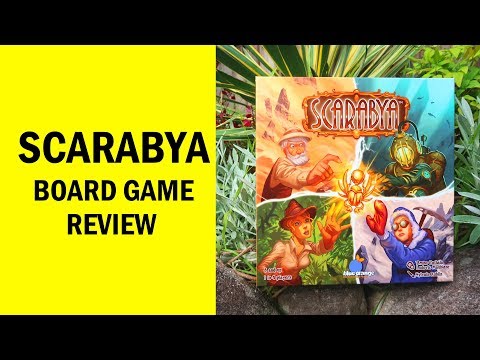
As the head of an international archaeological team, it is your job to establish camps across the four corners of the globe and uncover the long-lost golden scarabs of Scarabya.
Scarabya is a tile-laying puzzle game, in which your goal is to score scarabs by positioning your tiles such that they create enclosed zones of 1 to 4 squares. Each scarab in an enclosed zone is worth a number of points equal to the number of squares in its zone. Players all play the same tiles, in order. Each turn, a new tile is drawn and all players simultaneously place their copy of the tile on their individual boards. The game is over after all 12 tiles have been drawn (and either placed or discarded). The player with the most points wins.
Featured Videos

Ask a Rules Question
All mentions
Browse transcript mentions, sentiments, pros/cons, mechanics, topics, quotes, and references.
Total mentions: 6
This page: 6
Sentiment:
pos 5 ·
mix 0 ·
neu 0 ·
neg 0
Showing 1–6 of 6
Video KABMyIsPHoI
Board Game Sanctuary Review at 0:47 sentiment: positive
video_pk 109929 · mention_pk 316460
Click to watch at 0:47 · YouTube ↗
Overall sentiment (raw)
positive
Pros
- Excellent spatial puzzle with a refreshing twist on the polyomino tile placement genre.
- Exploits negative uncovered spaces for scoring.
- Satisfying to create excavation sites with scarabs for double points.
- Early tile placement has a flown effect later in the game.
- Requires foresight, adaptability, and space subdivision.
- Tight game feel, especially towards the end.
- 3D obstacles shape decisions.
- Ability to make wave decisions makes the game interesting.
- Tiles fit together in different variations, making the game replayable.
- Minimal player interaction in multiplayer mode, allowing focus on one's own board.
- Head-to-head and solo modes offer different experiences.
- Excellent table presence.
- Good decision-making and spatial decision-making opportunities.
- Simple, easy-to-learn ruleset, perfect for families.
- Unique focus on using uncovered spaces and maneuvering around spots.
Cons
- Can be prone to analysis paralysis, especially in the mid-game.
- Analysis paralysis can slow down the game.
- Over-populated genre with games like Cottage Garden, Indian Summer, Number 9, and Patchwork.
Thematic elements
- archaeologists looking for scarabs
- ancient proportions
Comparison games
- Patchwork
- Cottage Garden
- Indian Summer
- Number 9
Mechanics (from transcript analysis)
- Drafting — Across each round the great explorer draws a mission card from the deck and reveals it. These cards tell players which tile shape they'll be placing on their board for the round.
- Pattern Building — Players are placing different shaped tiles on their play boards to create excavation sites.
- Set Collection — Players earn points by enclosing uncovered scarabs using their tiles, ensuring that the enclosed area is four squares or less. This is known as an excavation area. At the end of a round if a scarab is enclosed in this way it scores points equal to the size of the excavation site.
- Tile Placement — Players are placing different shaped tiles on their play boards to create excavation sites. Subsequent tiles added to a player's board must be connected adjacently to an existing tile.
- Variable player powers — Players begin by selecting a colored frame, assigning the greatest Explorer role to the youngest player who then builds their game board by using the four large tiles whilst also placing the 3d pimple shaped rock obstacles inside the holes.
Video topics + discussion points
No key topics recorded for this video.
Quotes (from this video)
- Scarab Eye is an excellent spatial puzzle it puts a really great refreshing twist on the polyomino tile placement board game genre.
- The 3d obstacles that are included in the game really shape the decisions that play is made from turn-to-turn.
- Despite its simplistic rule set and short play time the game can be prone to some analysis paralysis.
- This one is more about using the uncovered spaces and trying to maneuver around particular spots on the wall.
References (from this video)
No references stored for this video.
Video 9_Ba3HY-ONE
Tabletop Tolson Analysis at 0:00 sentiment: positive
video_pk 85510 · mention_pk 219281

Click to watch at 0:00 · YouTube ↗
Overall sentiment (raw)
positive
Pros
- Turn order mechanism offers interesting trade-offs between initiative and future turns.
- Worker placement allows for faster gameplay, approaching simultaneous play.
- Unpredictable outcome keeps players engaged until the end.
Cons
- Excessive resources can clog the board and result in negative points.
Thematic elements
- gathering resources and sheltering settlers
- Neolithic northern Scotland
Comparison games
none
Mechanics (from transcript analysis)
- Card Drafting — By playing early in the turn, you get to draft your card first.
- Resource Management — Players have to manage their resource board. If they get too many resources, they have to move their slider to the right and gain more miden, which just clogs up their board and are negative points at the end of the game.
- Turn Order — Players discs are stacked on one another with the topmost acting first. You can choose to pass or play. By playing early in the turn, you get to draft your card first, but you also become bottom of the stack for the next turn.
- Worker Placement — Players can begin placing their workers after selecting their card and not waiting for other players to pick their card first.
Video topics + discussion points
No key topics recorded for this video.
Quotes (from this video)
- Well, look at all the shades of brown in my box cover.
- Let's settle this once and for all.
- Sounds like your game is set in the ancient world. Yours, too.
- This is so uncanny.
- Tell me more about the mechanics in your game.
- Whoa.
- I'm beginning to see how complicated your game can get.
- So, what's your game like?
- Okay, a nice worker allocation game. Sweet.
- Very cool.
- You always have to feed your people.
- Okay, I'm on board.
- You better believe it. It's a fine balance.
- So, what makes your game cool?
- No way.
- I bet it's tough to decide.
- What's your favorite part of Scarabra?
- Interesting trade-off.
- And that really speeds things up a bit.
- What if any drawbacks do you see with your game?
- So, in other words, analysis paralysis.
- Give me an example.
- And that's just for the red banners, huh?
- What about your game can be challenging?
- Nice, but also timing is key.
- Wo, that's wild.
- You got it.
- Okay, I think I got it hardly.
- However, I will recommend Ezra Renomaya to players who want a juicy, highly interactive game.
- Way to go, Shem. And SJ McDonald. Double header for next game night.
References (from this video)
No references stored for this video.
Video Aq-lsKACmlg
Ryan and Bethany Board Game Reviews Top List at 3:10 sentiment: positive
video_pk 85123 · mention_pk 217536

Click to watch at 3:10 · YouTube ↗
Overall sentiment (raw)
positive
Pros
- Designed by Tim Phillips, known for amazing games.
- Expected to be thinky, involved, and smooth.
Cons
none
Thematic elements
- Historic
Comparison games
- Hrien's Wall
- West Kingdom games
- Ezra and Nehemiah
Mechanics (from transcript analysis)
Mechanics unknown.
Video topics + discussion points
No key topics recorded for this video.
Quotes (from this video)
- I think it's going to be very cool, very immersive.
- It sounds like it has all the, you know, all the ingredients to be pretty pretty darn cool.
- These card games are like the perfect weight for tons of different situations. They are thinky and they're fun and they're fast and I'm excited for this one.
- I want to see the booth. I want to see the booth.
- I love bizarre history themes.
- Um and while it's unsolvable in the real world, here in this game, you get to solve it. You get to feel clever. You get to be the one that pulls it off.
- But I think this game is fantastic. It is already in the running for my top game of 2025.
- It is such a clever, smooth, cool card game that plays um you know up to eight players each.
- I think this is the kind of game that can kind of transcend the hobby a little bit.
- Sign me up. I am ready for this game. I take my money. Yeah, just take it. Just take my money.
- So, the fact that I can get all those same feelings in half the time, oh my gosh, this is an absolute home run for me.
References (from this video)
No references stored for this video.
Video DfJgNDSNuEk
Rahdo Runs Through Top List at 102:42:40
video_pk 84835 · mention_pk 216258
Click to watch at 102:42:40 · YouTube ↗
Pros
none
Cons
none
Thematic elements
Comparison games
none
Mechanics (from transcript analysis)
Mechanics unknown.
Video topics + discussion points
No key topics recorded for this video.
Quotes (from this video)
- It make me to have a lot of fun because when I'm playing the board game, I always laugh.
- I'm learning something because when we are playing board game, we used to speak in English.
- whenever I learn a board game and not only learning some other times I get time to teach the board games to other people. I feel that I achieve a lot in my life.
References (from this video)
No references stored for this video.
Video QASOivUwpH8
Review at 0:02 sentiment: positive
video_pk 68067 · mention_pk 164397
Click to watch at 0:02 · YouTube ↗
Overall sentiment (raw)
positive
Pros
- Elegant and clever mechanics, especially the drafting system.
- Escalating gameplay with more workers in later rounds.
- Excellent execution of resource conversion.
- Strategic depth in planning and passing for cards.
- Thematic integration of recycling and generational progress.
- Incentivizes both specialization and variety in gatherers.
- The game ramps up well after the initial round.
Cons
- The first round with only one worker feels lackluster and slow.
- Desire for objective cards (from solo mode) to be included in multiplayer.
Thematic elements
- Helping humanity thrive and survive
- Scotland, about 5,000 years in the past
Comparison games
- North Sea Redux
- Ship Rights of the North Sea
- Raiders of the North Sea
- Tigris and Euphrates
- West Kingdom trilogy
- South Tigris trilogy
- Circadian
Mechanics (from transcript analysis)
- Card Drafting — Players draft cards from available rows, with passing being a key strategy to secure future picks.
- end-of-round scoring — Players must feed their villagers, and the generation of midden negatively impacts end-of-round scoring.
- Resource Management — Players gather and convert resources, manage storage, and deal with waste (midden).
- Set Collection — Collecting sets of different gatherer types provides end-game scoring bonuses.
- Worker Placement — Players place workers to perform actions, with a special worker allowing placement in occupied spots.
Video topics + discussion points
No key topics recorded for this video.
Quotes (from this video)
- And if you've done that, well then welcome to Scotland, everybody.
- This is huge part of the game. There's a lot of brinksmanship.
- The more prosperous we are, the more stuff we collect and store, the more midden we create.
- This is not a high-scoring game, folks. 11 points is a pretty big deal.
- Oh man, that's going to be great. So, I cooked uh two I got two bones.
- So, I love the story this game tells, of course, but then on top of that, I love this. This is so simple and so elegant.
- I don't know why we can't use these in the multiplayer game. Minor complaints because make no mistake, the game is a lot of fun without it except for maybe that first round.
References (from this video)
No references stored for this video.
Video Fs8652l-aTU
Meeple University Rules Teach at 0:17 sentiment: positive
video_pk 63910 · mention_pk 157428

Click to watch at 0:17 · YouTube ↗
Overall sentiment (raw)
positive
Pros
none
Cons
none
Thematic elements
- waste management and recycling in a village
- around 500 BC (based on sun's location)
- procedural/ instructional
Comparison games
none
Mechanics (from transcript analysis)
- Card Drafting — There are three open drafts; players pick or pass
- Card drafting with open drafts — There are three open drafts; players pick or pass
- Drafting — Draft cards from available options
- end-of-round scoring — Count points from village cards, upgrades and tiles
- Food/cooking conversions — Convert resources into food to feed settlers
- Resource Management — Manage resources and storage, feed settlers
- Solo variant rules — Rules similar with slight drafting variant for solo play
- special action tiles — Random special action tiles give extra goals or cards
- Storage/waste slider — Unlimited storage with a waste slider that affects negative points
- Upgrading buildings — Upgrade buildings to improve actions/resources
- Worker Placement — Place workers to actions in their village
Video topics + discussion points
No key topics recorded for this video.
Quotes (from this video)
- the game plays one to four players
- with mechanics such as chaining Drafting and Resource Management the game is of medium complexity
- feed one food per settler
- you have unlimited storage capacity but each time you need more storage you move your slider to your right means you'll produce this waste
- the components featured in this video are prototype
- rules and artwork are not final
- the minister of recycling in their country
- now to build your village and recycle your waste in Scarab
References (from this video)
No references stored for this video.
Transcript Navigation
Showing 1–6 of 6