/pic4933337.jpg)
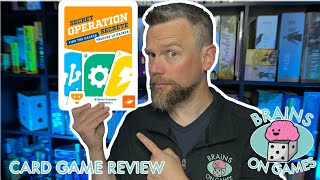
Misión secreta (Secret Mission) is a semi-cooperative card game with one or more hidden traitors.
Players play the role of engineers trying to build a state-of-the-art superrobot which is divided in 4 parts (card boards). Players add the pieces necessary to build each part, adding cards face down to the boards.
Every time the number of added cards equals the number of needed items, the players flip the cards and check if the added items match exactly the ones needed. If so, the task is completed, if not, they must build that part again from zero.
The goal of the game is to build the complete robot before the deck ends. If players fail to do so, the traitors win.
You depend on each other to fulfill the mission, but you’ll need to unmask the traitors that hide among you before it is too late.
—description from the publisher

- Simple introduction to hidden identity games
- Very quick to teach and play (about 5 minutes to explain)
- Language-independent iconography suitable for bilingual audiences
- Good for large groups; quick play sessions
- Requires a large player count (4-10) to reach its full potential; otherwise it may feel limited
- Memory and tracking can be challenging; some rules depend on recall
- Less suitable for small playgroups (2-3 players) most of the time
- Building and sabotaging a robot under suspicion and bluffing
- Robot-building workshop with hidden roles
- bluffing, deduction, and memory with bilingual accessibility
- One Night Ultimate Werewolf
Mechanics (from transcript analysis)
- Bluffing and deduction — Players share information and bluff about their plays while trying to identify saboteurs.
- Card play with face-down components — Cards are played face down onto robot components; order is revealed later to determine success.
- Hidden identity — Players have secret roles (engineer or hacker) and deduce others' identities via actions and cues.
- Hidden Roles — Players have secret roles (engineer or hacker) and deduce others' identities via actions and cues.
- Memory — Remembering what cards were played where to reason about which components are still needed.
- Nonverbal cue reading — Interpreting players' actions and tells to infer truthfulness.
- Set Collection — Players collect sets of component cards by matching symbols to complete robot parts.
Video topics + discussion points
Quotes (from this video)
- this is a super simple hidden identity game and i think what a great introduction to that genre
- it's language independent which is perfect for a company out of montreal that wants their games to be bilingual and accessible to french or english but you know anyone can play this thing
- it's quick to play
- we got things going in probably about five minutes i had to explain what the block cards were
- the only downside to this kind of a game is that you need such a large play count