
Sellswords Deep Dive
What the Community Thinks About Sellswords
Reviewers see Sellswords, the Level 99 Games two-player tile placement design, as a quick and light head-to-head game with more thought in it than its size suggests. Board Games UnLocked places it among its under-the-radar picks and argues that it flew under the radar because it is compact and easy to overlook next to heavier strategy titles, not because it lacks substance. Getting Games met it at a convention demo and called it a lighter cousin of Equinox, enjoying its simplicity while noting that the card text can be hard to parse.
The agreement is strong on the core. Matches are short, placement decisions carry weight, and the flip mechanic lets a single turn change the outlook of a whole board. The disagreement centers on how much randomness and unclear wording shape the experience. The Board Games UnLocked playthrough treats the draw as a source of tension and surprise, while both channels acknowledge that some abilities and rules need more explanation than the printed materials provide.
Core Mechanics That Define Sellswords
Numeric Flip Combat on a 5x5 Grid
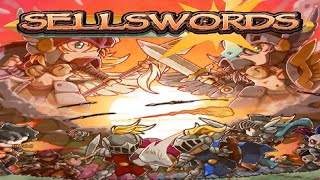
Each card carries numbers around its edges that represent its combat strength. Players place cards on a shared 5x5 grid, and when a newly played card sits next to an opposing card, the numbers are compared. The higher value flips the other card to the winner's color. Board Games UnLocked explains that the goal is to finish with more of your cards on your side than your opponent, and that this is why the cards are called sellswords: they are loyal to whichever side is winning. Because a single strong placement can reverse several tiles at once, the combat rule gives each match a steady sense of momentum. The playthrough also showed that some placement abilities resolve before the numbers are compared, which can let a card move out of danger before it is challenged.
Adjacency-Triggered Card Abilities
Every card has a text ability, and many of them depend on where the card lands. Reviewers pointed to cards that cannot be flipped at all, cards that gain value from neighboring allies, and cards that reach past the adjacent squares to compare against a tile two spaces away. The Board Games UnLocked playthrough repeatedly stopped to check whether a neighboring tile counted as adjacent, and that confusion shaped the reviewer's conclusion that positioning is the central skill. Level 99 Games built the abilities so that a well-placed card can change the entire local situation, which is why reviewers describe the game as rewarding careful reading of each card.
The Sellswords Experience
Quick, Swingy Head-to-Head Tension
The defining feel of Sellswords is a fast tug-of-war. Board Games UnLocked notes that the games move so quickly that players often want to start another round immediately, and the playthrough shows totals changing with every placement. Players recalculate after each move, look for the one placement that flips the most tiles, and then watch an opponent answer with a counterattack. The reviewers also note that the loyalty theme sharpens this tension: a player who starts to win may suddenly find that tiles and allies switch sides, which makes every lead feel provisional.
Lighthearted, Chaotic Banter
The playthrough video is loud, funny, and openly exasperated at times. The host jokes about the rules, complains about the luck of the draw, and laughs at the unusual abilities printed on the cards. Their verdict on the publisher, that Level 99 Games "does weird things with their games, but they're awesome," captures the tone many reviewers share. The game does not ask players to take it seriously, and the table talk is a large part of its appeal, even when a string of unlucky flips turns the mood sour.
What Makes Sellswords Stand Out
Drafting Through Limited Information
Board Games UnLocked highlights the draft as one of the most interesting parts of the game. Players choose which sellswords to bring into their hand, and because the choices are visible, they can reason about what the opponent still holds. The reviewer described being able to "easily read what your opponents might still have in their hand" and then predict how the opponent will use the cards they have hired. This blend of partial information and visible choices gives the game a bluffing and reading element that feels larger than the rulebook.
Terrain Starts and the Sellswords Odyssey Expansion
Board Games UnLocked notes that many games begin with a terrain card placed in the middle of the grid, and that each terrain card has its own special ability and scoring rule. Reviewers say that these starting cards change how the game plays from the first turn. The companion title, Sellswords Odyssey, uses the same core flip combat but swaps the original fantasy roster for Greek gods and their followers. The reviewer described both games as distinct flavors of the same engine, so players who find one too familiar can try the other without learning a new system.
Potential Drawbacks
Vague Card Text and Rules Gaps
The most consistent criticism is that the printed explanations do not always match the depth of the cards. Getting Games observed that the card text "could be very vague," and that the rulebook's explanations of individual cards can also seem unclear. The Board Games UnLocked playthrough reached a similar conclusion, noting that the game "doesn't really explain a whole lot" about how adjacency and ability timing work. Reviewers generally found the answers after some reading, but they recommend that new players resolve edge cases together before the first match.
Luck in the Draw and the Flips
Some reviewers feel that the draw can decide a game before players have much control. In the Board Games UnLocked playthrough, a drawn card was described as "completely undermining" a planned strategy, and the host grumbled about repeatedly receiving free-flip cards. The Yggdrasil variant, which begins with each player drawing from the top of the deck and keeping one card, was described as limiting how much players can plan around their opponent. Reviewers who enjoy this uncertainty see it as part of the appeal, while others find it frustrating in a game that is so dependent on precise placement.
If You Enjoy Sellswords
Players who enjoy the flip combat of Sellswords will find similar satisfaction in Equinox. Getting Games called Sellswords "Equinox light," describing Equinox as a deeper game with hexagonal tiles, flipping mechanics, and intricate combinations, while Sellswords keeps the flipping satisfaction in a much smaller box. For players who want the same structure with different theme and expansion options, Sellswords Odyssey offers the same engine with new heroes. Board Games UnLocked compared Sellswords to Onitama as a quick strategic one-versus-one, although the reviewer noted that the two games feel different in their decision-making. Players who enjoy the reading of an opponent's options and the short, sharp rounds of Sellswords will likely appreciate Onitama's focus on compact, tactical turns.
What Reviewers Are Saying
"This was like Equinox light because Equinox is like a real brain burner. It's so awesome with hexagons and you're flipping tiles, and there's all these very intricate combinations. This game is just simple, light, and fun."
— Getting Games
"If I'm playing red, your your essential goal is to have one is to have more of you the cards flipped to your side than theirs and that's why they're like sellswords is cuz they're like they're they're not loyal to anyone's side."
— Board Games UnLocked
"I really like abilities more than I like high power. Yeah, you're going to win with high power, but abilities kind of tend to do a lot more."
— Board Games UnLocked