






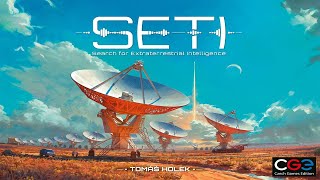

































In SETI: Search for Extraterrestrial Intelligence, a eurogame for 1–4 players, you lead a scientific institution tasked with searching for traces of life beyond planet Earth. The game draws inspiration from current or emerging technologies and efforts in space exploration.
Players will explore nearby planets and their moons by launching probes from Earth while taking advantage of ever-shifting planetary positions. Decide whether to land on their surface to collect valuable samples, or stay in orbit for a broader survey. Additionally, by directing your telescopes to gaze into distant star systems, you may detect traces of alien signals or undiscovered exoplanets, and collect promising data to examine and study back home.
Back on Earth, you can invest in upgrading your equipment so you can analyze incoming data more efficiently, boost your telescope signal capacity, or increase your supply of resources—all to expand the scope of your search that could lead to a discovery of extraterrestrial life forms.
You will also make use of over 200 cards to aid your efforts or focus your research in a particular direction for additional bonuses and rewards. Each card has unique effects and illustrations and depicts real-life technologies, projects, and discoveries (like the ISS, Large Hadron Collider, Perseverance rover, Voyager probe, and many more).
Finding traces of extraterrestrial life is only a matter of time—utilize the resources you have at your disposal strategically and you may well end up being the one to make the biggest scientific contribution towards advancing our understanding of alien life within our galaxy.
SETI: Search for Extraterrestrial Intelligence pays homage to space and planetary exploration, astronomy, the ongoing search for signs of life in the vastness of space, and efforts to understand the nature of life in the universe.
—description from the publisher
- Really, really great game.
- Really, really fun.
- Strategy can get very deep.
- Searching for extraterrestrial intelligences
- Castles of Burgundy
Mechanics (from transcript analysis)
- Action Point Allowance — Players choose actions and their order to prioritize tasks.
- set collection — Players collect 'traces' of aliens to discover them.
Video topics + discussion points
Quotes (from this video)
- It's time for the Golden Geek Awards where you, the people, get to vote on your favorite games of the year.
- The nominations are open right now, so you can go vote on those.
- This is quite possibly my favorite time of the year, the time where the artist series comes out with Board Game Geek.
- It's just really, really fun. I like Settlers because each individual action that you can do in Settlers is pretty darn simple.
- I love that concept for a game.
- It's just got like a really cool art style and I think it's in the Hokkaido area of Japan but one thing that's really cool is there's these like those crates are made of wood and stuff.
- This is Brass: Birmingham. This is the third installment in the Brass series.
- The stakes are very real.
- This is just like a game where you could like really make a hybrid build and kind of engine for yourself. That was super duper cool.
- It's worker placement, but there's no blocking.
- If you can have some flair along with your function, why the heck not?
- The best inserts, of course, help your games go into the box nice and neat and stuff.
References (from this video)
- Strong space-themes with varied strategic routes
- Elegant integration of exploration and communication mechanics
- Some players may find it heavy or abstract
- Array
- Space exploration and alien contact
- strategic / system-driven
Mechanics (from transcript analysis)
- Card-driven actions — Use a set of action cards to perform a variety of tasks like deploying satellites and communicating with life forms.
- Multi-Avenue Scoring — Players pursue points from satellites, planets, and alien interactions with different paths.
Video topics + discussion points
Quotes (from this video)
- it's a camel betting game
- you can't take it too seriously
- you are Vikings and you're exploring different islands
- This is a trick taking game and it really leans into being a trick taking game
- it's an area control game and it's also a set collection game as well
- money is unbelievably tight in this game
- you've got to make bets on who's going to be first, second, and third
- the cards shift
References (from this video)
- rich, puzzle-like mechanics that allow you to customize your engine
- variety of actions and multi-use cards create multiple strategic routes
- dynamic board rotation adds depth and spatial challenges
- endgame and end-of-round scoring provide layered incentives
- sustainable production notes (Czech Republic factory, recycled materials) and transparent material handling
- the game is quite long for a heavy Euro, which can sap tension and lead to downtime
- limited player interaction for direct competition; spaces feel large and open
- role-playing or narrative engagement fades in the second half for some players
- solo play and speed runs are untested or not clearly advantageous; pacing can feel slow
- endgame scoring tiles are random, which can introduce variance not everyone enjoys
- Array
- Space
- Engine-building puzzle with space exploration theme
- Galileo Galilei
- The Garden
Mechanics (from transcript analysis)
- area majority — There are zones where majority control yields points, creating a spatial contest dynamic alongside the trace system.
- Area majority/territorial scoring — There are zones where majority control yields points, creating a spatial contest dynamic alongside the trace system.
- board rotation — The solar system board rotates across rounds, forcing players to continuously adapt spatial planning and trajectory decisions.
- Card-driven actions — Players use multi-use action cards that provide different effects; some cards can be discarded to take their top-action benefits, and new cards cycle into play.
- End-of-round income and deck-building elements — Players tuck income cards under their boards to gain immediate benefits and, at round end, collect ongoing income; deck-building emerges as cards cycle and provide future actions.
- Exploration scoring via traces — Scoring is driven by collecting traces (yellow, blue, pink) through landing, orbiting, and data scanning to establish paths toward alien discovery.
- Multi-use cards — Cards have multiple uses, including top-action discard options and on-board bonuses, enabling varied engine-building paths.
- Multi-use cards with discard and reuse — Cards have multiple uses, including top-action discard options and on-board bonuses, enabling varied engine-building paths.
- Resource management — Players manage a small set of resources to move probes, scan data, and upgrade technologies, with publicity acting as a separate incentive mechanic.
- Resource management (credits, energy, publicity) — Players manage a small set of resources to move probes, scan data, and upgrade technologies, with publicity acting as a separate incentive mechanic.
Video topics + discussion points
Quotes (from this video)
- the biggest downside of this game is how long it is
- there are not a lot of table talk; there isn't a lot of competition for spaces
- it's a long game
- there's a lot of really cool mechanics going on here
- I would definitely feel it's more like a six, maybe a six and a half on the BGG scale
- game of the year maybe not so much but it's definitely something worth checking out
- you can really kind of make the space agency that you really want to play
References (from this video)
- search for extraterrestrial intelligence
- solar system and stars; space exploration agencies
Mechanics (from transcript analysis)
- Area movement — Move probes to planets; movement largely via free actions; various costs and effects described.
- card management — Spend three Publicity to take a card from the deck or face-up display.
- Card Play — Play a card from hand by paying its cost; white cards have immediate effects; silver boxes are Missions.
- Compound Scoring — First/second place rewards on stars; markers track progress; scoring can occur multiple times per star.
- Data computer — Input data into a computer; fill it to gain benefits and eventually analyze data for blue Life tokens.
- Discard for credits — Discard a card from hand for the resource in its top-left corner for two credits.
- end game bonuses — Four common endgame objectives; selecting them at 25, 50, or 70 points affects scoring.
- End game objectives — Four common endgame objectives; selecting them at 25, 50, or 70 points affects scoring.
- end-of-round flow — Round ends with passing, income collection, and rotating the first-player marker.
- free actions — Any number of free actions in addition to a main action.
- income — Gain income (credits, energy, and cards); tuck a card to income pile for ongoing benefits.
- Income and tuck — Gain income (credits, energy, and cards); tuck a card to income pile for ongoing benefits.
- Landing — Spend energy to land on a planet; landing costs can be reduced to two energy after an Orbiter is present.
- Life traces — Yellow, pink, and blue life traces on stars grant rewards and publicity.
- Main actions — Seven main actions indicated by hexagon icons; an eighth action is passing.
- missions — Silver box missions provide rewards when completed; triggerable and conditional missions exist.
- Orbital mechanics — Having an Orbiter around a planet affects costs and actions; advancing discs ties into planetary motion.
- Planet movement — Move probes to planets; movement largely via free actions; various costs and effects described.
- Planet scanning — Scan stars using a telescope; select color-coded stars and gain data tokens and points.
- Probe launch — Launch a probe from Earth; only one launched Probe on the solar system board at a time.
- Probes stay — Probes remain on planets or orbits for the rest of the game.
- Races and expansion — Five extraterrestrial races are introduced; resolving races grants new rules and powerful cards.
- Resource conversion — Exchange two credits, energy, or cards for one resource of another type.
- Resource management — Credits, Energy, Cards in hand, and Publicity as resources.
- resources — Credits, Energy, Cards in hand, and Publicity as resources.
- round structure — Five rounds total; after five rounds, tally points.
- scoring — First/second place rewards on stars; markers track progress; scoring can occur multiple times per star.
- Star resolution — Stars can be resolved multiple times; markers indicate how often a star has been won.
- tech and upgrades — Rotate planets, develop Techs (one of 12) for benefits; Techs upgrade main actions.
- Tech effects — Tech upgrades can enable multiple launched probes, reduced movement penalties, and other benefits.
- Tech trees — Rotate planets, develop Techs (one of 12) for benefits; Techs upgrade main actions.
Video topics + discussion points
Quotes (from this video)
References (from this video)
- mini-games add variety and flavor
- cooperative-but-tight decision space
- heavy and sprawling
- coop-intrigue and discovery
- space exploration with aliens
- brainy and ambitious
- Hadrian's Wall
Mechanics (from transcript analysis)
- cooperative exploration — unlock aliens and mini-games by collaboration
- moving galaxy board — dynamic solar-system map that changes with play
Video topics + discussion points
Quotes (from this video)
- Creature Caravan is absolutely wonderful
- these expansions add a little bit more player interaction which I think is absolutely amazing
- I think this is one of the most aesthetically pleasing games I've played
- Beyond the Sun is space-themed
- Fromage is truly just a really great game
- MOS: Dawn of the Bronze Age is absolutely wonderful
References (from this video)
- Strong thematic integration with an orbit-based system
- Alien discovery mechanics add depth and variability
- Well-designed AI bot with adaptive behavior
- Multi-use cards provide flexibility and synergy
- Solo objectives give clear goals and pacing
- Aliens do not dramatically alter the base game, which feels like a missed opportunity
- Planets are not highly distinct; potential for greater variability
- Scanning action is fiddly and token-heavy, especially for lower player counts
- Game length is long, especially for two players; may require expansions or session planning
- Extraterrestrial intelligence, exploration, and resource management.
- Solar system map with three rings orbiting the sun; space exploration theme.
- Emergent storytelling through alien discoveries and strategic planning.
- Civolution
Mechanics (from transcript analysis)
- AI bot progression — The AI opponent gets stronger over time, using specialized cards based on revealed aliens to challenge the player.
- Alien discovery and scoring — Revealing alien species provides new scoring options and actions, creating evolving strategies each game.
- Data scanning / AI scanning action — Scanning actions generate data tokens to support AI/opponent; tokens and markers add complexity; adjustments may be made via house rules.
- Multi-use cards — Cards can be spent for a resource, tucked for an extra objective, or paid to perform a special action; some cards offer additional end-game objectives.
- Orbital movement / space-time management — Player actions influence probe movement along a solar-system map with rotating rings; timing of moves adds tension and strategic planning.
- Planet landing and planet-specific rewards — Landing on different planets grants special abilities and rewards, with some planets offering unique bonuses or moons.
- Solo objectives — Dedicated solo objectives provide a track and end-game movement for the solo opponent, guiding player decisions.
Video topics + discussion points
Quotes (from this video)
- I love the game. It's a fantastic, you know, medium to mediumheavy weight Euro game.
- I actually think the theme really comes through and the thematic integration here is really good.
- it's the perfect fulfillment of the theme.
- It's such a cool idea that you don't see in a lot of other games and it's the perfect fulfillment of the theme.
- The AI bot here is extremely well done, easy to manage.
- It's really the glue that's holding everything together, bringing out all of that theme.
- SETI for me at this point is definitely one of the best games to come out in 2024.
References (from this video)
- from CGE; trusted publisher with a strong track record
- high conceptual appeal with real science inspiration
- unknown exact solo/ multiplayer balance until reviewed more deeply
- astronomical exploration and signal detection
- scientific search for life beyond Earth
- science-forward, methodical research approach
- Galileo Galilee
Mechanics (from transcript analysis)
- card/ action synergy across planets and moons — manipulating telescope focus, probe placement, and signal discovery
- medium-heavy Euro exploration — cards/turns exploring planets, launching probes, and telescope-based actions
Video topics + discussion points
Quotes (from this video)
- It's an Allstar cast of designers led by Antoine Boza of Seven Wonders and ghost stories Fame
- absolutely my most anticipated game of the year
- Slay the Spire the board game is incredible
References (from this video)
- Thematic mystery and discovery
- Cooperative tension with a shared goal
- May depend on player teamwork and communication
- Mechanics could feel abstract without clear guidance
- exobiology / search for life
Mechanics (from transcript analysis)
- cooperative_exploration — Players work together to explore and discover extraterrestrial life hints.
- deduction — Interpret clues to identify life signatures and possible discoveries.
Video topics + discussion points
Quotes (from this video)
- These are my top 10 Udemy board games
- for number ten, I have Bus, a wacky but mean worker placement game.
- For number nine, I have Scythe, an engine building game.
- For number eight, I have Necoima, a much better version of Jenga.
- For number seven, I have Tea Garden, a hand management game with beautiful artwork.
- For number six, I have Mountain Goats, a push your luck racing game.
- For number five, I have Rebel Princess, a trick-T game with asymmetric abilities.
- For number four, I have Andromeda's Edge, a worker placement game, but with a lot of things going on, but it's so much fun.
- For number three, I have Wingspan. You guys know what this is at this point.
- For number two, I have Distilled, where you're making whiskey in this game.
- for number one, I have STI, where you're trying to find extraterrestrial life.
- And this game is beautiful.
References (from this video)
- Engaging solo play with clear objective tracking
- Multi-use cards provide flexibility and strategic choice
- Strong space exploration theme with tangible discoveries
- Rule complexity can be intimidating for new players
- Pacing can slow during setup and some late-game steps
- Space exploration, data gathering, discovery of alien life
- Solar system exploration and life search
- Array
Mechanics (from transcript analysis)
- Card-driven actions — Use cards for actions, with middle actions and free actions by discarding.
- Orbit/landing and rotation — Wheels rotate to advance actions; probes can orbit or land on bodies.
- Probes and data tokens — Probes start on Earth; data tokens populate a computer and sectors.
Video topics + discussion points
Quotes (from this video)
- I will teach the game as I play, just like I always do.
- This whole middle part of the board is made up of three different pieces that spin. Right?
- Now we have 16 points, which means we have completed this objective.
- The anomalies Three enormous, highly reflective objects have been discovered in our solar system.
References (from this video)
- Rich theme integration with aliens and data
- Modular board with area control and multiple data tracks
- Deep upgrade system that reshapes actions
- Long playtime and potential analysis paralysis
- Setup can be lengthy; five rounds can drag for some groups
- Solo mode is serviceable but not captivating for all players
- Extraterrestrial communication and data collection
- Galaxy exploration and search for extraterrestrial intelligence
- Euro-style progression with alien factions and tech upgrades
- Orleans
- Pulsar 2849
- Dominion
- Kohora
Mechanics (from transcript analysis)
- Action economy — On your turn you perform a single main action with optional free actions; energy management and data/telemetry systems shape your choices.
Video topics + discussion points
Quotes (from this video)
- IT'S A BRILLIANTLY DESIGNED game
- the rotation of the Earth is just super cool
- I would play SETI at the drop of a hat
- This game rewards long-term planning
- it's a beast to set up
References (from this video)
- Rich, chunky Euro with a wide decision space and crunchy choices
- Strong production values and a high-quality rulebook with a dedicated rules-teach video
- Clever integration of multiple mini-games into a cohesive engine-building experience
- Clear thematic flavor and accessible card art that ties into real-space tech
- Long playtime, especially at 3-4 players (roughly three hours or more)
- Two-player games may feel less interactive due to player count dynamics
- Alien mini-games can be uneven in appeal and some players may wish for more variety
- Initial text on aliens can be dense for new players
- Scientific discovery, data analysis, and encounter with alien civilizations
- Interstellar exploration and data-driven search for alien life across a galaxy
- Procedural, engine-building with emergent storytelling through scoring and alien encounters
- Terraforming Mars
- Ark Nova
- Gaia Project
Mechanics (from transcript analysis)
- Alien mini-games — Discover alien races that introduce additional scoring and short sub-games.
- area majority — Majorities in scanned sectors, landing sites, or data areas yield points and alien life tokens.
- Area majority scoring — Majorities in scanned sectors, landing sites, or data areas yield points and alien life tokens.
- Data collection and analysis — Scanning stars and collecting data onto a central computer to identify signs of life.
- deck-building / multi-use cards — Cards can be played for ongoing effects or discarded for end-of-round bonuses.
- End-of-round board interaction — Advancing markers moves board layers and changes upcoming round setup.
- mini-games — Discover alien races that introduce additional scoring and short sub-games.
- Multi-action round with eight main actions — On your turn, choose one of eight main actions and resolve free actions with resources.
- Probe placement and movement — Launch probes to Earth, planets, orbits and move them using energy, with potential spins.
- Roll/Spin to Move — End-of-turn spins rotate mission sectors affecting probe positioning and travel costs.
- Spin mechanic — End-of-turn spins rotate mission sectors affecting probe positioning and travel costs.
- Tech upgrade system — Spend publicity to acquire technologies that improve efficiency of actions or unlock new options.
- tile placement — Launch probes to Earth, planets, orbits and move them using energy, with potential spins.
Video topics + discussion points
Quotes (from this video)
- This is a wide game in terms of its rules complexity
- It's an expert game
- A fabulous game and it's definitely a recommendation for me
- This is one of the best games this year
- Crunchy choices all of the time
- There are lots of crunchy choices all of the time
- The rulebook is tremendous; the rules teach video is fantastic
- If you're happy to sit in for a good three-hour crunchy experience this will be for you
References (from this video)
- Unique gameplay experience
- Evolving game mechanics
- Interesting alien discovery process
- Complex strategic depth
- Long game length
- Tight resources in early rounds
- Steep learning curve
- Less engaging at two players
- Alien research
- Space exploration
- Scientific discovery
Mechanics (from transcript analysis)
- Area Control — Scanning and controlling solar system sectors
- Multi-use cards — Cards with multiple potential actions
- Resource management — Managing credits, energy, and data
Video topics + discussion points
Quotes (from this video)
- We are trying to play through as many or all of the games that we have in our possession that were released last year
- It's a game where everybody is contributing to the same board
- Just enough to enjoy it
References (from this video)
- In top 50 games overall
- Flying up top 100
- Excellent design
- Compelling gameplay
- Beautiful aesthetics
- Expansion coming
- Searching for extraterrestrial life
- Space exploration
- Science fiction discovery
Mechanics (from transcript analysis)
- Action Management — Simple actions with payment of credits/energy
- Probe Management — Launch shuttles to put probes on planets
- randomized encounters — Unknown what aliens will show up
- Resource management — Manage credits and energy for actions
Video topics + discussion points
Quotes (from this video)
- It's hitting people's hands now
- Really captured people
- This is one of the greatest games ever made. I don't care what anybody says
- This is a big sandbox and just go play in it
- There's something so compelling about this game
- I think board games are art
- Fight me I don't care. Best party game ever probably
- It creates so much laughter. It delivers so hard, man
References (from this video)
- Strong solo experience with a competitive rival
- Engaging engine-building and tech progression
- Beautiful artwork and thematic flavor
- Rulebook is clear and well-structured
- Expandable with aliens and new content
- Two-player scanning rules can be confusing and may not reflect base game balance
- Rule complexity may be intimidating for new players
- Some end-game scoring milestones can feel opaque without the rules reference
- Space exploration, alien discovery, tech race
- Solar System exploration with alien discovery
- Engine-building with exploratory mission storytelling
- Freedom in the Galaxy
Mechanics (from transcript analysis)
- Card-driven actions — Players draw and play action cards that drive turns and engine growth.
- End-of-round and round-based scoring — Rounds with income, milestone markers, and scoring tiles; endgame tallies.
- Exop fossils and exertion cards — Non-player alien factions; collecting fossils and exertion cards for end-game scoring.
- Missions and triggers — Mission cards that trigger bonuses when conditions are met; complete to gain points and rewards.
- Probe deployment and movement — Launch and move probes using movement points, with orbit/lander mechanics.
- Resource management — Collect data tokens and manage resources (credits, energy, publicity) and a data pool.
- Resource management and data tokens — Collect data tokens and manage resources (credits, energy, publicity) and a data pool.
- Scanning and life traces — Scan sectors to mark life traces, which determine alien discoveries and scoring.
- Tech tiles and rotating solar system — Research tech tiles that provide bonuses; the solar system rotates as a result of actions.
Video topics + discussion points
Quotes (from this video)
- Seti is definitely in my top 10 of 2024.
- Solo mode's great.
- Enjoying it already.
- Is it worth getting for solo play?
- The solo opponent is going to be scanning a lot. That's just a fact.
- I would happily play this repeatedly, multiple times.
- The solo mode is very engaging and the rules are well-presented.
References (from this video)
- excellent core mechanics that flow well
- high production quality and strong rulebooks
- theme resonant for science-minded players
- could feel abstract to some players
- complexity may require careful setup and study
- astronomy and alien contact
- space exploration and signal analysis
- science-meets-mechanism with thematic flavor
- Gloomhaven (narrative-heavy, campaign-style)
Mechanics (from transcript analysis)
- cohesive production — high-quality production and well-presented components
- mechanism-rich engine — flow and balance of core mechanisms that CGE does well; rulebooks highlighted as strong
Video topics + discussion points
Quotes (from this video)
- If you enjoy the Ingenious game, I would definitely have a look at Ingenious 3D.
- Tower Up is the game that I would play with non-gamers.
- This is SETI, and it's cool from a mechanical perspective.
- The narrative is exceptional. The writing style is superb.
- Civolution has micro turns... your turn is generally fairly short and doesn't contain any chaining of actions.
References (from this video)
- Rich thematic integration with exploration and aliens
- Expansion adds variety with player powers and more aliens
- Engaging, point-rich euro-style engine-building
- Complexity may deter casual players
- Expansion can complicate rules for new players
- search for alien life and scientific exploration
- Night sky exploration, probes and data processing
- Euro-style resource management with thematic alien encounters
- Lost Ruins of Varnac
Mechanics (from transcript analysis)
- Card-driven actions — Acquired cards provide additional missions and focal strategies.
- probes and data — Launch probes and manage data to unlock new opportunities and scoring.
- Resource management — Players manage resources to take actions and pursue missions.
Video topics + discussion points
Quotes (from this video)
- it's really about exploring around
- this is a cooperative game, you and all your teammates crash landing onto a planet
- it's really about enjoying the kind of stories that emerge as you explore these different parts of the world
- Flip 7 is a really simple push your luck game, round after round
- The Old King's Crown... it's the hottest game right now. People are playing this a bunch
- Lost Ruins of Varnac, which is also from CGE in that you're trying to find a way to keep that round going
- It's war on steroids. Like, there's a million things you can do to augment what you have played
- it's just silly fun
References (from this video)
- Adds three new aliens with varied playstyles and flavorful themes
- Asymmetrical starts are easy to teach and speed up play
- Quick Start cards effectively shorten the game without removing excitement
- Signal tokens and new scanning-related mechanics increase player choice
- More cards and tokens add variety without overwhelm
- Increases complexity and setup with many new components
- Some players may need a first playthrough to fully grok asymmetrical abilities
- Exploration, collaboration, and competition via research and signaling.
- Outer space exploration with alien civilizations and interstellar research.
- Asymmetrical starts and modular expansion influencing play flow.
Mechanics (from transcript analysis)
- Expansion cards and variants — A large set of cards; some provide alternatives to existing effects; increases variety and synergy opportunities.
- Glyphs and special tokens — Glyph tokens and glyph-based bonuses; players collect glyphs and can decipher them to gain bonuses.
- Multi-use cards — A large set of cards; some provide alternatives to existing effects; increases variety and synergy opportunities.
- New aliens and asymmetrical starts — Three new aliens each with unique board layouts and starting powers; asymmetrical starting conditions to alter strategy and teachability.
- Once-Per-Game Abilities — Each organization provides a starting resource, a special ability, and a one-time action per round.
- Organizations with ongoing and one-time abilities — Each organization provides a starting resource, a special ability, and a one-time action per round.
- Publicity economy and end-game scoring — Publicity has a cost/benefit dynamic; certain actions grant or consume publicity; leftover publicity yields end-game points.
- Quick Start cards — A subset of starting bonuses designed to shorten the first round; allow players to begin with predefined benefits.
- Signal tokens and scanning action — Signal tokens are spent to discard extra card from the row when scanning, enabling more efficient information gathering.
Video topics + discussion points
Quotes (from this video)
- This expansion is everything I want from an expansion.
- I will never play SETI without this expansion.
- 10 out of 10 for me.