Let's Talk Board Games #35 - SETI, Rajas of the Ganges, Chandigarh and more!
Games in This Video
3 games are featured in this video — they unlock as you watch.


Transcript
Hi everyone. My name is Monique and I'm Naveen from Before You Play and welcome to another episode of Let's Talk Board Games where we talk about a few games that we've played recently and how we feel about them. Yeah. So, uh, last time we did one of these episodes, we said that we're going to be playing more games so that we can review them. And so, we are back with another episode. We have five games that we're going to be talking about and most of these games, I believe all of them technically came out in 2024. Yes, that was the trend that we started last episode. We are trying to play through as many or all of the games that we have in our possession that were released last year. Uh and so that is again the theme of this episode. Now, some of them were published later in the year, I believe. Uh and some of them may not have had a wider release until this year. So, just keep that in mind. But first, this episode is kindly sponsored by Bezier Games for their upcoming card game called Zombie Princess. In this game, the princes from Rebel Princess have returned as zombies. That's right.
In Zombie Princess by Bezier Games, zombie princes have infected the local villagers, wildlife, and the noble knights. And it's up to the fierce Rebel Princesses to save the land from ever growing hordes of zombies. Yes, Zombie Princess is a card game in the same line as Rebel Princess, which is actually a video that we've done a tutorial for here on the channel. Just like Rebel Princess is a modern twist on the classic card game Hearts, Zombie Princess is a modern twist on the classic card game Spades. And in this game, players can compete individually or in teams against other Rebel Princesses to see who can slay or rather rescue the most zombies. In addition, Zombie Princess keeps the modern twists from Rebel Princess, such as changing round cards that keep gameplay engaging, as well as unique Princess abilities.
So, if this game sounds interesting to you, please follow the link in the description down below to get updates from Bezier Games as this game will be releasing later in the year. And thank you so much to Bezier Games for helping sponsor this segment. All right, thanks so much. Now, let's go ahead and get into the games. But before we do, as usual, we do need to mention that all of the games featured today were sent to us as review copies from their respective publishers. All right, shall we? Yes. Okay, first game. Uh, this one was sent to us by Ludnova and it is a game called Chundagar. Yeah. Now, Chandagar is a city in India in the Punjab region. Uh, and so this game is basically loosely themed. Uh, in the 1950s, uh, the Indian government commissioned a French architect to help redesign the modernization of the city. And so, it is our job to assist that designer uh, in building out buildings in the way we see it. Yeah, something like that. We are cityb building. Now, uh, just so you know, this is a game for two to four players, and it's designed by Tony Lopez, and it plays in about 45 to 60 minutes. So, it's one of those like medium medium light games, but plays not very long. And so, the way that this game works is each player is going to start the game with a project card. Now, in the middle of the table, we have a board, and we also have our little mele that's going to represent us as architects, I believe. And we're going to be walking around the board in order to to build these four different types of buildings. They're stuff like shops, temples for sure. Um, and I forgot the other two names, but they are colorcoded and they're also shaped, you know, as
these types of buildings. And the project cards that you have in the game are different abstract configurations of these uh various buildings that you're going to want to try to build on the map. So the map is divided into different sectors and each sector is basically a square that has a certain number of uh building spaces on them. They they all have different amounts of building spaces that you can build. It's not going to always be symmetrical where it's like two buildings here, two buildings here. One sector could be one and two, one sector could just be one and one, right? And so um you're navigating moving around so you can build these buildings and so that you can enhance your scoring opportunities. Yeah. that you can basically match the configurations on your project cards because the the configurations are going to be stuff like having a temple in three sectors that are in a row. It doesn't matter what space you built it in in that those sectors, but they need to be in three sectors that are configured in a row or maybe in a diagonal line. And uh when you go to score the project, you're going to score a multiplier actually for the number of instances that configuration appears on the board. Yeah. So this is a game where uh everybody is contributing to the same board. Yes. Um so you might be building something for your scoring parameters and I can see that and it can feed into something for one of my scoring parameters. Right now at the beginning of the game, each player is going to start with a certain number of uh buildings in your reserve. So just keep in mind that in order for you to build these buildings, they need to be in your reserve. And so on your turn, there are only two different types of actions.
You're either going to walk around the city and build buildings or you're going to acquire new project card and uh potentially score them. Now, when taking the first action, which is walking around and building, uh you're going to actually first add up the number of footsteps that are shown across your project cards. So, at most you can have is three project cards, but some of these projects might not have any footsteps. So, you basically add up the number of symbols that are at the top lefthand corner and that's the maximum number of steps that you can take. And when moving, you're moving from junction to junction. So basically the intersections of these sectors. And each time you move, you can build. You cannot build before moving, but you you move and then build. And building doesn't really cost anything. It's not one of those games. You you literally just uh choose a building section that is along the same street as the junction that you're in. Yeah. So you basically have the sides of the sectors that are facing that intersection uh to choose from.
Yeah. And then um it doesn't cost you anything, but you better have the type of building you want to build in your possession at the time, right? So it must come from your reserve. And that is basically the simplicity of moving and building. Now, in this game, there are also going to be four different types of specialists. And they are different colors because they correlate to the four different building types. The game comes with six different specialists per color. And each time you play, you're only going to randomly choose one of each color to play to play with, I guess. Um, and basically, they're going to start the game in one of the sectors on the board. And each of these specialists gives you some kind of like unique ability that you'll be able to utilize for the rest of the game if you become friends with them. If you like curry favor with them. Curry. Yeah, exactly. And in order to do that, you need to go and build a building of the same color as a specialist in the sector that they are in at the time. Yeah. So, if the blue specialist, you really like their ability and they're in that far top left corner of the board, you have to find a way with as many footsteps as you have, get there. Make sure you have a blue building in your possession and then build there. And ideally, you also have a scoring parameter in front of you that will trigger uh as soon as you're ready to score it where that makes sense for you, right? And after building in that sector, you now get to move the blue specialist pawn to a different sector. So, it's it sort of makes it a little bit more difficult for other players who might be chasing these the specific specialists around. Um, and when you do acquire help from that specialist, you'll take their token to show that now for the rest of the game,
once per turn, you can activate their ability. Y uh some of them even score you points at the end of the game if you're able to to buddy buddy with them. And these abilities are going to be stuff like uh once per turn you can teleport directly to a junction that is next to a specific building type or each time you build a temple you score a point. But that's basically how the specialist works. Yeah. And the thing about specialist is um everybody has the opportunity to curry favor with them. So it's not like a race where it's like now I only have the blue ability because I'm the first one there. But by being able to go curry favor and then move that specialist, you can make it a difficult task for your opponent to now have to work their way towards them, right? But everybody has the ability, the potential to be able to utilize all of the specialist abilities. Now, the other thing is each street on the board has an endgame scoring competition for the player who is able to put out the majority of their supervisors along that street. And so the way that that works is as soon as the last spot in a sector has been built, if you're the person who built the last building there, it doesn't matter if that was your only contribution to that sector. As long as you were the last person to build there, then you get to place one of your supervisors in the plaza, which is in the center of that sector. Now, at the end of the game, you're going to we're going to look at every single street. So it's every row and column basically and whoever has uh the most number of supervisors in that row or column gets the corresponding number of points and those points are randomly distributed uh
during setup. Yeah. You shuffle them up and then you basically put one on on the intersection of every single um row as well as column and then uh there's also one on the diagonal as well. Yes. The one on the diagonal is for the sectors around the perimeter. Right. So it's not just one street. Now, as for the other type of action, instead of moving and building, you can add a new project card to your project row. Because, like I was mentioning, you can only have at most three projects in front of you. And whenever you gain a new project, you're going to place it on either end of your project row. Yeah. You'll never be moving around these project cards. They will sit in front of you like a conveyor belt. Yes. And then after you decide which side to place it on, there are two arrows that are going to be touching each other at the bottom of the cards. Those tell you the types of buildings that you get to take into your reserve. So you only really get buildings into your reserve whenever you take this action. So eventually, you know, while you're walking and building, you'll run out of buildings and you'll be kind of forced to do this. Now, if it is your fourth project card, so basically you've you've overstepped your max. Then you'll be forced to bump out the project card that's on the opposite side of your project row. Yeah.
putting it down here because you like this uh these two arrows touching cuz you're like, I really need red buildings and blue buildings. Oh, perfect. I'm going to line them up here. Then you're going to shift that last card that's on the end and that's going to come off of your conveyor belt. And so you're going to try to score that project card. It gets bumped off and that is the time in the game where you get to score those cards. It's a majority of the points that you'll be earning is in those moments when you bump off that project card. And like I said, it's a multiplier. It's going to score you a certain number of points depending on the number of instances you see that on the board, but each building can only count for one instance. Yes. So like a scoring parameter might be you want to see a yellow building across the street from a red building. So then at that moment you'll you'll kind of halt the game and just say how many times you see that instance and anytime that there is um a double use of the same building, you cannot do that. Yes. So it it it can only be scored one time. that it that's kind of really important especially like in um sections where it might be like you want three of the same building in the same row. So it's like well that applies here and here so that building that exactly yeah it can only apply once and uh scores by the way or points are kept secret. So yeah that's right um I thought that was kind of interesting at first I was like huh it it's it's secret because well um because the way the game end is triggered is when one of the four different building types are depleted.
So if you know like, oh, I'm dominating. I'm going to try to make it so that my arrows touch so I can just kind of Yes, that's true. Yeah. Get rid of it. Yeah. So, yeah, because there are moments where you want to be able to control when the game ends. Uh, and so that is probably a big consideration. Uh, it is simple, but also there's a strong abstract component. Uh, and the components are very cute. I think the first thing that that I really noticed about the game is the artwork and just the the visual appeal of of of it on the table. It's very colorful. The artwork is very uh whimsical. Like the artist is actually very well known in the industry. Eduvalls and I I thought the artwork was really beautiful. Yeah. Um component wise very very nice. The card is is good quality. Um the fact that there are multiple different specialists for each color. Very nice. Um and I also like the art style. Yeah. Theme wise, I think the theme is loose. You know, this is uh something that definitely happened in the 50s. you know, there was a French architect who was commissioned, but that's a bit of the history that that it talks about. That's pretty much it. Like I I don't think the mechanics necessarily are thematically. It's an abstract game. It's an abstract game.
Yeah. For me, I actually enjoyed our plays of it. Um, I typically don't really like abstract strategy games too much, but um, does not like there's in there's enough strategy in the sense that like there was uh, one of my very first project cards was have as many uh, red buildings all along the perimeter of the of the um of the map. And I we I started out building those out. And then also um, one of the specialists was every time you build a red building, you get a point. So, I was like, "Okay, I don't want this to be the thing that gets kicked off too early because I want to score it as much as possible by setting myself up, but then there's like a point in the middle of the game where you're like, just take the points, man. Just be done with this." So, so there it gets kind of interesting. So, so like you kind of squish that scoring parameter into the center and then eventually you have to get it towards the end back back out and then eventually kick it off because you are going to run out of these buildings as you're starting to move around and start to to place out and if you're only focusing on one thing to score, you are going to get left behind. So, at a certain point, I was just like, I really wanted to get this thing to score 10 points, but I think I'll just take six points right now. just get the buildings so I can move on and score and focus on these other technically this third one that I've now incorporated. So, it's pretty clever just contributing to the same board.
Yes. So, there's opportunities where Mon'nique is setting something up and I'm like, that looks like kind of like this configuration that I that I like. Okay, I can make this work. Right. Because at the start of the game, you know, your main goal is going to be trying to make your one project, you know, trying to maximize it as much as possible. But as you get, you know, further and further into the game, other things start opening up and you start seeing more project cards that are like, "Wow, that is lucrative. That's better. That's already scoring six points. Yeah, I need to take that before Naveen does." But you're also considering what types of buildings it's giving you because you'll only have, you know, so many buildings in your reserve. So, I think the game is really cute. It's very pleasant. You know, nothing there's nothing there's no cost to anything. It's not very uh stressful or anything. I I will say though, we've only played this game at two. Yeah, it plays up to four players and there's not a big difference in terms of the board size or anything like that. So at two, it did feel very open and it felt like, you know, it's just me and the other player who are making these configurations around the board. If Naveen sees that I have a certain project, he's going to try not to feed into it and vice versa.
Like you you knew I had uh build red buildings all around the edge, so you're like, well, I'm not going to build around the edge because you you are going to score that eventually. Yes. And some specialists also make the one limitation that I found, which is the number of spaces you can move. They made that a lot more lax. So like especially the specialists who are like you can teleport directly to a junction that's right next to a green building. Yeah. A park or something. Well, it's like okay, I'm going to build a park over here, here, and here. So now once per turn, I can basically just teleport to wherever I want to go. So specialists like that made it even more sort of open. I feel like at a threeplayer game it would probably be even more interesting. Just enough time waiting for your turn to come around. Not like a four player game where it's like you, you you now me.
Then it go you got to wait that whole cycle. I think three is probably the sweet spot for it. Yeah, probably because you're all contributing. You're all building. You're all making a problem, you know? Or Yeah. cuz like when it when it goes back and forth between the two of us, you're probably going to influence some and but then I can go back in real quick and then do do my thing and and like make sure that I get what I want out of that my next turn versus in a three-player game it's like uh yeah, there's a little bit more stress to it. Yeah. Um I will say uh be very aware of all those different endame scoring parameters that are on the edge uh because some streets control some some streets are going to be more lucrative. So, timing as to when you're going to be the one to cap off a particular uh section. Yes, that's important, especially in the late game. Yeah, cuz at first there's there's basically no buildings out there. So, as the as the board starts to kind of come together and as you're scoring your different project cards, you're going to be like, well, there's two spaces available. Do Yes, if I put this building here, that's going to be great for my next project card, but that's also leaving that one building spot for my opponent to just come in and swoop in and get the lucrative endgame scoring.
So, you also have to be aware of that. So definitely check out what are the most uh highest scoring streets and uh kind of focus on those at the beginning as well. Yes. And and that's another reason why I think a three-player game would be more interesting because that competition for the area control would just be a lot more tense. Yeah. Cuz it's just you or me. So sometimes we were just uh canceling each other out. Some sections I thought at the beginning like, "Oh yeah, that's definitely going to get filled and then the game just kind of took us in a different area and then nobody filled it." But in a three-player game that's most likely going to happen. Yeah. So overall, I found the game to be very pleasant. Um, it's a very quick game and it does have interesting decisions. That is what I liked about it. The fact that I'm still like, "Oh, I which I think that's the biggest decisions. Which project do I take and which one do I score now?" Because which one do I want to maximize?
But also, what combination of cards will get me the types of buildings that I want? I think that action is the one that was most interesting. And some arrows when you come together, uh, they'll have multiple buildings on it. So, you're like, "Okay, well, this is really good right now. enough. I can get three or four buildings right now that could make my next couple turns very lucrative. So, uh yeah, I enjoyed it. It's very light. Uh good family weight game. Yeah, family weight game. Three players probably the best. Yeah, and and probably uh you know, it has pretty good replayability because of the sheer amount of different specialists there are in the game. So, anyway, that is Chandagar a an enjoyable experience. All right, next up we have a card game that is based off of a board game that we both really enjoy and it is called Rogers of the Ganges Cards and Karma. So, this is a game for two to four players that was designed by Inca and Marcus Brand and published by RnR Games.
And uh it is a card game based off of a board game called Rogers of the Ganges. We've actually made a playthrough video of it um on our channel and it is one that is still in our collection. We enjoy that board game very much. Now, this is basically like a card game port of it. I mean, it pretty much says it in the title, but basically in the board game, what you're doing is you're trying to earn fame and money, and it had this like scoring criteria that was that felt very unique to us when we first played it. It's basically uh the game is a race to um there's two different tracks and you want the tracks to intersect. So, one track you're scoring fame, one track you're scoring money. Yes. And whoever can kind of do that first and whoever can go the furthest across is the winner of the game. So, it's not really a points game. Uh, it's more of a race game. And it's no longer unique. Now, other games such as Arc Nova, you know, feature that kind of scoring condition, but that was the first time we'd, you know, heard about it. It's actually a dice drafting game. No, not dice drafting. It's a dice game where you you have dice and then you use them in order to do things on the board and use powers and and everybody has their own board also where you're taking tiles and you're trying to make like a little uh you're trying to make a palace a palace rounds basically. So that's the board game. Now in this game cards and karma you're basically just taking cards from a grid. So depending on the number of players that you play, and again we've only been able to play all these games today at two, so keep that in mind, but depending on the number of players, the grid will be bigger. And this grid of cards is comprised of buildings, uh,
goods, ships, as well as different palace officials who will give you some sort of action. So it's basically all based off of the original game. In addition, each card at the top right hand corner shows a color dye. And so on your turn, you're going to take one of those cards. And you always have the option of taking a card and using it for the die face because each player will start the game with these cards in her hand that represent dice. And the opposite side of the card shows a die that has a certain number of pips just like in the original game. And so at the top right hand corner of these cards, it tells you the color of the die but not the number of pips. So you don't know what the value of the die is going to be when you take it from the grid. So, if you know like, okay, I need blue. I don't know what's going to be on that, but that's the only blue out there. It's on my turn. I will take that blue. And hopefully, it's a value that I can use.
You use Yes. And the values are important because when you're taking any of the other four types of cards that are in the grid, you have to pay for them using dice in your hand. Some cards will require you to pay with an exact amount, but it doesn't matter what the color is. Some cards such as the buildings will require you to pay with a specific color and at a minimum value you can overpay. Yeah. So it could be like if I really want to get that building it might be eight blue. Yes. So then you can combine a five blue and a three blue or a five blue and a four blue and just overpay. Yes. And you don't get any change back. It's it's basically one of those types of games. Whenever you take a card from the grid and on your turn you're just taking one card. Um you're going to place it in front of you unless you're taking it for the die value which goes in your hand. the other cards, you're going to place it in its own row. Just like in the original game, in this game, you're you're trying to gain money and fame.
Yep. Because one thing that I forgot to mention, which is the most important part of the game, is each player has a row of scoring cards in front of them. Uh, six scoring cards to be exact. And the object of the game is for you to just flip them all over. It's a race to see who can flip over all of the cards first. Yeah. And you flip cards over. If you acquire six coins, you instantly flip a card. or if you acquire three fame, you instantly flip a card over, right? And coins, I believe, are the right side. You flip from right to left and fame is left to right. Um, and so that is the most important thing to keep in mind. That's like the whole point of the game. You're just trying to flip these cards over. Now, when you take the cards from the grid, they will typically give you sometimes um immediate bonuses in the form of money or fame or sometimes karma, which is another type of resource that was in the original game. Now, the goods, goods cards are always free. They go in front of you, and what you're trying to do with goods is you're trying to collect either three of the same type or three of all different types. And each goods card will have one or two different types of goods on them. As soon as you are able to have either three of the same type of good or three different types, then you immediately sell them for money and you literally discard these cards. Yeah. And the amount of money that they're worth is actually printed on the card itself.
It's not going to be a standard or anything like that, but um so as if you sell and then you have six coins, then you immediately just turn those six coins in to flip over one of your victory cards. Yes. And then when you flip that over, uh there's also going to be a nice little bonus for you on all of the scoring cards. And that has that happens immediately. So as soon as you have the six coins or three fame, you must flip over a card. Now, you may notice if you um have played the original game that that is sort of an application from the board where uh in order to sell your goods, you have to to it's oh, it's a dice placement. That's what it is. Yeah. Yeah. Yeah. So, there are spots on the board uh where you can either sell three of the same type of good or three of different types. And that is the the application in its card form, I guess, in this game. Now, when you buy buildings, they're also going to go in their own building row. and you are trying to get also either three of the same or three different buildings and they're the buildings from the original game. And as soon as you have three of a kind or three unique or three unique, then you get what's called an administration card. And this is a really powerful sort of card in the game which uh you can either spend to take an additional action on your turn or you it can represent a wild die or you can just spend it to just take two dice from the stack. So, this is a very sort of strong card that you're going to be trying to get. And you can get that in a in a number of different ways. One being with the three buildings. Um, the ships on the other hand, they all have a number on them. And you are trying to acquire
them in ascending order. Doesn't have to be numerical order. Yeah. I think there's like 29 different ships and they're numbered 1 through 29. Mhm. And you have to get them in ascending order because if you ever take a ship with a number that is lower than the cards to its left, then you have to discard all of the lower values. And you really want to avoid that because if you are able to acquire three ships, then you get an administration card. Again, is very, very strong. And by the way, if you have ever three administration cards, then you turn them in automatically for two fame, right? So yeah, there's a lot of conversions. There's a lot of conversions. It's get this so that you can convert into either money or into fame because again every three fame you get to flip a card or every six coins you get to flip a card. And so whoever can race to flip all six of their cards first is the winner of the game. And the last type of card by the way is just like uh there are these these uh palace people. I think they're important people uh on the council. I think in in the original game they were the the people on the board. Yes. Who you would activate in order to take their special power. And so that is applied in card form here. You basically purchase the card and use their ability immediately.
And they all do different things, but otherwise that's essentially it. There is a little bit more to the game because you can use karma to increase or decrease the dice. But each round players will take two turns and then rounds are very swift. Like at the end of a round you that's when you refill the grid. So the grid does not get refilled during the round. uh which means there is a bit of a race to take the cards that you want and the game end is triggered as soon as somebody has flipped over all six of their scoring cards and then you everybody has equal number of turns but that's essentially the game. What are your thoughts Naveen? Um I really like Rogers of the Ganges. Um it's still a game that we really enjoy playing and um this one it actually does a pretty decent job of porting over and integrating all the elements of the board game. But if I was to pick one of the two, I would definitely want to play the board game.
Um, I still like this game. I think it actually pretty good and uh it does a pretty good job at getting to kind of the core of what you're trying to do. Um, I do like the idea of the fact that the cards are double-sided where one side is the mystery die with the value and the other side is whatever you're trying to actually use the dice for in the ported version of the board game. Um, but I think that the feeling of the race element is stronger in the board game. Oh, yeah. Yeah. Um, this one, the fact that things just kind of auto turn in and it flips over, it's a little lackluster, I guess. Um, but I still enjoyed it for some reason. So, like I'm very I'm I'm kind of torn on it, but I I don't know if I enjoy it more because I have such a fondness of the of the board game. Yeah, that's fair. You know what I mean?
if I didn't take outst Oh, that's what the river does. Oh, yeah. That's cool. Like, so like I kind of like gave me the propensity to kind of like this a little bit more. But it's Yeah, I know what you mean. It's strange because we have almost like a doublesided bias. like we have a bias towards liking it because we really like the original and the similarities uh are very striking, but we also have a bias to not like it as much because I I I also find myself comparing it to the the original board game which obviously is ridiculous because this is a card game and there are a lot of different games, you know, throughout the years that have done this where they made a card game version and maybe it's just that I've never really been into those. Like I've always felt it I always found it a bit strange that they made a card game version of this game that doesn't really do something, you know, extra to make this standalone on its own. You know what I mean? Like it is a it's a card game, so it makes it more accessible, right? It makes it easier to bring around. It's faster to play. It's 30 to 45 minutes. Although the original game is not that long either, but obviously it's a a bigger um experience than something like this. But it doesn't really do it doesn't have like that extra bit to make it stand. I think the the thing that is lacking is the tension of wanting to go to specific spots in
the board game. This one is just kind of a grid and it's like, oh, that's the only blue dye. I hope I get that on my turn, but it doesn't have that same feeling as like the six is going to go onto that orange spot and oh yes, I got that. You know, and it obviously removes the whole tile aspect of the game which I really really like. like the palace board and building out your Yeah, that part's gone. Yeah, that part is obviously completely gone. Makes sense. But I think when playing this game, I was very amused by how clever they were able to port certain things like, huh, okay, the cards are dice and you don't know the value of the dice you're going to roll because it represents like you rolling it. Yeah, exactly. It represents you rolling it. And I thought that was very clever. Um, but a lot of it did feel just sort of mechanical. Like the conversions are a lot. Like having to remember three of something lets you sell, but three of another thing gets you an administration card and three of those also does something. It was It felt a lot. You know what I mean? Yeah. Yeah. I know.
It's It's weird. Like I I do enjoy it, but I also don't at the same time. It's so strange. Uh yeah, I say try it if if you have an opportunity to try it, especially if you are fond of the base game or the the board game or card game ports. That's true. Yeah. If you do like card game ports, this might be one for you. Yeah, it is interesting as a as a card game port, but like I said, I think I'm just not that kind of gamer. Gamer. Okay. Um, I do like the flow of the game. This game really flows like when you you just take a card, you do this stuff, and next person, and then once uh two turns have gone, then you just refill the board and you go again. So, and the fact that things just auto cash in just makes it that much more of a flow. you're not
holding on you've built out and stuff. But maybe that's a big part of why I thought it was maybe just okay because it's so fast for me because you're not really like agonizing over decisions. You know what I mean? It is just a very like, okay, well, I have the dice for that or I'm just going to take that as a die because I don't have any dice in my hand, you know? That's true. So yeah, I guess it was just okay in the end. But if this sounds interesting to you, try the original. Anyh who, that is Rajes of the Gandes, Cards and Karma. Okay, the next one we want to talk about is actually one that I did not play or mess around with at all. I did see its final production. Uh, and this is Micro Macro Jigsaw Funf Fair. Yes. So, this is a 500piece puzzle. I wanted to feature this because uh we we received it as a a review copy and I'm a big fan of the original game Micro Macro. Yep. And uh this is the Jigsaw version. Now, if you're not familiar with Micro Macro, this is a game that was released a few years ago. I think it did it win the spiel in its category. It was it was nominated at least. It was definitely nominated. It might have won maybe. So, it's basically a map. So, a lot of people kind of argue about whether or not it's truly a game. It's a mystery game where there is a large map and it's kind of just like a where's Waldo experience except everything is in black and white because it's a white map just with a just drawing color stick figureish drawing. Yes. But the thing that's cool about the original game is it also comes with you know it's it's like a crime city where there are a lot of crimes that are being committed in
this city and there are these cases that you're trying to solve and it might be like what is going on with the guy in the hat or something. This is not Yeah. You're talking about the original game. The original game. Yeah. So, like there's like a deck of cards and like the first card you would get like you're trying to solve a case over the course of several cards, right? Yeah. Yeah. There's like 16 cases or something. Yeah. So, there might be like u the crime scene that you discover is a man is underneath he's dead underneath the piano. Yeah. There's And now you got to backtrack like right in time but like on a flat surface basically. Yes. I do remember the original had some uh questionable themes for children especially. So anyway, that was the original and the biggest thing about that game is you would go to the scene, you would look for it on this map and then you would try to piece together what happened to this person who's under the piano because the artist actually drew the passage of time on the same map for all of these different scenarios.
It's kind of like, okay, this is a a reference that maybe a lot of people will not know. It's like Donnie Darko. Like you can see the timeline of people if you know that movie at all. Mooney does not know. No, no, it's not a spoiler at all, but like if you're familiar with Donnie Darko, like you can like you can see the fourth dimension. So this game is basically the fourth dimension on a map on a map, which is time. Yeah. And I thought that was so cool because I was looking like, oh my gosh, so before this person went there, this this happened and it's really cool on the map if you like that kind of thing. Now, this is a puzzle. So, this is not like the original game or the others in its series because that game has now been expanded to include several in the series. This the whole point of this is building the puzzle. I like puzzles. I I can't say I've done very many of them. So, going into this, I wasn't sure how difficult it would be, but man, it was difficult. This is 500 pieces. It's all black and white. It's all black and white. Black and white.
Like in a Where's Waldoesque style drawing? Yeah, the only frame of reference that I had were the borders first of all. So, I started with that. And then there are like big landmarks like there's a ferris wheel, there's this, and that was pretty much it. Everything was just these like random characters that you would also see in other parts of town. So, this was difficult for me to do. I finished it. It took me two days and I worked really hard on it, but I was able to finish it completely. Naveen didn't want to help, but supported you. Uh, I thought that after you finish the puzzle, then you would have cases. Um, I did not read anything about the game in advance. Just so you know, this does not come with cases. It does come with like 50 uh prompts, like basically characters for you to find on the map, but they are very simple, like just find the character. Some of the prompts might say like, "And how many of this thing do you see?" But it doesn't actually give you the answer. Oh, really? Yeah. So, I was just counting and you don't I think maybe the prompts help you build the puzzle. I did this thing where I just built the puzzle and then looked at the prompt and then assumed that there'd be a case now to to deal with. But, um, it's not like that. This does not have the cases. It does not do the same stuff as the original game. You're building the puzzle. Even if you saw the prompts and you're building it over several hours, how are you going to I have I don't know. I think it's just something that's like look, oh, I found the piece that has this person, you know? Yeah, I don't think it necessarily helps you find it. And the other thing is once you fully build the puzzle, you can't like
it's very difficult to see the actual map because the jigsaw outlines. Yeah. The jigsaw the jigsaws themselves contribute outlines because it's all drawn in like a in linear drawing. Yes. So then you have you incorporate just the puzzle pieces creating a line. So yeah. Okay. So the activity is definitely building the puzzle. Um, when I finished it, I just did the the 50 kind of like where's Waldo stuff on the actual map that it comes with because it does come with a map so that you can, you know, reference it when you're building the puzzle. So, that's about it. It's a jigsaw puzzle puzzle. I I think it would be cool to like build it and then color it in. Oh, that'd be nice. And then frame it. I think that would be I've always had this like dream of building puzzles and framing them and putting them on the wall. Can you draw within lines? Are you pretty good at that? No, I would not I would not be able to do that. But uh if you're an artist then maybe you can. That would be nice. Yeah. So anyway, that is it. That is micro macro. Oh, it's called Jigsaw Funf Fair because it's actually a part of the larger map. It's the fun fair part of it. So I think that that is so cool about the original Micro Macro experience. It's just one one big map and the artist is very talented. So Well, there you go. That is Micro Macro Jigsaw Funf Fair. All right. The next game is another game that is based off of a different game, but this time it is a roll and write and it is called My Shelfie the Dice game. So, this is a game based off of My Shelfie, which is a game that we actually have a playthrough of on our channel as well. Um, but the designers are different. So, My Shelfie
was designed by Matthew Dunston and Phil Walker Harding. And this game is designed by Simone Luciani. It's a game for two to four players, and it's published by Lucky Duck Games here in the United States. And so this is basically a roll and write version of the original which was a tile drafting game. So in the original My Shelfie, you're building out your shelf. You're trying to organize it using objects that you're drafting from the center of the table. There are goals, etc. that sort of make that game thinky. In this game, players are taking turns rolling dice, and the dice are six-sided, obviously, and they basically have five different faces on the dice that represent the five different rows of your shelf. And each player has their own board that has these shelves on them. The sixth die face is a joker. The wild. Yes, it's a wild basically. And so what you're trying to do is you're trying to uh circle different objects on your shelf in order to score for them at the end of the game because they'll have a certain number of points uh on them depending on how difficult it is to acquire the object. Mhm. And so the way the game works is on your turn, you're going to roll all of these dice and you're going to make combinations of dice of the same dice face. So the reason why you're doing that is because your shelf is also divided into columns with a certain number of pips at the top. And those pips represent the number of faces that you need in that combination in order to circle it on your board. So if like the top row is the cats, like the pink cats and you take your turn and you roll the
dice and if you get three pink cats, then now you can go over and actually circle the three pink cats section. Yes. Basically the pink cat that's in the third column. Correct. So the further right that you go on each shelf, the hard the harder it is because you need more die faces of that specific type and the more lucrative those are going to score you the most number of points. Now the jokers are considered wild uh but you cannot use them on their own. You combine them basically with combinations of the other die faces in order to just increase by one the number of die faces that you have in that combo. Yeah. So like in my example, if you rolled a perfect three red cats and you have one wild, you can add that on and make it now four red cats. Yes. In order to circle in the fourth column. But if you roll multiple wilds, you cannot add them on to the same criteria. So, I could not add on two wilds to make it five red cats. You could only have ever one wild at any given time. They're pink. Pink.
Fine. She's like dying inside that I'm saying red. Calls pink red. Okay. Uh yes, but he is right. You can only ever have one joker per combination. And you can also only circle at most three items per turn. Yeah. So, you could do like the cats. Uh you could also get whatever the blue resource is and also the green resource. Um and have a wild that kind of fits into each one of those. Yes. Uh if you rolled just the right amount and then also uh you can roll up to two times after your original roll. Yes. Keeping as many dice as you want. So it's one of those games. Now once you've completed once you've circled an object, that space is is now it's done for the for the rest of the game. You've already circled it. Yes. If you've done the three red cats, no more three red cats. Yeah. So it does become a little bit more difficult as you progress through the game for you to be able to circle things. Um, and the big thing though is at the end of the game, you're going to add up the points for each row and column that you've circled at least three items. So, there is a three item minimum. Uh, if you don't circle that many, let's just say you did score the most lucrative, you know, fifth column of an item, but that shelf, you've only circled two items, then you're not going to score points for that row. Yep. So, that is the big thing that you have to consider. And uh to make it even harder, as soon as a player has completed an entire shelf or column, all other players have to cross off the remaining items that they did not circle in that row or column. Yes. So, this is a little bit of a race element. If it's like we're both competing over this thing and it's like, oh, if I could really get
that blue to be the complete like thing to score, then I'm going to get a lot more points, but Mo'Nique goes and kills it for me. So then I will not be able to score that that one really lucrative kind of row. Um that creates kind of a little bit of that in the game. It's it's nothing too like punitive, but you will come to points later on in the game as as things kind of get tight. Yeah. Where that you're going to be forcing your opponent to kind of cross things off that they wanted to score. Yeah, I think that's like the angle in the game. That is like the point of tension because especially in higher player counts, you know, if people are completing different combinations of things and you're like, "Oh my gosh, I'm going to take my chances." and not circle the third item here in order for me to to get this item over here. And then oh no, Naveen completed that row and now I have to cross it off. I'm not going to score anything for that shelf at all. So that is the the the point the one point of contention in the game. The other thing though is if especially later in the game, if you roll and you just could not make a legal combination, you couldn't even circle one item. Then you do get penalized, you're required to choose a shelf, a row on your board and cross off the remaining items in that row. And that's significant because the game ends as soon as one player has completed two rows. Whether that's having to cross them all off or circling them all then you finish out the round so that players have equal number of turns and then the game ends. Real simple. Um so this one uh plays differently than uh my shelfie unlike the Rogers game that we kind of talked about. Uh but I actually kind of liked it. Yeah. Yeah. I thought it was pretty
good. It's cute. Uh we like rolling rights. I don't think for us I know that uh we don't feel that rolling rights are overdone. I love roll. We personally really like them. Yeah. Yes. I'm a big Roland and Wright fan. They're just so easy to play to bring with you to introduce to other people. Specifically this one. I mean like it's really thin. Doesn't take much space. I always like in roll and writes like that push your luck element of like oo if I roll one more pink one more pink I can get that five. It's very light. Is it worth it? Yeah. This game is very light. And that that one, you know, that one point of contention is like the one sort of multiplayer like, oh my gosh, what's he going to do? But other than that, it's it's fairly light. I will say the one thing about this game is in other rolling rights, you know, one person rolls a dice and usually everybody gets to do something and that's not present here. So, if you're playing like a four-player game, you're literally going to sit and watch everybody roll their dice. There's a perfectly perfectly good two-player game. Yeah. Yeah. It's probably fine. Yeah. I don't know about Yeah. sitting around waiting three other people to take their turn. Yeah, it's kind of like Gonchan Clever. I really like it as a solo game. But Gonchan Clever, you everybody gets something.
You get a little something, but it's like just a little something after, but it's still something other players turns. This one is literally nothing. Like you're going to wait until that person is done. Yeah. When you were teaching it to me, I was like, "So, at what point do I make a decision on what you rolled?" And you're like, "No, you don't." You know, you just wait for your turn. But it is a very light, simple game. And like Naven was mentioning, you know, that is a thing that I like about games like this that are sort of a play off of a different game but played differently. Um, and I don't know, it just has enough just enough. You know what I mean? Just enough to enjoy it. Yeah. Just enough to enjoy it. Yeah. So that's essentially it. There really is no other bells and whistles. Everybody just has a board, markers, and you have dice. And that's pretty much the extent of My Shelfie, the dice game. But like I said, it is almost nothing like the original game. It has the same boards, same art style, I think. So, nice and simple. My shelf feed the dice game.
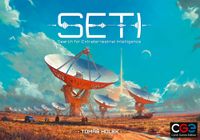
Mhm. All right, that was the lightest game of today's video. And so, this last game is by far the heaviest. This is a game that is based in space and it is called SETI, Search for Extraterrestrial Intelligence. Yes, this one is uh published by CGE and designed by Thomas Hol and uh it's a one to four player game that plays about 40 minutes per player. Mhm. Um I think it plays a little longer than that personally. Maybe. Maybe. Yeah, it feels a little longer than that. Um but yes, in this game you are trying to uh search for extraterrestrial intelligence. There are uh two aliens that are mysteries to you that uh you and your opponents are also going to be trying to research and figure out who they are so you can figure out how to exploit them to score points. Oh, exploit them. Hey, that's what you end up doing. This is CGE's big release from last year. Um, it's loosely based off of real scientific principles, I believe, and there's a lot of like factual uh card text on all of the cards, but there is a lot going on. You know, that is that does seem to be the main point of the game. You are searching for these two aliens. The game comes with five different aliens and they are all asymmetric in terms of how you can score on them. But at the start of the game, they are randomly drawn from these five aliens and placed face down. So as you are playing the game, you don't know which aliens are going to be in the game. Now the game board itself is wild because it's separated into three different sections with a
rotating segment in the middle that is supposed to represent the solar system and it will rotate throughout the game. And that rotating of the board is significant for certain aspects. And so the way that the game works is each player also has their own player board. And on your turn, you're just going to be taking one main action and as many free actions as you'd like, but there are like eight different types of main actions that you can take in the game. Yeah. So like you can like uh play a card that has different effects on them. You can uh build a probe on Earth. Uh you can also launch that probe into orbit if you are on a particular planet or you can actually land on a planet. So there's a bunch of different little things. There's a bunch of different things there. There are some main concepts though. Uh the first thing is this game has multi-use cards. So there is basically one deck of cards and each card can be used in three main ways. At the top lefthand corner they each have a symbol and that allows you to use the card by spending it as a free action.
You trash it. You can trash it as a free action. But if you do that, then you're not using it for its main effect, which you can take as a main action by spending resources in the form of credits slash uh energy depending on the action that you take in order to take the card's main effect. And the third thing is certain effects in the game will allow you to take a card from your hand and tuck it under your income column that you're going to be trying to build throughout the game. It's one of those Euro games where at the beginning of a round, you gain the income based off of all the different symbols you have depicted. Yes. So there's ways that you can tuck these cards that are in your hand underneath so that it can pay dividends in the future rounds, right? And so that is the the first main thing is the card play in the game. Now, uh we didn't mention this, but the game is played over the course of five rounds. So it is a set amount of time. And the other main thing is one of the biggest things that you're going to try to do in order to discover these aliens is you're looking for traces of alien life. And in this game, they are represented by three different colored symbols. There's a pink, a blue, and a yellow, I believe.
And they're each tied to specific main actions. So, one of the main things that you're going to be doing, especially in the in the beginning, is you're going to be sending a probe out into the solar system. You're paying resources to literally send a probe out onto planet Earth. And with free actions and other ways of doing this, you're going to be moving it around the solar system to either other planets or sometimes into asteroid fields or to comet spaces or just sort of in space. And that is why the rotating of that board is significant because uh there certain things will prompt players to have to rotate the board and that may move you around the solar system either involuntarily. Yeah. Uh you know unplanned or it can benefit you in a way. Yeah. You could have your eyes on one of the planets like like let's say I really want to go to Venus but the board I'm perfectly lined up but Mo'Nique takes a specific type of action that actually rotates it away. Now, it's just that much harder for me to get there because I have to spend time and resources just to get to the planet I want. Right? So, we're not gonna be able to go into detail about the spending of resources, but just know that some things are are very resources are very tight in this game. So, moving your probe around the solar system can be quite uh can be quite resource exhaustive. Yeah, typically. Uh so, there's uh credits in the game. Uh credits is basically the money on how you play your cards into play. Uh there's also energy, which is useful for um getting your cards into orbiting or landing onto a planet, but also it's how you can move. You can spend energy freely as one of your free actions to move your probes adjacent to the planets
and try to get them into position so that you can take those other actions. And it's like one energy per space. Yeah. So, it's hard to get to far away planets. And if you if you step into um an asteroid field, it requires two movements to leave them because they're more difficult spaces. So that is the extent that we're going to be able to get into that. Um otherwise as soon as you land onto a different planet that's not Earth in the solar system, then you now have the option to take the main actions of either orbiting around that planet by literally spending resources and placing your probe into orbit on the planet side of the three section board or you can land on the planet itself. And it's typically pretty expensive to do that. that uh specifically landing will always gain you one of those three traces of of alien life. Yeah. So, you basically built out your probe on Earth.
You've sent it out into space. You've maneuvered it onto the planet you want. You spent a certain amount of resources to land it. And now you've done your scientific research on that planet to discover something about this alien species. Yes. And whenever you gain the symbol as a reward, then it allows you to place one of your tokens on that matching symbol that's on one of the two aliens that hasn't been covered yet. And basically, as soon as all three symbols for an alien have been covered, then that is when you get to reveal the alien. And each alien, like we were mentioning, is asymmetric. Some majority of them have different or all of them actually have specific setup instructions that you have to follow because they typically have their own deck of cards. And now for the rest of the game, whenever you gain those symbols as rewards, you can place them on the alien uh boards in order to score points in different ways. Y some of them carry some sort of risk. So they really are asymmetric in terms of the effects that it'll how it impacts your game for the rest of the game. Yeah. So basically, as soon as you discover an alien, you kind of halt the game and you say, "Okay, let's learn about how to play with this alien." So there's like a upfront teach, but then there's also like a mid-game teach for each alien that you flip over. Yeah. Which is kind of nice because it just like there's a lot going on in the game for the upfront teach. So it's kind of nice how like you're playing you're playing you're playing and then it's like, "Okay, now we're going to reveal the alien. This is how this alien works." If it's your especially if it's your first time playing Yeah. with that particular alien. So it kind of like lessens the burden of keeping everything in your head. It's not a huge overhead. So, like if it's your first time playing this
game, then you don't have to teach the aliens because it's going to be a lot of the same that you've already been doing. They're just different in the way that they score basically and just some little things here and there. But that is the the majority of what you're going to be doing in the game. Now, another way to gain I think the pink trace is by is by scanning. Scanning. There you go. And when scanning, you're going to actually place one of your tokens in the different sectors around the solar system board. And you're going to replace your cube with data cubes that are from that sector. And data are these blue cubes. It's another type of resource that you place onto your computer. It's called your computer. I know this probably sounds like a lot, but it's on your it goes on your playerboard. You have to play them from left to right. It's this whole other aspect of the game. And the computer is important because it's how you gain the blue trace. So all of these things sort of need each other, right? You're going to need to find all three traces in order to flip over an alien. And there are two aliens in the game. So you have to do this multiple times. And then as soon as you find an alien, you're going to need to continue doing this because you want to score points via that alien.
Yeah. So, so if you want to do all this stuff but uh at a better kind of rate or with better rewards, then there's also this aspect of upgrading your technology. So, you can upgrade your computer, you can upgrade your scanning ability as well as your kind of ship and like orbit ability. Yes. And the way you do that is there's a separate track which um publicity publicity I can never say. Yeah. So, there's another track where every time you have uh six publicity, which is just a simple track that you're going up because you can gain publicity by visiting different like asteroid fields. Every time you go to a planet, you gain publicity. Just another type of resource. Yeah, it's just a tracked resource. And so, uh as one of the other main types of actions that you can take in the game is upgrading your tech. And there's this whole board on the side which has the different options of tech that you can upgrade. So, if you want to upgrade your computer because you're collecting a lot of data, uh you can kind of create these uh these spots that kind of give you bonuses every time you put a data piece on it, right? Or you could make your uh your spacecrafts um better uh at navigating space uh like you can go through those asteroid fields uh without any penalties. Yes. And now they gain you publicity or you can make your scanning ability better. So, those are the three main types of of tech. And so, that is actually another type of of main action. A big action. Yeah, those are a majority of what you're going to be doing. And in order to gain that pink uh trace, by the way, there is an area control aspect of scanning. So, in each of those sectors, when you're placing your cube there and taking the data cubes, um, nobody gains the pink trace
until the entire sector is filled with player cubes, and whoever contributed the most to that sector gains that pink trace to be able to, you know, flip over the alien. So, I know it sounds like a lot because we don't have the board in front of us to actually explain this, but that is a majority of what you'll be doing. There are also public goals. So, as soon as you reach certain thresholds and points, then you have the ability to claim multipliers on these goals. So, there is a bit of a race depending on which goals you are really maximizing at the time. And that is essentially it. Oh, yeah. Right. Yeah. That's a good little overview without actually seeing the game like in play. It is a lot. It's a lot. And the thing about it is it's a bit unique. So, you know, it has, you know, components to it that you sort of mentally find in other games. Euro elements. Yeah, for sure. Yeah. Euro elements. It definitely still, I think, is a Euro game. Oh, yeah. You know, the the way that you pay for things, you just taking a main action. You know, there's a lot of Euro mechanics in the game, but it feels very different from anything that I've played before. Yeah.
So, what are your thoughts? I know you Naveen. It's Yeah, I had this arc with this game. Okay. So, at first I didn't like it. I'm be honest with At first I think at first you were curious. At first, no. Like, okay, learning it and like getting into it. At first, I was like, oo, maybe I don't like this game. But then as I've played it more, I'm like, actually, I do like this game. So, um I do think though it is a little long for what it is. It's very long. Uh the income at the beginning of the game is very limited and so the game plays over the course of five rounds. Personally for me, I wish there was some way. It's one of those games where every round, it gets longer as it goes on. Uh so round four and round five, it's going to just be a longer round than round one or two.
Um so I wish there was a way to trickle in all the income that you've gained over the course of round one through four and it only be a four round game. Does that make sense? Interesting. uh kind of you know what I mean? Like like it just the ramp up of like the first round is like I don't have much stuff to do much. Round two, I kind of still don't have too much. Round three, okay, okay, it's a little bit better. Round four, okay, I have a good amount of stuff. And then round five, you're like, okay, I'm taking a lot of action. I think that's kind of the point. I I know. But I think it's one of those games that wants you to feel that like resources. The first time we played this game, we were like, "Wow, I don't know how we're supposed to take any actions." Like you start the game with with just a few credits and like two credits is putting a probe out, which is the basis of all your other actions. Yeah. And it's not like other Euro games where it's like, well, I can take this action that'll get me more of these resources.
Like, there are only a like you'll maybe gain like an extra energy in a round or something. You're really counting on your income from round to round and a round ends as soon as everybody passes. So, you can take as many actions as you're able to. It's not like a certain number of turns per round. So that's why the game can feel longer during certain rounds and it can be very, you know, you're trying to play strategically, you're seeing what other people are doing and trying to react to that and so it is a very very thinky game. Yeah. And then there's also the element of um as soon as uh somebody has at least six of the publicity then you know that that player can take the action that gets him a tech and that is one of the ways that the the board moves. So, if I see like, oh, Monique has like six, she's totally going to get a tech. I'm in position right now. I need to get off this planet like ASAP. Otherwise, I'm going to be in an asteroid field, and it's going to cost me way more energy to get out of this position right here if I don't have that tech that makes asteroids like kind of non-existent for you. So, um there is a good amount of interaction that goes on. it it's a multiplayer solitary game, but there's a good amount of just being aware of what your opponents are doing uh in terms of the area control aspect of the game and also um their ability to manipulate the board. It's multiplayer solitire, but also not that's what I'm saying. It's there's there's some elements of it that's multiplayer solitire. Like I'm going to go do this.
You can't stop me from playing this card, but you can stop me or you can cost me energy by moving the board if you feel that you want to take attack right now. Yeah, you know that is true. The interaction lies basically in that and in the area control in the different sectors and certain act there's a certain action that is cheaper if somebody has already placed Yeah, that's more of a later game thing. Um yeah, so if there's if there's a uh a probe that's in orbit of a particular um planet and you eventually go visit that planet, then it just makes it that much cheaper to uh land on it. Yeah, there are certain uh aliens that also have a have a mechanic of of chance and fear that have to do with how other people are playing. Yeah. So, it's really interesting. I think that I I just think it was really funny the first time we played because Naveen was very huh I don't know how I feel about this game when we felt just how tight the resources were. Yeah. At the start and then there was a Yeah, I don't like it and at the very end I mean like no this is good. This is a good game. This is actually pretty good. Yeah. It's because it's the first two rounds. The very first time I played it was not satisfying. It's like, okay, I get three credits. Yeah. Two of which, bye-bye.
That goes to the probe. I only got one credit left. I want I'd love to play these cards, but this costs two, that cost three. So, there is also the ability um in this game uh if you are in a pinch, you can turn in uh two of a resource to represent one of something else. There is that element which can come very much so in handy when you are flush with are flush with resources. Yeah. uh in rounds four and five, then you can turn things in and like I just need one more energy to move somewhere. Okay, I'll just turn in these two credits because I'm not launching any new probes or something like that. Um so that is in the game which is which is very including cards. Cards count as a resource that you can turn in. And I think that was interesting because it's not like for a game that where the cards are such a big part of it. It's not like you get a ton of cards like you only get so many and at the end of the round you can only keep four. Yeah. I found myself never in a position where it's like I'm overabundant of cards because you're also spending them free actions. The cards are a very valuable resource in the game. I do appreciate the multi-purpose uh the multi-use of the cards and then also like looking at like, oh, this one gets me a credit income. Like, ah man, I really want what this says, but I really could use a credit income for the next four rounds.
So, I'll find a way to tuck this under because credits credits for me like in this game are like you need to have credits because that's how youight that's how you put the cards in play that you can actually do what's in the white section or you can actually pro uh put out a probe uh and then get them off of Earth and into the solar system. And cards are are interesting in themselves because some of them have immediate effects, some of them have endgame scoring in the gold, and some of them are missions which you're trying to which give you sort of a a goal to complete in-game. Yeah. So like some of the missions could be like uh now that this card is in play, go visit Venus and go visit Neptune. Yes. And then they give you a resource or a benefit when you complete the goal. So I thought that that was a really interesting part of the game because you're not just focused on the aliens and getting these traces of life. You also have these many things to work on, you know, while you play. I will say the the least um in a two-player experience, because that's that's the only way we've played it. Um, the thing that I felt was lacking in terms of like a balance for a two-player game was the area control aspect of the scanning. Yeah. Um, because it's the same, right? No matter what the player counts, like you put out the same amount of data. Yeah. Have the same amount of data. Now, yeah, granted, they did try to scale it a bit because there are these uh alien figures. No, you use a you use a neutral player color to represent I forgot what it's called.
It's a another type of milestone. a neutral milestone or something like that where basically when when whenever players pass a certain point threshold, you place one of the neutral player colors on an alien trace that hasn't been found yet. So, it basically has neutral player colors help you locate the aliens faster. So, it's not just a slug. It's just the area control aspect of the game. Like sometimes like in order for something to score or to to to trigger like you need to pull off five pieces of data. Yeah. So that would require you to scan a bunch into a particular sector. And sometimes it was like in our games it's like a whole sector can go unscanned. Yeah. But my but one of my mission cards is like have two yellow sectors completely scanned. It's like I'm not going to do that myself. There's just no way I'm going to be able to do that unless you focus on like the scanning tech, but like the other techs are also very nice to try.
Kind of hard to get publicity. So I I I hear you on that. I think especially uh maybe at maybe at a three player game maybe might be the sweet spot. That is like the player count that I definitely want to try it at. Four players. I don't think I would want to play at four. So long because it does say 40 per player and I think that runs long. Yeah. Yeah, that that would be super long. Three players might just be enough to to have that like extra bit of of interestingness, I guess, added to that to those aspects where a two-player game doesn't quite hit it. Yeah, lots of points to be scored in this game. Um, you can definitely get into the upper hundreds uh into 200s also. Um, which Mon'nique has done several times. So, I have not broken 200, but I'm I'm committed to doing it one day. But otherwise, I I found the game to be really interesting. You know, it's very different. It's weird. It's a weird game. Like, the first time we played it, it has a really great player aid that everybody gets. Very nice. And it really lays out these are the different types of actions and the amount of resources that you have to spend for each. And then it has like all of the the different uh effects and symbols. The symbology is all laid out on those player aids. But it is strange. It's not like anything I played before. There was a bit of a learning curve, but once you start going through the motions, it's not too bad. And it's really it's like the Eden was saying where it doesn't feel good in the beginning because things are really tight. Yeah. But as you kind of get towards the end, it does feel satisfying and you see the aliens and then now you're kind of playing this different game than it was in the beginning. The experience evolves. I I think that was really interesting part
of the game. You'll get better uh on further plays because then now you can justify like your first game you'll be like two credits that's a lot. I only got three. But in the future you're like okay no I can I can spend that. I can do this. Okay. This is it's going to ramp up at this point. But the first time you play it it's just like what the heck when am I going to get my income going? You know right. Definitely the more you play the game the better you the better you'll get because then you can start justifying certain actions at the right time. Yeah. Overall, I do enjoy the game. Uh definitely want to try it at three just to see what kind of dynamic changes just a little bit, but a perfectly fine game at two. Yes, overall I agree. I actually really enjoyed it. Um my trajectory was a little bit more of like a linear upward where I was so quite unsure about it in the beginning just because of how uh strange it felt.
And it has so many components like this is like a you got to set it up for a while kind of game. It would be nice to have an insert for this one. It would be nice. Yes, there's a lot of cardboard, but the actual gameplay experience I really appreciated. Um, and I am really looking forward to seeing more games from this designer. I think there are some I think they came out with three last year. So, it was this Tea Garden and Galileo Galile. Ah, all in one year. All in one year. Three different publishers, I believe. So, yeah, that's quite a feat. So, um I think they have more games coming out. So, hopefully we can try the other ones. If you've played this game before, we would love to hear your thoughts because it's I don't know what kind of a spectrum of of opinions people have. I tried to avoid as many reviews until after we've we finally played it. So, this we've had this one for a couple months now and so now I'm interested to kind of open up my mind and seeing what people think about it.
Yes. But please let us know. Anywh who, that is SETI Search for Extraterrestrial Intelligence. Well, there you have it. Those are five of the games that we've been playing recently. If you have any opinions on any of the games that we talked about, please let us know in the comments down below. Thank you so much to Bezier Games for helping sponsor this video, we really appreciate it. And thank you all so much for watching the video as well. If you like to see more videos like this in the future, please consider subscribing. Thank you. Bye.