/pic8498842.jpg)
You and your friends (or people you hire off Craigslist) each take the role of a competitive shark, battling it out to eat tourists, locals, or even a dead whale carcass in a race to get 50 points. There's tricks and treats and fights and bites along the way. It's a back and forth tile-laying-take-that-oh-no-you-didn't finfunfest (I think that's German for shark-party.)
With so many different tile types and draws, each game is delightfully different, like the friends you hire off Craigslist. There's luck in the tile pulls and dice rolls. There's strategy in tile usage, plans of attack, and fight or flight choices. Adults and kids and hobos alike will love the quick-natured fun battle of Sharks Feeding Frenzy!
—descriptions from the designer

Sharks Feeding Frenzy Playthrough
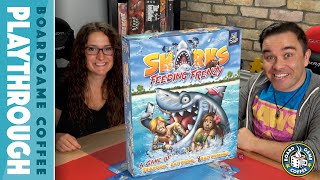
- Accessible and easy to teach; great for families and casual players
- High interactivity with lots of direct player interference and humorous moments
- Flavorful theme, silly bios, and a strong chaotic-but-friendly vibe
- Can feel chaotic and occasionally punitive due to heavy player interaction
- Strategic depth is light; players seeking heavy engine-building may find it underwhelming
- Tile effects can be dense for new players and may require a couple of plays to grok
- Cartoonish predator-prey chaos with humorous bios for each shark, emphasizing frenetic negotiation, back-and-forth play, and player-versus-player interference.
- An underwater arena where sharks and other sea life chase humans represented by food tiles. The board features islands, boats, whirlpools, churning currents, and a variety of hazard tokens that reshape the path to prey.
- Playful banter driven by proximity, threat management, and the occasional faux-lore snippet about shark bios.
- Survival
- Dolphins of Duffington III
Mechanics (from transcript analysis)
- Boat (blocking) tile — The boat tile blocks adjacent spaces around it, preventing sharks from occupying those spaces. It also can be used tactically to displace opponents when certain conditions are met, introducing a level of strategic denial.
- Brawl / dinner bell — When a brawl tile is used, it triggers a space-wide fight. In two-player play, it’s a direct clash; in multi-player scenarios, it gathers multiple sharks for a big melee with results leaning on tile draws and die rolls.
- Chum bucket dynamic — Placing a chum bucket affects any sharks that can see it within the same row or column. When the heads collide, fights ensue and the winner siphons a tile from the loser’s gut locker.
- Deck Building — The boat tile blocks adjacent spaces around it, preventing sharks from occupying those spaces. It also can be used tactically to displace opponents when certain conditions are met, introducing a level of strategic denial.
- Gut locker loot and point economy — Winning fights or triggering tile effects allows you to take tiles from your opponents’ gut lockers. Food tiles convert directly to points, making gut locker management a core strategic element.
- Mine / blast — Mine tiles explode when activated, blasting nearby spaces and potentially reshaping who can reach which tiles. They add a tactile sense of danger and timing.
- Octopus slow-down — An octopus tile attaches to a shark and reduces movement by one. The only way to remove it is to roll a one or a two, or to remove it via other draws. It creates a temporary liability that actors must plan around.
- Power-ups (start-of-turn bonuses) — Power-up tiles grant a one-off bonus at the start of a turn, such as a free tile move or repositioning a tile. They require careful timing as they usually preclude playing another tile that turn.
- Roll-and-move with head-tilt mechanic — Each shark uses a four-sided die for movement; only the head’s position determines what food is gobbled, while the tail is largely ornamental. Movement decisions are constrained by board features and tiles.
- Roll/Spin to Move — Each shark uses a four-sided die for movement; only the head’s position determines what food is gobbled, while the tail is largely ornamental. Movement decisions are constrained by board features and tiles.
- Tile-based abilities — A large pile of tiles provides a spectrum of one-time effects. Most tiles skew interaction toward attacking rivals or shuffling threats, creating a highly confrontational experience rather than cooperative play.
- Tile/Map Shifting — The traveler tile lets sharks wrap around the board, appearing on the opposite edge. This grants surprising routes and recontextualizes threats and opportunities.
- Torpedo destruction — Torpedoes let you target a line to blow up tiles and displace any sharks in their path. It’s a decisive tool that can instantly reshape the gut locker and board state.
- Traveler wrap — The traveler tile lets sharks wrap around the board, appearing on the opposite edge. This grants surprising routes and recontextualizes threats and opportunities.
- Treasure chest / gut locker manipulation — Treasure tiles allow stealing or shuffling tiles from an opponent’s gut locker. The risk is that you could end up removing valuable food tiles, balancing risk and reward.
- Whirlpool / teleportation — When a shark passes over a whirlpool, it is randomly relocated. This can either reposition you toward valuable food or fling you away from safe paths, injecting stochastic drama into turns.
Video topics + discussion points
Quotes (from this video)
- this is perfect like fun friend family game to get into it's easy to teach
- the only part of the shark that matters is the head so the tail is just there for decoration
- it's a bit of a dick move
- feed britney to bigger sharks or something
- survival is awesome
- I'm Mark Maya and this is Board Game Coffee
- the tiles can really screw with you, but that's part of the charm
- the gut locker is a tiny treasure cache of points if you win fights
- islands give you a move boost that can turn a bad roll into a win
- the traveler lets you wrap the world, which is surprisingly powerful later on