

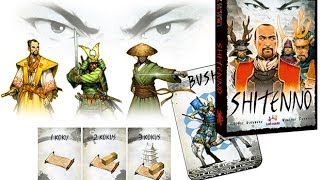


Shitenno Deep Dive
What the Community Thinks About Shitenno
Shitenno is a 2011 game with a title that reviewers openly find awkward. Giancarlo and Felicia of Board to Death TV spent their opening minutes joking about the name, then rated the game highly in their dedicated review. The Chairman of the Board channel takes a more measured view. Its roundup ranks Shitenno third and treats the design as interesting on paper but less engaging at the table than the host hoped. A separate February purchase video from the same channel, Chairman of the Board, offers no verdict because the host had not yet played the game. From the artwork alone, the host guessed it was an area control game and noted that it seemed to have faded into obscurity.
The reviewers agree on two points. The card division phase is the heart of the design, and the feudal Japanese theme of honor and courtly politics suits it. They disagree mainly on how the game holds up over repeated play. Board to Death TV found the downtime acceptable and even mild for competitive players, while the Chairman of the Board host felt the repetition and turn order effects weakened the experience.
Core Mechanics That Define Shitenno
The Card Division Phase
Each even year, the highest-ranking player draws troop cards and koku, the game's currency, and separates them into offers. Board to Death TV explains that the player attaches one of the hierarchy tiles to each offer and presents it to the next-highest player. The receiving player may accept or decline. A declined offer passes down the rank order, and if every player passes, the player who made it must keep it. Because a stingy offer can come back to the offerer while a generous one forfeits valuable cards, the phase punishes both extremes. The game's description frames this as a court courtesy: the last lot of cards is left for the player who made the division. The Chairman of the Board host describes the same loop with a focus on turn order, noting that the first player's offers are only as safe as the next player's willingness to take them.
Province Control and Majority Bonuses
In the odd year, the generals compete for control of provinces. Board to Death TV's walkthrough explains that a player can bribe the officials by discarding koku equal to the cost of the leftmost open space, or conquer the province by discarding the troop cards matching its geography. Each control cabin placed grants immediate favor, which is scored as victory points, and the player takes the top bonus tile from that province. Titles modify these placements. The daimyo, the highest title with four seals, gains two extra points per cabin, while the hatamoto, the lowest title, counts as a troop of any type once per turn. At the end of the game, each province marked with a red lantern pays bonus points to the player with the most cabins there, and a tie goes to the player whose cabin sits furthest left.
The Shitenno Experience
Honor-Bound Bargaining
Playing Shitenno feels like sitting in a court where every offer carries a consequence. Because an offer that is refused comes back to its maker, players weigh each division carefully and try to read the intentions of the people across the table. Board to Death TV found that the negotiation fits the theme of honor and warfare in feudal Japan well. The reviewers also tried a house rule in which the highest-ranking player draws cards without revealing them, which they said adds a bluffing element that made the game more interesting. The Chairman of the Board host agreed that the design rewards reading the table, but felt that turn order could undo even careful planning.
A Measured, Vintage Euro Pace
The rhythm of play is deliberate rather than frantic. Board to Death TV said the game plays fairly quickly even with its downtime and decision making, and the reviewers did not mind the pauses, although they acknowledged that other players might. The Chairman of the Board host described a classic Euro feel supported by vintage artwork. That methodical pace suits players who want careful thinking to matter more than luck, though the same pace is the source of the complaints discussed below.
What Makes Shitenno Stand Out
The Negotiated Card Division
Both channels return to the card division as the game's strongest idea. Board to Death TV called the negotiation phase a great mechanic for this game. The Chairman of the Board host, who found much of the rest of the design dry, said the card splitting is used in quite a novel way for an area control game, one the host had not seen before. Because the cards serve as currency for claiming regions, the negotiation feeds directly into the board, which keeps the phase from feeling like a warm-up.
Components and Theme
Board to Death TV praised the sturdy boards, tokens, and tiles, and described the theme as great. The Chairman of the Board host called the artwork very nice in the purchase video, and in the roundup said the game looks really nice with its vintage look and classic Euro feel. The presentation gives Shitenno a distinctive presence on the shelf, and the theme makes the courtly politics easier to picture during play.
Potential Drawbacks
Player Order and Kingmaking
The Chairman of the Board host found that player order matters more than the game's presentation suggests. Offers travel in turn order, and the criteria for donating cards to regions change as the game goes on. A fourth player can find progress toward a region swept away before their turn comes around. The host also warned of kingmaking. A player who is losing can steer offers toward the player they want to stop, which the host acknowledged should not happen among players in the right spirit, but which remains a real option.
Repetition and a Dry Feel
The same reviewer felt that the game was repetitive, with strategy that reduced to collecting duplicates so that the player could return to the same regions. The host said the design could have used a side mechanism or two to add dynamism, and described little grinding halts that kept the game from becoming a keeper. Board to Death TV raised a related point about downtime, since competitive players must weigh which troop and koku cards they need before each offer. The reviewers still respected the underlying framework. Together, their notes suggest that Shitenno rewards players who enjoy a methodical, thinking-heavy game and may feel slow to players who expect more variety.
If You Enjoy Shitenno
None of the reviewers named a direct comparison title for Shitenno. The Chairman of the Board roundup does place it alongside other games reviewed in the same video, including Zeuscape, a set collection card game built around a split and choose mechanism that the host, like the Shitenno reviewer, described as unusual. Players drawn to the offer and refuse tension of Shitenno may find that comparison useful, although the two mechanisms work differently. For a fuller picture of how the game plays, the Board to Death TV review and the Chairman of the Board roundup are the best places to start.
What Reviewers Are Saying
"The negotiation phase or when you divvy up the cards is a great mechanic for this game that is strongly suited for the theme of honor and warfare in feudal Japan."
— Giancarlo and Felicia, Board to Death TV
"I think the game is a little bit too rinse and repeat, a little bit too repetitive, and it could have done with a side mechanism or two just to make it a little bit more dynamic."
— Chairman of the Board
"Lots of strategy with a good blend of luck, depending on what troop card you draw and what troop tile is revealed to see if you can combo off and place another control cabin in that province."
— Giancarlo and Felicia, Board to Death TV