



Shogun Solitaire Deep Dive
What the Community Thinks About Shogun Solitaire
Shogun Solitaire has garnered attention within the solitaire wargaming community, particularly from specialist reviewers who appreciate its unique mechanics and presentation. As a niche solitaire title, the game has been explored primarily through dedicated board game media coverage. The reviewer consensus centers on the game's ambitious design and accessible learning curve paired with genuine strategic depth. While the game presents significant challenge when pursuing a perfect victory, reviewers consistently note the engaging nature of play and the satisfying moment-to-moment decision-making.
Core Mechanics That Define Shogun Solitaire
The Objective-Taking System
At the heart of Shogun Solitaire lies a deceptively elegant objective-taking mechanism. Players lead four feudal clans (Kato, Amago, Hojo, and Taeda) and must secure twelve objectives total (three per clan) by playing consecutive cards of matching colors to an active play area. The game requires not just card play but tactical sequencing: players cannot play two cards of the same type in a row, forcing meaningful choices about which unit type (soldier, cavalry, samurai, or ninja) to commit at each step. Success in any given turn hinges on both deck luck and the strategic arrangement of remaining cards in hand.
Adversarial Cards and Escalating Pressure
The gameplay challenge deepens through a deck of enemy cards that actively work against the player's progress. Assassins eliminate leaders in hand, Ronin cards force the return of previously captured objectives, Envoys clog the hand without function, and Raids demand either a samurai to block them or a full hand reset. The Ronin cards, in particular, represent a strategic crux: they can swing the game from near-victory to defeat by forcing players to relinquish control of objectives they fought hard to secure. This escalating pressure means that momentum is precious and fragile, and the ratio of enemy cards to friendly cards shifts as the deck depletes.
The Playing Experience
Solo Strategic Tension
Shogun Solitaire delivers a solo experience characterized by meaningful tension. The interaction between the player's hand of cards and the deck draw creates moments where luck and skill intertwine. Reviewers note that the decisions (which card to play, when to discard and redraw the entire hand, whether to reorganize the deck via the ninja's special ability) all carry real weight. The game rarely feels like pure chance; instead, it respects player agency while remaining unforgiving about execution.
Portability and Play Time
Shogun Solitaire occupies a rare space in the solitaire wargame catalog: it fits inside a pocket-sized box, yet delivers a complete game experience in approximately 15 to 30 minutes of play. This portability makes it ideal for travel, whether on business trips or casual outings. The quick playtime allows for multiple attempts in a single sitting, encouraging players to chase a perfect victory without requiring a sprawling commitment of table space or calendar time.
What Makes Shogun Solitaire Stand Out
Beautiful Card-Based Presentation
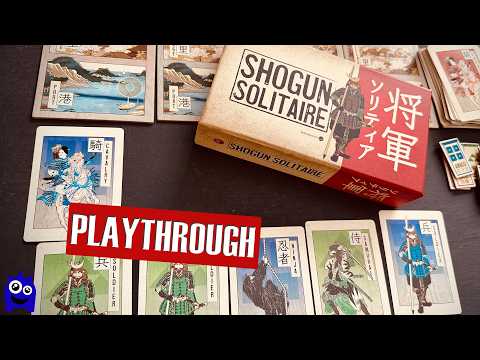
The game's visual presentation departs from the typical solitaire wargame format dominated by map boards and counters. Instead, Shogun Solitaire uses vinyl cards with striking Japanese-themed artwork that reinforces both the historical setting and the clan-based conflict narrative. The objective cards, when flipped at game's end after a full victory, form a unified piece of art that symbolizes the unification of Japan. This approach makes setup and teardown intuitive and emphasizes the elegance of the card-play system.
Thematic Coherence in a Card System
While Shogun Solitaire features military elements, reviewers note that it operates more as a war-themed game than a traditional war game. The theme of unifying feudal Japan through securing strategic objectives resonates throughout, from card types (soldiers, samurai, leaders) to the four-clan structure. The card-based abstraction feels thematically appropriate rather than arbitrary, allowing players to experience the conceptual challenge of coalition-building without getting bogged down in hexagonal terrain or complex supply rules.
Potential Drawbacks
The Difficulty of Achieving Perfect Victory
Reviewers emphasize that securing all 12 objectives is a genuinely difficult achievement. The deck contains Ronin cards that inflict permanent setbacks, and the ratio of friendly to enemy cards means that lucky draws early become scarce later in the game. Winning all 12 objectives likely requires favorable luck with respect to when Ronin cards appear; getting one early, before any objectives are captured, makes the task manageable, but drawing one after building a position can prove catastrophic. This high-difficulty ceiling appeals to solitaire enthusiasts chasing a complete victory but may frustrate players expecting a more achievable goal.
Variability and Card Draws
The game's outcome is substantially influenced by deck composition and draw order. While the ninja card provides tools for deck manipulation and forward planning, players remain vulnerable to cascading bad draws: a hand full of Envoy cards, or a run of Raids that consume precious resources. Some players may experience games where no meaningful strategy can overcome a sufficiently hostile card draw, making replays feel more like luck contests than tests of tactical skill.
If You Enjoy Shogun Solitaire
Shogun Solitaire is part of a broader series of travel solitaire games published by Worthington Games, including Pacific War 1942, the War of 1812 Solitaire, and the French and Indian War Solitaire. If you appreciate the quick-play solitaire format, the beautiful presentation, and the balance of strategy with manageable complexity, these companion titles offer similar structure with different historical themes. For those drawn to the clan-based unification theme and card-driven combat, Shogun Solitaire represents a unique entry in the solitaire catalog that rewards both careful decision-making and willingness to accept the role of chance in solo gaming.
What Reviewers Are Saying
I do like the theme. I love the artwork. I love the components. I love the travel size. This game I do feel like it has a good bit of strategy to it and I feel like there's some subtleties to gameplay. I feel like the decisions are fun. I like this one a lot.
— Zilla Blitz
The cards are beautiful. The theme is great and the gameplay is really fun and challenging though.
— Zilla Blitz
Shogun Solitire, very different game. Artwork's beautiful. Really fun. It's I wouldn't call it a war game. It's a war themed game about having four clans taking over uh becoming the one shogunate in Japan. So that's been fun to play too.
— Zilla Blitz