


Siege of Valeria Deep Dive
What the Community Thinks About Siege of Valeria
Reviewers present Siege of Valeria as a solo-only tower defense game built on dice and cards, and most of them come away impressed by how much play it delivers from a compact box. Designed by Glenn Flaherty with art by The Mico, it belongs to the Valeria game line. Liz Davidson of Beyond Solitaire calls it a quick and tricky tower defense game that Davidson expects to keep in the collection. Davidson's enthusiasm is notable because it was Flaherty's first published game, and Davidson approached it with some nerves about not liking a friend's design. Davidson describes it as a weeknight or Saturday afternoon solo game that lets players crunch a little without overloading the brain, and praises its relatively few components.
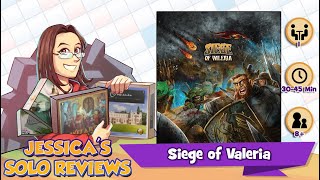
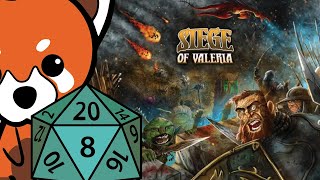
Jessica is more measured. Jessica's base game impression was modest, and Jessica considers the campaign expansion the point where the full experience emerges. Jessica notes that the base game can feel repetitive once its puzzle is understood, and argues that the expansion is an example of content that should have shipped in the base box. Monique of Before You Play finds the game clever and well designed, though Monique grew tired of the central fighting partway through a session. Quackalope had not yet played the game when recording, but described it as a tower defense style experience in a small box, the kind of niche they had long wanted filled.
Core Mechanics That Define Siege of Valeria
Troop Deck Building
The deck building layer in Siege of Valeria grows out of combat. Reviewers explain that when a player defeats a troop in the front row, that card is taken into hand instead of being discarded, and its ability at the bottom of the card becomes available whenever the player chooses to use it, typically by discarding the card. Liz Davidson gives examples such as a troll brute that changes one die to a six and an ifrit that spins a plus two bonus to Overkill an adjacent siege engine. Monique describes most of the strategy as finding combinations of these powers that either generate more dice or enable cheap kills. Defeating a siege engine adds another layer, since it yields a champion that can be placed in a turret of the player's choice. Champions can be flipped for ongoing or once-per-turn bonuses, such as a plus two against a siege engine, which is why reviewers often plan turret placement around the siege engine they most want to remove.
Events and Card-and-Dice Combat
Each round follows a loop that reviewers describe in similar terms. The player rolls a dice pool of red strength dice and blue magic dice, which Liz Davidson calls holy dice. Siege engines then activate according to the row they occupy, and an event is drawn and resolved from its own deck. Liz's example, a card called Fool's Rush In, adds strength tokens to the weakest enemy in the Vanguard, the front row. Jessica notes that events are usually harmful but occasionally helpful, and Monique confirms that they remain part of the main game even though a player could leave them out. Only after these steps does the player spend dice on actions. Blue dice cannot defeat a troop on their own, but they can satisfy blue costs and can add their value to a red die that is spent. Enemies often require a specific total, and Overkill, which means spending extra pips to exceed a target, is a recurring tool for killing an adjacent siege engine. The round ends with troops in the Vanguard damaging the turret below them, after which the battlefield advances, new siege engines enter the back row, and reinforcements fill the empty spaces.
The Siege of Valeria Experience
The Tension of the Siege
Reviewers consistently describe a sense of pressure that comes from knowing where threats are. Jessica explains that a troop left in front at the end of a round damages the turret beneath it, that turrets can take three damage, and that a fourth point of damage overruns the city. Liz Davidson describes the Vanguard as the place where the game can get out of hand, because even a strong performance against siege engines does not save a player who lets the front row run wild. Monique frames the same dynamic as a constant effort to put out fires, while Jessica points to the sudden-death potential of a siege engine reaching the front line. Reviewers agree that the tension comes from balancing long-term siege engine removal against short-term damage control, and that an ideal turn often means sacrificing something now to set up a better future play.
Puzzle-Solving With Dice and Cards
The other dominant feeling is a puzzle that reviewers enjoy working through. Liz Davidson calls the figuring out of which enemies to defeat, when, and why the real substance of the game, since a turn itself is not complicated but the sequence of decisions is. Monique says the game is fun because it asks players to puzzle through the different abilities in order to remove siege engines, and Monique finds the search for combinations to be the enjoyable part. Jessica says that the dice and card interaction becomes a puzzle of which dice to roll and which troops to fight, and that the card interactions produce cool combinations, such as flipping a poor die result and then doubling it with another troop's ability.
What Makes Siege of Valeria Stand Out
A Compact Footprint Packed With Decisions
Liz Davidson highlights how much the game delivers in a relatively compact box with relatively few components, describing it as a lot of game in a small package. Davidson notes that the decisions remain interesting even though a single turn is not especially complicated, which many reviewers see as a strength for solo play. Quackalope similarly values the game engine in a small box concept, which fits the appeal of quick, portable solo play. Liz Davidson's one reservation concerns table presence, since keeping the grid of cards neat is a struggle, and a playmat would have helped organize the layout. Davidson's overall verdict is that the game's size, time demands, and problems to solve make it well suited to a relaxed solo session.
A Campaign Expansion That Adds Persistence
Jessica's most enthusiastic praise is for the campaign expansion, which links three battles so that outcomes carry forward. Winning a battle can keep a duke in play to lead the troops, while the enemy commander and boss rotate out, and a campaign score allows a single lost battle without ending the campaign. The expansion also adds elite troops that demand exact dice values, a shapeshifting commander that changes each round, and boss siege engines that appear in the final rounds with two abilities that must be overcome. Jessica estimates a full campaign at roughly an hour and a half, which Jessica considers a practical length.
Potential Drawbacks
Luck and Swingy Results
Luck is the concern reviewers raise most directly. Jessica recounts rolls that came up mostly ones, twos, and threes, and observes that when the right troop cards are not available, a player can be at a serious disadvantage. Monique describes the game as quite swingy, with some sessions lost badly and others won easily depending on the starting siege engines, the champions drawn, the dice, and which events surface.
Base Game Repetition and Expansion Dependency
Jessica argues that the base game gets repetitive because the central task never changes, and that the troop deck changes too little across a game to alter the experience. Jessica played the base game several times and found that scores clustered in the top scoring tier, which made the challenge feel unbalanced. Jessica's own rating for the base game was 66 out of 100, rising to 81 once the campaign was added. Monique similarly reported burning out on the core troop fighting about halfway through a session, though Monique suggests this is a feature of the genre rather than a flaw in this design.
If You Enjoy Siege of Valeria
Players who enjoy Siege of Valeria should look for other solo tower defense and survival games that combine limited resources with a visible threat track. Quackalope points toward 20 Strong, a survival dice game in which players assign rolled faces to monsters and encounters while managing a dwindling supply of dice, which is a close cousin to the card-and-dice pressure described here. Quackalope also mentions Final Girl, a highly modular solo game with extensive hand management and story-driven play, for those who enjoy a deck-driven solo adventure. Resist, a solo card-driven game of missions and invasions, and Rolling Realms, a solo roll-and-write challenge, were also discussed as solo titles worth exploring. Solo deckbuilders with a strong puzzle core and a clear sense of danger are the closest genre match.
What Reviewers Are Saying
"I really enjoy working through a hand of cards and trying to wring as much as possible out of them. That's something that brings me a specific kind of gameplay joy, and this is offering that in droves."
— Beyond Solitaire
"I feel like this is a good example of an expansion that should have been in the base game. The expansion is where the full game experience really comes into play."
— Jessica, Watch Review
"I think the game is really clever. It's really well designed, and it's fun trying to put out fires and puzzle through the different abilities in order to remove those Siege engines."
— Monique, Before You Play