/pic4924648.jpg)
The future of humanity awaits you in Space Gate Odyssey. A system of viable exoplanets has been recently discovered and the Confederations are flocking into space to colonize it. In this 2 to 4-player development and flow-management board game, you play the leader of one of these Confederations and play your influence in the Odyssey command station to send as many of your settlers as you can on these exoplanets.
After decades of research and technological development, humanity is preparing to leave the Earth to colonize this discovered system. To get there, only one possible means of transport exists: space gates. For reasons related to physics and other quantum aspects, these gates can be built only in space. The Confederations have therefore embarked on the construction of their own station in orbit, equipped with space gates.
At the beginning of the colonizing era, these portals make it possible to go on one of the first three discovered planets. As soon as an entire contingent of settlers has joined the gate of a space station, it is teleported to the corresponding exoplanet. The landing conditions vary according to the planets and the choice of colonized spots quickly becomes strategic.
As soon as one of the three exoplanets is fully colonized, each Confederation gains influence according to its placement, then access to one of the two later discovered exoplanets becomes possible. At the end of the colonization of the five exoplanets, the stations are teleported to the Hawking planet and the influence of each Confederation is assessed. The leader of the most influential Confederation will be promoted to the rank of Governor of this new system.
One of the biggest challenges in Space Gate Odyssey is your ability to quickly develop and intelligently arrange your space station. The better you optimize the flow of your settlers to your station, then to the exoplanets, the more of them you can send to the favorable spots and thus gain influence.
The choice of the modules, their arrangement, and the distance between the airlocks and the gates are therefore essential elements — especially since, at the end of the game, the domains of the modules you used to build your station will bring you additional influence points if they are in line with the position of the domains on the Hawking planet Predominance.
Finally, you must be careful not to leave too many open corridors on the space void as this represents a real danger for your settlers and could therefore damage your reputation.
Your most amazing quest starts with Space Gate Odyssey. Will you be able to take over your opponents in order to take control of the new system, or will you stay at the dock?
—description from the publisher


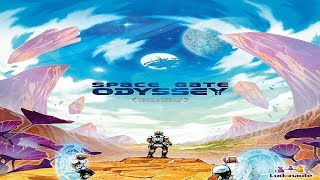
- Good production quality
- Thematic planet placement
- Interesting core mechanics (engine building, worker placement, area control)
- Strategic building of your station/engine
- Unique concept of managing people/airlocks
- Three different tiers (gates, upgrades, airlocks) offer options
- Rules are somewhat disorganized and unclear, explaining spots before how to get modules.
- Pacing is slow and not very exciting.
- Actions can feel unrewarding.
- Endgame scoring (predominance tokens, losing funds for colonization) felt insignificant.
- Lack of clear benefit in differentiating between the three colors (blue, pink, green).
- Low player interaction.
- Thematic elements don't always translate into compelling gameplay.
- Feels like a jack-of-all-trades, master of none.
- Game might lack long-term replayability without expansions.
- Mechanics don't always feel rewarding.
- Colonizing the planet
Mechanics (from transcript analysis)
- Area Control — Players compete for control over planets, with points awarded based on influence or presence.
- Engine Builder — The game is fundamentally an engine builder where players develop their station to perform actions.
- Modular Board — The game features a modular board or components that players build out, such as rooms and gates on a ship.
- Set Collection — Players collect points from different planets based on their colonization efforts.
- Worker Placement — Players place workers (meeples/people) on action spots to perform tasks like acquiring resources, building modules, or colonizing planets.
Video topics + discussion points
Quotes (from this video)
- The rules are a little bit wonky.
- This game has some issues that I'm kind of foreseeing but it also has a lot of good things about it.
- The pacing is you you get to build your module you get to build your station which is essentially your engine.
- The production of this game is really good.
- It's slow and really at the end of the day like you're not gonna be doing a lot.
- The fact that you have three options but in all reality you should just go one option because that's gonna read be the most benefit.
- This game needs like an expansion it needs something to it.
- There's no player interaction except for that.
- This game was kind of just a jack-of-all-trades it's it tried to be a couple kind of different genres and wound up being just a master of none.
- I really like the game but at the end of the day it's like well I don't really want to play it again I mean I do but I don't because it's kind of boring.
- None of it felt rewarding.
References (from this video)
- Overly long
- Overly boring
- Punishing mistakes
- Lack of player interaction
- Repetitive scoring
- Space
Mechanics (from transcript analysis)
- Area Control — A mini area control mechanic where players fill up areas on tiles.
- Tile Placement — Players build the setting by placing tiles.
- Worker Placement — Described as a worker placement game.
Video topics + discussion points
Quotes (from this video)
- viewer discretion is advised
- I was like yeah like worst game those are worth talking about one that's fun to [expletive] about in bad game so I'm always I'm almost slightly more excited to talk about bad games and [expletive] lame to talk about the best games
- I think the delineation we mentioned cuz we've done they're just disappointing is that I would play disappointing if someone's like hey do you want to play and I'll be like sure if someone offered like I'd be like no like no and you're a bad human for even offering this to someone like why do you want to make someone so unhappy
- it's it's the same company that did this game that did the oh the Bob Ross the classy with my yeah yeah yeah deal I mean it's alright yeah whatever
- I'm gonna go on record I think that this is an unfair Pig because he that's like that's like if I want to go back to other end of the year but it's like oh yeah you know commits the worst game that year well I already know I don't like it so no
- if at least those are fun you know story driven games this one oh and the story was [expletive] weird
References (from this video)

- Cool cover
- Neat ideas
- Liked it
- Didn't really take off at all
- Building a space station
- Space
Mechanics (from transcript analysis)
- Engine Building — It's running a kind of like an engine building thing through the space station.
Video topics + discussion points
Quotes (from this video)
- A frenetic 10-minute game from Queen.
- This is one of the key games I have not played. This is the sixth one.
- That's a cool name.
- I felt it could have done a little better. Um, it's it's almost too slight for me.
- I found it a little too fiddly, but as you can see, it's moving up in ranks.
- So it it's kind of funny it took him so long to come out with an Axis and Allies World War I game.
- I know I enjoyed it, but also it's 10 years ago, so it's hard to remember.
- This is the prequel to Clue where you're going around trying to kill Dr. Lucky.
- And I found it to be a lot of fun.
- If you like He-Man, this really brings it out.
- I've heard good things about this game, but I have never played it.
- This game is very weird and unique but I like it.
- This is one of the classic war games.
- It's running a kind of like an engine building thing through the space station.
- I liked it, but it has been a while.
- This is the OG Fury of Dracula game.
- I have never played Peanuckle. I know a little bit about it, but it's interesting to see this one kind of rated way here in the middle.
- I find it very odd that they are they're basically the same game. I'm not sure why they have two separate entries.
- Bidding to take Bowolf down a path has almost nothing to do with the theme.
- I liked it fine.
- I do like that you use the box and stuff as terrain.
- This is kind of a holy grail for many people.
- I'm not as big on the horror theme as many other people are, but I know people like this concept here of horror games running around.
- Of the ones I talked about today, I think Masters of the Universe, the board game, um, is my favorite.
References (from this video)
- space exploration and colonization
- space stations and colonization of planets
Mechanics (from transcript analysis)
- Action point management — Action points are represented by engineers; chief engineers are worth two points, regular engineers and robots are worth one; players spend points to take actions in rooms.
- Action Points — Action points are represented by engineers; chief engineers are worth two points, regular engineers and robots are worth one; players spend points to take actions in rooms.
- Modules and space station building — Players add modules to their space stations; initial activations grant extra or upgraded engineers, later modules become empty corridors affecting flow.
- room-based actions — There are five color-coded rooms; each room grants a specific action when a player has enough action points in that room.
- scoring and end condition — End when all five planets are settled; players score for majorities of module types and for settlers on planets; penalties for open exits.
- Space gate and settler relocation — Filling a space gate module allows settlers (frogmen) to move to planets with matching space gate symbols; planets have unique placement rules.
Video topics + discussion points
Quotes (from this video)
- "Space Kade Odyssey is a lead and follow action point management game in which players compete to build up their space stations in readiness for colonizing new planets"
- "the game ends once all five of the planets have been completely settled"
References (from this video)

- Vibrant space exploration theme
- Promising multi-table setup and flow
- Potential thematic or mechanical complexity in translation
- space colonization and influence building
- Spacefaring Confederations vying for exoplanet systems
- Array
Mechanics (from transcript analysis)
Video topics + discussion points
Quotes (from this video)
- two distinct modes that you can play family and advanced both modes have similar gameplay both have a different feel and each requires players to take a different approach
- mega board game because unlike traditional board games this one isn't played at a single table no no blood feud requires a really large room or two separate rooms with two to four tables to play it
- the time has finally come for you an epic sing-off that's taking place in all the towns pubs and taverns which will be your chance to get your hands on that sweet sweet prize and earn the title king of all bards
- two ways to go about this either find treasures and legends belonging to other players or allow your own legends and treasure to be discovered by other players and this give-and-take between players is what makes guardians of legends sound particularly interesting to me
- the future of humanity awaits you in space skate Odyssey where a system of viable exoplanets has been recently discovered and the Confederations are flocking into space to colonize them
- the actions of the players are driven by the cards in their hands which highlight actual events and personalities of that time
- this Lovecraftian gaming experience with literary and musical dimensions
- cultist storm also includes a soundtrack crafted especially for the game
- a last bastion is a cooperative game in which the players take on the roles of heroes defending an ancestral Bastion against the monstrous horrors of this baleful queen
- in this tournament held on a remote island mages use magical seeds in their own sorcery to create fences of natural elements to enclose and capture various beasts
- consumption food and choices is a worker placement and resource management game designed by a dietician