


Space Potato Deep Dive
What the Community Thinks About Space Potato
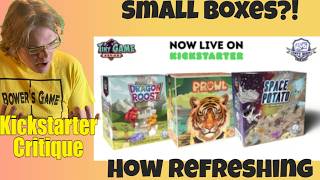
Reviewers describe Space Potato as a compact worker placement game with more going on than its size suggests. Grant, Grant's Game Rex frames it as a game that packs a lot of strategy into a small box, placing it within the small box line from its publisher. Bower's Game Corner approaches it from a different angle, reviewing the Kickstarter campaign for a set of three small box games that includes Space Potato, and the channel's praise centers on the physical product. Board Game Buzzz covers the game during a convention visit and reacts enthusiastically to its pitch and theme. The shared view is that the design is ambitious for its footprint and that its premise is memorable.
Where reviewers differ is in how much they can judge. Grant Lyon's account is a brief overview of the rules as presented, and Bower's Game Corner evaluates the campaign page rather than extended play. Board Game Buzzz is working from a demo and a pitch conversation with the people behind the game. The result is a community perspective that is enthusiastic and optimistic, though it stops short of detailed verdicts on how the game plays across a full session.
Core Mechanics That Define Space Potato
Worker Placement for Mining, Refining, and Repair
Space Potato is built on worker placement, and Grant, Grant's Game Rex describes the workers as the central action. Players place their astronauts to mine chunks away from an asteroid, refine the raw materials, and repair parts of the ship. Each placement is a choice about which of these chains to advance, and the game asks players to manage the resources that come out of them. Because the mining, refining, and repair steps feed into one another, the choice of where to send a worker is a choice about the whole chain. Grant, Grant's Game Rex describes this as a compact version of the familiar worker placement loop, with the depth coming from how those three activities connect.
A Shared Ship Under a Breaking Asteroid
The defining tension comes from the shared goal. The asteroid has struck the spaceship, and every player is working on the same repairs. If the ship is not repaired before the asteroid breaks apart, everyone loses. Grant, Grant's Game Rex describes the structure as semi-cooperative: players must collectively finish the repair, yet only the player who scores the most points while repairing the ship wins. This pairing of a shared timer and an individual scoreboard is what separates Space Potato from a purely competitive worker placement game, since every placement must balance personal gain against keeping the common project alive.
The Space Potato Experience
A Race Against the Breakup
Reviewers consistently describe the feel of Space Potato as urgent. The asteroid is always breaking up, so players are never just accumulating points at their own pace. Grant, Grant's Game Rex puts the stakes plainly: players have to get the work done before the asteroid breaks up, or everyone loses. That deadline shapes how the group approaches the table, and it means the experience leans toward watching a common clock while each player tries to come out ahead. The combination of shared pressure and individual scoring gives the game its tension.
Theme That Sells the Table
The theme is a large part of how the game lands with reviewers. Board Game Buzzz presents Space Potato with a comedic, slightly absurd premise in which the crew is cloning people to replace those dying out on the asteroid, and the reviewer reacts with clear excitement at the pitch. The feeling is one of playful sci-fi, with the absurd cloning premise sitting comfortably alongside the seriousness of the repair race.
What Makes Space Potato Stand Out
Depth in a Small Box
The most consistent praise is that Space Potato delivers strategic depth in a compact format. Grant, Grant's Game Rex singles out its small box design, calling it one of the publisher's small box games that carries a lot of worker placement content. Reviewers see this as a notable achievement, because a game that fits a small footprint can still offer multiple paths to mining, refining, and repairing. For players who want a short, thoughtful worker placement session rather than a large box, the design answers that need directly.
Components That Look Like a Full Game
Bower's Game Corner is especially positive about the physical product. Reviewing the Kickstarter, the channel says the components look appealing and that the game feels substantial for its size. The reviewer notes that the art styles across the set are distinct and that the mechanisms vary widely, which reinforces the idea that the small box format is not a compromise in production quality. This is a recurring point of appreciation for the Space Potato package.
Potential Drawbacks
The Campaign Presentation Undersells the Product
Bower's Game Corner raises the most direct criticism, aimed at the presentation rather than the rules. The channel argues that the main image on the Kickstarter page does not show off the components, and that large areas of the page are underused. Missing details such as gameplay videos, clearer descriptions of mechanisms, and player count and age information also come up in the review. The channel still gives the campaign a passing grade, but its message is that a game with this much to show deserved a stronger page.
Limited Hands-On Perspective
The second concern is one of evidence rather than design. The available coverage is brief. Grant, Grant's Game Rex summarizes the game in a short segment as part of a larger monthly roundup, and Board Game Buzzz describes it in the context of a convention visit and a conversation about its upcoming release. Neither account reports extended play, so questions about balance, the pacing of the repair race, and how competitive scoring holds up across different player counts remain largely open. Readers should treat the enthusiasm as a strong first impression rather than a settled verdict.
If You Enjoy Space Potato
Grant, Grant's Game Rex covers several other worker placement releases in the same roundup, and those titles are the most direct points of reference available. Red Leaf University is a Euro strategy worker placement game built around six specialized campus areas, each with its own mini game, and upgradable workers. Prague Unseen also uses multiple mini game spaces, with different worker types changing how each space plays. Nijar uses an action and bonus grid for worker placement, and Tea and Rum uses a worker pulling mechanism that creates timing tension. Players who value worker placement that rewards careful sequencing will find a shared design interest across these titles.
For fans of the small box format specifically, Bower's Game Corner points to the broader small box market as a point of reference, naming Tiny Epic among the companies that make smaller box games. Players who enjoy a compact game with a memorable theme and a shared threat will likely appreciate the same qualities here.
What Reviewers Are Saying
"This is a game that packs a lot of strategy into a small box. This is one of MV Born Games' small box games, but this is a worker placement game with a lot of different stuff going on. It is a bit semi-cooperative because you are basically all trying to repair the common spaceship."
— Grant, Grant's Game Rex
"I I really don't have a firm, the firmest grips on the size of this these boxes yet, but this this one in particular feels like a lot of game in that box."
— Bower's Game Corner
"This is Space Potato, and it's coming out next year. Oh my goodness, I love it."
— Board Game Buzzz