



Speakeasy Blues Deep Dive
What the Community Thinks About Speakeasy Blues
Speakeasy Blues is a 2018 game set in 1920s New York during Prohibition, where players build and run their own speakeasy. The reviewers at Board Games UnLocked came to it with real interest, largely because the premise of creating your own speakeasy felt unlike anything else they had played. The reviewers said the era is well covered by other games, including the Arkham titles, but that building a speakeasy from the ground up was an angle they had not seen before.
That early enthusiasm did not survive the table. The reviewing team came away disappointed. They described rules that were hard to follow, symbols that were not clear, a board that offered little reason to look at it, and a quiet, low-interaction game that ran well past its advertised length. The channel also featured it in a worst-of-2018 countdown, where the host called it boring and said it was among the games that disappointed the most. The reviewers credited the components and the dice mitigation, but they did not find enough in the core loop to recommend the game with enthusiasm.
Core Mechanics That Define Speakeasy Blues
Dice Mitigation and Placement
Speakeasy Blues uses dice in place of a traditional worker supply. Two sets of dice sit off to the side of the board, and on your turn you take two dice of the same color, roll them, and assign each result to an action. You can also spend a dollar to reroll all of the available dice. Reviewers agreed this keeps the randomness in check. One reviewer noted that the randomness was almost non-existent because of the two sets and the reroll option, and that most players could reliably get something close to what they wanted.
The reviewers were less convinced that the system added much to the game. They described it as literally just dice placement, and argued that the same actions could have been handled with workers on spaces without changing the experience. Another point of friction came up when a player had no legal place to put a die: that player simply lost the action for that turn, which the reviewers found frustrating when it happened.
Speakeasy Card Stacking and Set Collection
Character, society, and crime cards are placed into four slots on your speakeasy board. Only the card on top of each slot is usable, so placing a new card covers the old one and ends its ability. Additional slots can be purchased. Points come from set collection, with competitions scored on the number of matching symbols or tokens in your speakeasy. This is the core system reviewers singled out for criticism. They said it was hard to see why you would stack cards this way, that the choice was rarely meaningful because cards could not be placed underneath each other, and that the game offered few cards that let you use the people in your speakeasy more than once. One reviewer described the placement as virtually stupid, and another said the stacking was ridiculous.
The Speakeasy Blues Experience
Jazz-Age Atmosphere That Never Fully Lands
The theme is the part of Speakeasy Blues that reviewers most wanted to like. The reviewers enjoyed the idea of molding a speakeasy toward the goals you pursue, and they liked the references to Prohibition, hooch, and the jazz scene. The problem was execution. Many of the historical figures on the cards were unfamiliar to the reviewers, and nothing on the cards explained who they were. Reviewers suggested flavor text or a short history section, similar to the historical notes found in some other titles, would have made the cast feel real. The board and the event cards were the main sources of disappointment: reviewers called the board absolutely bland, said it lacked table presence, and said the events were unremarkable. One reviewer wished the locations on the board had been given the same sense of detail as the soiree space, with places like a club, a hangout, or an antique shop.
Quiet Turns With Little Table Tension
Play tends to feel quiet and self-contained. Reviewers said that most actions helped the player taking them without meaningfully hindering anyone else, and that blocking a spot rarely mattered, since other players could simply take the dice off and open it up. Take-that cards were described as weak, since the reviewers often gained as much as the player they took from. Reviewers described the feeling as close to solitaire, with each player building their own speakeasy and reacting only lightly to the others, rarely even bothering to block a spot someone else wanted.
What Makes Speakeasy Blues Stand Out
The Reputation Track as a Resource
Reputation is the part of the game that reviewers most often praised with qualifications. The track determines how many actions a player can take: a low reputation severely limits your options, while a high reputation opens up more actions and adds points at the end of the game. Reviewers described it as another resource to manage alongside money. Their criticism was that the track could stop mattering after the first few turns, since a player who focused on it early could stay high for the rest of the game, and that a bad reputation should be harder to recover from. Still, reviewers agreed the track made thematic sense, since a speakeasy full of criminals should have a lower reputation than one with glamorous guests.
Components and Artwork
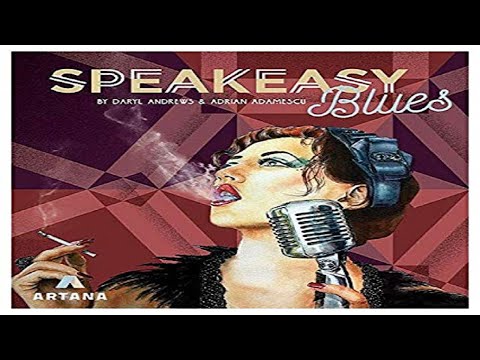
Reviewers said the physical production was largely a strength. The board, dice, and tokens were described as high-quality, and the tokens had a satisfying weight. The art style also grew on at least one reviewer, who compared its minimalist, mid-century look to the work of Wes Anderson films. Reviewers were not uniformly positive: the cards were called too flimsy, and some of the darker artwork made it hard to read card text under table lighting. Overall, the production gave the game more presence than its board did.
Potential Drawbacks
Rules, Final Scoring, and Unclear Symbols
This was the most consistent complaint. Reviewers said the rulebook was organized backwards, explaining every action and placement option before explaining the round structure, which left them unsure what anything meant. Final scoring was the part of the rulebook they found most confusing, because the rules referenced the endgame without explaining it until the last moment. The symbols on the cards were another point of frustration. Reviewers said that a symbol-driven game needs crystal-clear symbols, and that the reference card was too small and too sparse to answer questions quickly. One reviewer misread the scoring reference, interpreting shields as worth ten points each, which was not the rule. Reviewers argued that a player aid or a larger reference card would have fixed much of the trouble.
Runtime That Outgrows the Box
The game is advertised at around 45 minutes, and reviewers said it did not play that quickly. Their experience ran much longer, and one group said a two-player game took roughly twice the expected time. Reviewers felt that four players was too many, since the lack of meaningful interaction meant extra players simply added downtime. They also said the game was too long for the amount of decisions it offered, and one reviewer felt a game of this kind should not require a break at all.
If You Enjoy Speakeasy Blues
Reviewers pointed to a few games that handle similar ideas more successfully. Board Games UnLocked suggested that Speakeasy Blues could have worked like Vidi Culture, a worker placement game where you build a single, visible operation, rather than a set of stacked cards. The same reviewer said the game could have borrowed the tableau approach of Akron II, where your build is laid out in front of you and every card references it. If you are drawn to the 1920s setting, reviewers noted that Arkham-style games already cover the era, so the speakeasy angle is the main thing that sets this game apart. For players who want a game where the symbols are easy to read, Race for the Galaxy was cited as an example of a game that relies on very few symbols, which made the difficulty of reading Speakeasy Blues stand out more.
What Reviewers Are Saying
"I'm being very candid because I really wanted to like this game. I was relatively excited about it."
— Board Games UnLocked
"I kind of wish the board was an actual speakeasy spot instead of just literal, just different colored sections. It's the most boring blend, no one would come over to this game, see it, be like, I want to play that, got for me before, just from the board, like it has no real table presence."
— Board Games UnLocked
"The stacking of cards, it was ridiculous. A theme just doesn't really do it for me, like that's why I never ever wanted to even try."
— Board Games UnLocked