




Spectaculum Deep Dive
What the Community Thinks About Spectaculum
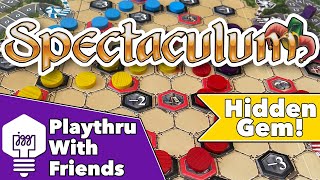
Spectaculum is a Reiner Knizia design that reviewers tend to describe as a stock-driven cube rails game with a circus theme. The reviewers in this set are unusually warm about it. Junkets Games placed it at the top of a month of plays, ahead of Northern Pacific, Dual Gauge, and Trans-Siberian Railroad, and Junkets Games called it a 10 out of 10 game. The consensus is that the game is light on rules and heavy on tension, which is an unusual pairing in the cube rails genre.
Reviewers agree on the core appeal: the game takes a familiar train-game skeleton and swaps the trains for a traveling show. Because the theme has nothing to do with rail, the game attracts players who might otherwise pass over a train title. The main point of disagreement is about luck. Some players accept the randomness of the draw as part of the design, while others find the outcome can hinge too heavily on a few lucky or unlucky turns.
Core Mechanics That Define Spectaculum
Route Building With Random Tokens
The route building in Spectaculum does not start from a hand of cards or a chosen tile. Each turn begins with a random draw from the bag, and the drawn tokens determine what can be laid out. Junkets Games explained the flow of a turn this way: the tokens are associated with the four companies, and the player places them onto the board as track. The reviewer added that this removes the usual decision about which company's track to build, because the bag decides the company and the player decides where the track goes.
Placement is what gives the draw meaning. Each token can raise or lower the value of the company it belongs to, so a single piece of track can move the stock market as well as extend a line. In the two-player teach on Junkets Games, the host placed tokens first in order to nudge prices before deciding whether to trade, and the placement choices repeatedly determined which dividends were paid out at the end of a turn.
Stock Trading and Dividends
The second mechanic that defines the game is the stock market that the track building drives. Each player can take up to two actions on a turn, and those actions are buying shares, selling shares, or collecting dividends. Shares are bought at the current track price, and a player who sells can push the price of that company down, which hurts anyone holding stock in it. Dividends pay out according to how much stock a player holds in the companies that the board rewards.
The teach shows how quickly the market moves. Players buy low, pump a price upward with placed tokens, then sell into the rise. In the same two-player game, one player noted that selling a large holding can be painful but necessary, and the other pointed out that every price increase has a cost for the opponent who is holding that stock. The stock trading is therefore a tug of war in which each move helps one player and damages another.
The Spectaculum Experience
Tense Head-to-Head Competition
Spectaculum feels like a duel even when the rules are short. In the two-player teach, the host and Anastasia were constantly pulling the market in opposite directions, and each turn often became a choice between building their own position and cutting the other player down. Reviewers describe the experience as more about the interaction than the final score. One player in the teach reflected on how the game keeps pulling them toward direct interference, saying that every time they play they plan to mess with the opponent's strategy and end up doing so again.
Luck That Demands Adaptation
The random bag gives the game its character. Players do not get to plan a fixed route, and they must adapt to the tokens they actually draw. The teach host described it as a matter of accepting the bag: you cannot play the game as though luck does not exist, so you adjust your turn to what you have. The same reviewers note that a few lucky draws can swing the outcome, and that the game is more about responding well to the bag than about executing a perfect plan.
What Makes Spectaculum Stand Out
Strong Rules Economy
Reviewers consistently praise how little the rulebook asks of players. Junkets Games described the game as very rule simple, with a turn that amounts to drawing tokens, placing them as track, and then using stock actions. That simplicity makes it an accessible entry point for gamers who are unsure whether cube rails games suit them, and it is the reason the reviewer recommended it as the first game to try in that genre.
A Theme That Breaks the Train Mold
Spectaculum uses the cube rails framework without trains. The circus setting gives the game a different identity from its genre peers, and Junkets Games pointed out that this is part of what makes it appealing. The reviewer argued that cube rails games might reach a wider audience if their themes were more varied, and Spectaculum is offered as an example of a game that already does this while keeping the mechanics that make the genre engaging.
Potential Drawbacks
Variance From the Bag
The most common criticism concerns how much the random draw can decide. In the teach, the host admitted that the draws shaped the result more than expected, and a few turns of unlucky tokens left one player far behind in the stock market. Reviewers who value a predictable plan may find the luck frustrating, even if the randomness is central to the game's identity.
Harsh Stock Market Penalties
The stock market can punish players sharply. In the teach, one player dropped to a deep negative balance and was close to being forced to sell stock at half price, which would have hurt considerably. Reviewers note that this creates memorable comebacks and collapses, but players who dislike being forced into bad trades may find the pressure unpleasant. The game also rewards careful cash management, so a player who runs short of money can lose ground quickly.
If You Enjoy Spectaculum
Players who enjoy Spectaculum's stock market will find a related satisfaction in Union Station, which Junkets Games describes as a stock-focused cube rails game in a tiny box, with a quick turn and a sharp sell-off mechanic. Players who want a heavier operational train game with the same route building appeal can look at Northern Pacific and Iberian Gauge, which the same reviewer names as the more demanding titles in the genre. Players who want a different lightweight route game can try Helis, which Junkets Games lists alongside Spectaculum as one of the games it has played most this year.
What Reviewers Are Saying
"This is effectively a cube rails game but it has nothing to do with trains from a thematic perspective, and honestly I love that."
— Junkets Games
"I don't think the winning is the end-all be-all of the game experience. I had so much fun playing this, and every time I play it, I'm going in for that kind of how can I mess with this strategy, but I am always determined to try to cut you out of things."
— Junkets Games
"You just draw two, no, three random discs, and then on your turn you have to place them out as track, and then you can buy and sell stock. You are trying to buy when it's low and sell when it's high."
— Junkets Games