

Spirit Fire Deep Dive
What the Community Thinks About Spirit Fire
Spirit Fire sits at an unusual crossroads in the board gaming community. The game has generated genuine excitement among those who understand what Orange Nebula is attempting, yet it has simultaneously sparked skepticism about whether the design can deliver on its ambitious vision. Reviewers praise the courage of the core concept while openly expressing concern about release timelines and community clarity.
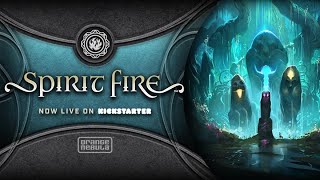
Orange Nebula, the publisher behind acclaimed games like Vindication and Unsettled, is attempting something notably different with Spirit Fire: a non-linear, open-world fantasy exploration system without combat. Reviewers recognize this as a bold design pivot. The team itself only settled on removing combat after four months of development, realizing that a traditional dungeon-crawler approach would overshadow the richer journey they wanted to create. This fundamental choice has reshaped everything that followed.
Yet alongside the respect for ambition lives genuine uncertainty. The game has no confirmed release date on major databases. The Kickstarter campaign launched without gameplay videos due to production challenges, forcing the team to scramble with their own documentation. Community questions about the reward structure were so confusing that Orange Nebula issued clarifications mid-campaign. These friction points have led some backers to quietly worry whether the final product will arrive at all, or whether years of development will ultimately produce what was promised.
Core Mechanics That Define Spirit Fire
Track Advancement Through Aspects
Spirit Fire uses a four-aspect deck-building system built around personal progression. The four aspects each have distinct personalities: Illumination tends toward awareness and mental capacity, while Intensity emphasizes vigor and resistance. Unlike traditional CCGs, players don't compete to build one perfect deck. Instead, the game is deeply situational. Before each challenge or quest, you weave your deck from available aspects to match what you expect to face. A negotiation might call for empathy-focused cards, while a mental challenge requires clarity and focus. This dynamic, responsive deck-building creates a connection between character growth and the story each player is writing.
Personal Quest Resolution Chains
Personal quests function as the narrative spine of character progression. These quests can be active simultaneously across multiple realms, traveling with you as you explore. Each quest you complete can unlock branches: complete one objective and two new paths open, giving you choices about which thread to follow next. This branching structure means character development feels shaped by your decisions rather than dictated by game design. The emotional weight comes not just from mechanical reward, but from the sense that you chose your own path through the character's inner journey.
The Spirit Fire Experience
Introspective and Exploratory
Spirit Fire prioritizes the feeling of personal discovery. This is not a game about ticking off objectives or min-maxing for victory points. The design encourages you to spend time in each realm, to uncover what draws your character forward, to make choices based on personality and motivation rather than spreadsheet optimization. The game rewards thoughtful exploration, not speedrunning. This creates a more meditative experience, one where downtime between major events feels purposeful rather than wasted.
Cozy Yet Challenging
Despite the absence of combat, Spirit Fire presents real challenges through mechanics that make you think. Negotiation, deception, puzzle-solving, and emotional consequence all pose obstacles without requiring you to roll dice for abstract combat. The world responds to your choices in ways that echo forward, affecting how future quests play out. This creates tension and consequence without needing combat systems to do the heavy lifting.
What Makes Spirit Fire Stand Out
Character Creation as Its Own Experience
Spirit Fire begins before you ever touch a realm or complete a quest. The character creation process is deliberately substantial, inspired by video game tradition and tabletop RPG character building. You don't simply pick a class and stats; instead, you engage with a personality-driven selection process. The team drew from Myers-Briggs-style personality frameworks, asking you to make choices that reveal your character's values and motivations. You then draft cards that align with those choices, building a deck that feels like it reflects who this character is. By the time you open the first realm, you've already invested in this character in a way that creates emotional ownership.
A Deck-Building System That Mirrors Growth
As you play, your available card pool grows. You don't replace your deck; you upgrade the options available to you. This creates a satisfying sense of progression where your character becomes more versatile, more capable, yet your core identity remains grounded in the choices you made at creation. Each new card unlocked feels like learning something about yourself, rather than simply acquiring power.
Potential Drawbacks
Ambitious Scope and Delivery Uncertainty
The concept is genuinely unusual, and that unusualness cuts both ways. Some reviewers have questioned whether the core gameplay loop will feel as engaging in practice as it does in theory. More pressingly, the extended development timeline has raised legitimate concerns. The game has no confirmed release date, and backers have observed relatively sparse communication from the team. Orange Nebula has released only a handful of updates over an extended campaign, with recent updates focused on explaining rules and artwork rather than production milestones. The longer ambitious projects take to reach production, the steeper the financial burden and the greater the risk that scope creep or production challenges derail delivery.
Conceptual Clarity and Marketing Challenge
Spirit Fire is genuinely difficult to explain. It is not a dungeon-crawler, not a legacy game, not quite a solo campaign despite being playable solo, and not a traditional deck-builder. This conceptual ambiguity has been a friction point with the audience. Even the campaign reward structure proved confusing enough that the team had to issue clarifications. Reviewers note that the game's unusualness means it will take time for the community to truly understand what they are getting. Until the game is in hands and being played, skepticism about whether the marketing and explanation match the reality is understandable.
If You Enjoy Spirit Fire
If Spirit Fire's vision of introspective, choice-driven exploration appeals to you, several other games offer related experiences. Unsettled, from the same studio, shares the exploration and puzzle-solving DNA but in a shorter, episodic form. Vindication offers a richer mechanical sandbox for making meaningful character choices over time. For those drawn to deck-building and character growth, Flesh and Blood and Magic: The Gathering offer competitive card systems, though without Spirit Fire's narrative focus. For the open-world fantasy appeal, Skyrim and Baldur's Gate remain touchstones, though in video game form. Kingdoms Forlorn and Aeon's Trespass: Odyssey offer similar extraction-based, modular campaign structures. Mythwind brings a cozy, exploration-focused tableau-building experience. Threshold offers modular, interconnected gameplay. The common thread: games that reward slowing down, exploring thoroughly, and treating character agency as more important than mechanical optimization.
What Reviewers Are Saying
I would say it was probably about four months into to development, we're about two years in, and after four months we're like why are we even trying to do another tactical combat game like every other game has is centered around combat, you know, it's it's rolling dice, mitigating stats, doing stat checks, and if we're trying to tell a story, how much more of a journey is there than, you know, combat, and and there's like 99% of the of the other part of the journey like isn't getting its due.
— Board Game Spotlight
The way that this Milestone track can take all of your behaviors and have them influence everything else that happen happens moving forward, just blew the game open as far as how complex the interactions between the different Quest and stories, some things, and you can digress other things based on those decisions, so it's really cool.
— Board Game Spotlight
It's such a weird concept and I don't think they're anywhere close to finishing it. The problem with games like these is the longer it takes to come out, the less money they have to finish it, and usually it falls by the wayside.
— Board Games Unlocked