/pic6929347.jpg)

/pic5585867.jpg)
/pic7902371.jpg)
/pic6929347.jpg)







































Splendor Duel Deep Dive
What the Community Thinks About Splendor Duel
TheGameBoyGeek was an early champion of the game, noting that it landed higher than the original Splendor on BoardGameGeek and calling the base design "pretty close to perfect" even before covering its small Counterfeiters mini-expansion. Grant Lyon arrives from the opposite direction: he had drifted away from the original Splendor toward games like Century and It's a Wonderful World, and Splendor Duel is what pulled him back, landing at number four on his all-time two-player list with a recommendation for players whether or not they already like Splendor. All You Can Board admits going in skeptical, wondering whether a two-player version of an already two-player-friendly game was even necessary, then ranked it among the best games played that year and called it a phenomenal game. Man vs Meeple brings a third angle: the channel does not care much for the original Splendor, but rates Splendor Duel about the same and credits it with reviving some admiration for the underlying system during a tournament-style bracket where it edged out Lost Cities.
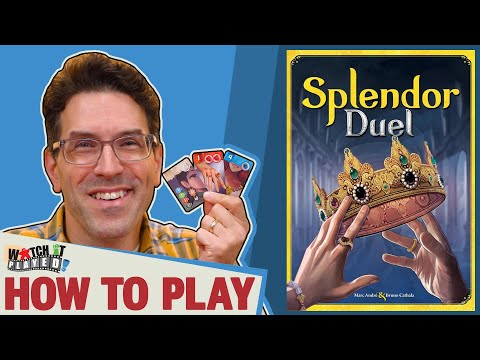
Watch It Played produced a rules tutorial identifying the designers as Marc André and Bruno Cathala and the publisher as Space Cowboys, and the video discloses that Space Cowboys helped sponsor it. Across the enthusiast reviews, the recurring thread is less about whether the base engine still works, and more about whether Splendor Duel finally gives that engine somewhere new to go.
Core Mechanics That Define Splendor Duel
Token Collection Along the Board
Instead of loose piles of gems, tokens sit on a shared board, and on a turn a player may take up to three gem or pearl tokens as long as they sit in an adjacent, unbroken horizontal, vertical, or diagonal line, per the rules explained in the Watch It Played tutorial. Gold cannot be taken this way; it only comes from reserving a card, and gold acts as a wild token toward any cost. All You Can Board describes the shift from the original game's simple piles to a board with dozens of slots as one of the things that makes buying decisions harder: sometimes the tokens a player wants are sitting in separate corners of the board with no legal line connecting them, forcing a choice between spending an extra turn or taking a gold token instead.
Card Bonuses, Crowns, and Royals
Purchased cards go face up in a personal display and provide permanent bonuses that discount future purchases in that color, the same engine-building backbone the original Splendor is built on. All You Can Board notes that many cards now also carry crown symbols and abilities that trigger the moment the card is bought, from taking an extra token to taking a token straight from the opponent. Collecting enough crowns lets a player claim a Royal card from beside the board, and per the Watch It Played tutorial, reaching three crowns grants one Royal while reaching six grants a second, with Royals carrying their own points and abilities.
The Splendor Duel Experience
Shifting Between Win Conditions
Grant Lyon points to multiple paths to victory as the thing that changed the whole experience for him: rather than chasing the same strategy every game, Splendor Duel adds three different ways to win, and he describes constantly asking himself whether to keep pushing toward one win condition or pivot because an opponent got a head start on it. All You Can Board describes the same tension from the player's seat, saying that being able to switch which win condition to chase in the middle of a match, in reaction to what the opponent is doing, felt satisfying in a way that echoes Seven Wonders Duel.
Reading and Blocking Your Opponent
Because tokens must be taken from a straight, unbroken line, All You Can Board frames the board-reading itself as part of the tension: a player can see exactly which tokens an opponent is likely chasing next and can jump in to disrupt that line before they get the chance. That same review calls the resulting push and pull of a duel game satisfying, since both players are watching the same shrinking board and racing each other for position rather than just building their own tableau in isolation.
What Makes Splendor Duel Stand Out
Multiple Paths to Victory
Both Grant Lyon and All You Can Board single out the added win conditions as the headline improvement over the original game. All You Can Board lays out the specifics: instead of racing to twenty points, a player can also win with ten points concentrated in a single color, or by collecting ten crowns across their cards, and having all of those avenues open at once meant switching the win condition being chased more than once in a single game.
Card Abilities That Add Depth Without Extra Overhead
TheGameBoyGeek's coverage of the official Counterfeiters mini-expansion praises how much strategic depth Splendor Duel can absorb without adding real overhead, singling out the expansion's counterfeit card abilities as a favorite addition because only three of them are in circulation at any moment, so new players only have to learn a few at a time. The same review credits even a small change like four fewer tokens available on the board with shifting which gems become scarce, which changes what a player is willing to go for.
Potential Drawbacks
Two Rulebooks to Juggle
TheGameBoyGeek flags one real downside once the Counterfeiters mini-expansion is mixed into a game: players end up cross-referencing two separate rulebooks for the abilities in play, which the review calls a minor but real inconvenience.
No Player Aid for the New Abilities
The same review also wishes the expansion had shipped with a folded player aid listing all of the new counterfeit card and noble abilities in one place, rather than requiring players to look each one up in the book as it comes out.
If You Enjoy Splendor Duel
Reviewers point back to the original Splendor most often, whether they are measuring how much Splendor Duel improves on it, as TheGameBoyGeek and All You Can Board both argue, or describing how it reignited a lost enthusiasm for the system, as Grant Lyon and Man vs Meeple both describe. All You Can Board also draws a direct line to Seven Wonders Duel, calling the resemblance between the two games' multiple win conditions the biggest comparison to be made, since both let a player pivot toward whichever victory path an opponent has left open.
What Reviewers Are Saying
"It adds a lot of new strategies and a new mechanism, and it just makes a game that already I didn't think needed an expansion and it felt like the game was pretty close to perfect. Adding this in just makes it better."
— TheGameBoyGeek - Hi Quality Hi Energy Board Game Reviews
"And so, if you like Splendor, I I really recommend Splendor Duel. And if you don't like Splendor, then I still recommend Splendor Duel because it's on my top five two-player games of all time. I think it's great for anybody."
— Grant Lyon
"Splendor Duel is a two-player version of that in the same way that Seven Wonders Duel is a dual version of Seven Wonders, where it takes the DNA and the essence but it changes it and makes it into a, you know, a foundation that is best at two, and Splendor dual does that so well. It does it very similarly to how Seven Wonders Duel does it."
— All You Can Board