


Springsign Deep Dive
What the Community Thinks About Springsign
Springsign is a prototype-stage game from End Games, and the coverage gathered here consists of preview impressions published ahead of its planned crowdfunding campaign. In Springsign, one to six players act as influential town councilors in a growing frontier settlement of anthropomorphic animals. Together the players build the town, but the townsfolk will soon vote for a new mayor, so every player is ultimately racing to win The Election by collecting the most votes.
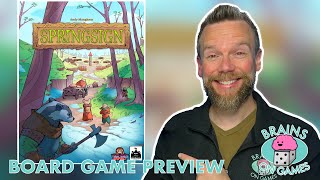
Brains On Games, hosted by Dr. Brian McDonald, offers the most detailed impressions in a dedicated preview. Dr. McDonald reports that the game was a hit with the group and that friends kept asking to play it again. Quackalope covered Springsign within a roundup of anticipated indie games, praising the theme, the production, and the sense that the game has earned good early reviews. Hungry Gamer presented a shorter mini preview that is warm about the Tableau building and the artwork but more direct about balance. Reviewers agree on the core loop and on the importance of the Anarchy threat. Their main point of difference concerns weight: Brains On Games calls the game light and approachable, while Hungry Gamer warns that players who prefer medium or heavier games may find it on the light side.
Core Mechanics That Define Springsign
Resource Management
Resource management is the mechanic reviewers return to most often. Players collect tokens such as fish for feeding settlers, swords for fighting bandits, and blue scrolls for acquiring relics, and each action costs a specific set of these tokens. Brains On Games describes resource management as the hardest part of the game, and identifies the limited backpack as the source of tension. Because only a fixed number of tokens can be held, players must decide what to keep, what to spend, and what to leave behind. Hungry Gamer makes the same point, noting that spending four swords to defeat a bandit is a big deal when inventory is so limited.
Tableau Building
Hungry Gamer describes Springsign as a light Tableau builder, explaining that relics acquired through study actions are placed into the player's personal tableau, where they grant ongoing bonuses or unlock new actions. The reviewer enjoys the way each purchase sets up a later ability, so that a player buys one building, then uses its ability to reach the next step. Brains On Games sees a related engine forming, since settlers hired into a player's homestead send their produce into the backpack every turn. Quackalope similarly frames the game around actions that build a central town map and a personal Tableau, which places the mechanic at the center of the experience.
The Springsign Experience
An Uneasy Alliance Against Anarchy
The Anarchy track is the element reviewers single out most often. Settlers and bandits marked with fire symbols add Anarchy at the start of each round, and if Anarchy becomes more popular than the players, everyone loses. Brains On Games describes this as the feature that elevated the game. Springsign is not cooperative, yet players sometimes have to work together to keep the fire symbols from running away with the town. Hungry Gamer agrees that the game will not win unless players let it, and notes that bandits can be discarded or defeated to keep the threat in check. The result is a semi-competitive town-building feel in which every player is campaigning for the mayoral seat while the shared threat keeps the table watchful. Brains On Games stresses that Anarchy is not a dummy player, since it is simply a running count of whether the town is growing fed up with its leaders.
A Light, Quick Turn Rhythm
Reviewers describe turns that move briskly. Each player takes one action at a time, and the board changes quickly, so the game keeps moving even when another player takes a card that was of interest. Hungry Gamer observes that because most actions are expensive, only a few options are realistic on any given turn, which limits how long any one player can stall the table. Brains On Games describes the game as quick to play and easy to learn, and says it is not a brain burner. Players who choose big, expensive actions may leave the board open for others, so pacing is a real tradeoff that reviewers say makes each turn feel purposeful.
What Makes Springsign Stand Out
Asymmetric Player Boards
Brains On Games and Hungry Gamer both single out the asymmetric player boards as the most exciting part of the design. Hungry Gamer explains that the front of each board carries a short story for the character, while the back gives each character different costs for the main actions. A study action, for example, may cost less for one character than for another, and every character has a special power that makes the game feel different when a player leans into it. Brains On Games expects the final boards to let every player take the same actions while paying different costs and gaining different abilities. Both reviewers stress that these boards are still being finalized in the prototype.
Animal Theme and Artwork
The art direction receives consistent praise. Hungry Gamer says the reviewer adores the artwork and the anthropomorphic animals, and describes loving them with every fiber of their being. Brains On Games highlights the cute animal characters and the fun artwork on the cards as a central part of the game's appeal. Quackalope describes the lore and theme as the first things that draw them in, and calls the theme and the production quality of the prototype strong. For these reviewers, the animal settlement gives an otherwise resource-heavy game a warm personality.
Potential Drawbacks
Balance Is Still in Progress
Hungry Gamer's main concern is that the balance is not there yet. The reviewer notes that the asymmetric powers appear in the prototype as drafts and wishes that some of them were more powerful, arguing that a game in which every character has a power that feels slightly unfair is especially enjoyable. Brains On Games makes a related observation that some cards appear extra powerful, and that players will want to fight over the most desirable ones, such as a relic that grants extra backpack space. Brains On Games also reports that the designers are still making sure everything balances. These are prototype impressions, so the concern is expected at this stage and is not a final verdict.
A Lighter Weight Than Some Players Want
Hungry Gamer cautions that the core gameplay loop stays largely the same throughout a session, with variety coming mostly from the cards in play and from the asymmetric characters. The reviewer notes that players who usually prefer medium or heavier games may find Springsign too light, and describes the solo mode as functional but different in feel from the multiplayer game rather than a bot match. The same reviewer wishes the settlers had more distinct artwork, since many share the same characters with different names and abilities. Brains On Games reaches a similar conclusion about depth, describing a game with some resource management and a little engine building that is nonetheless not a brain burner.
If You Enjoy Springsign
None of the reviewers drew a direct comparison to a specific published title, so the most useful guidance comes from the mechanics they highlighted. Reviewers' perspectives point to the following broad recommendations:
- Light Tableau builders: Hungry Gamer describes Springsign as a quick Tableau builder, and says that players who like building a personal display of relics and abilities will find that appeal in its straightforward form.
- Worker placement and engine building games: Brains On Games contrasts Springsign with engine builders and worker placement games, and notes that the settlers' backpack income gives it a modest engine feel that still stays light.
- Games with asymmetric player abilities: Both Brains On Games and Hungry Gamer praise asymmetric boards that change how each character plays, so players who enjoy that kind of variety should watch the final boards closely.
What Reviewers Are Saying
"This was a hit. What made it a hit was the limited number of resources that you could hold, so you were always making choices towards the end of the game about what you needed the most."
— Dr. Brian McDonald, Brains On Games
"First of all, I adore the artwork. I mean, I'm a sucker for the anthropomorphic animals, I just, I love them with every fiber of my being."
— Hungry Gamer
"You're going to be taking resources and taking exploration cards and taking actions that build a central town map, but you're trying to get as many votes as possible. You're developing the city together, but only one person is going to be reelected as the town mayor, so you need to make sure you get as many points as possible."
— Quackalope