
Story of Many is a cooperative fantasy adventure board game for 1-4 players about exploring a vast land, combating deadly foes, and delving into mysterious adventure sites. With over 400,000 words of adventure text, and limitless possibilities for creating and advancing your own character, brave a world filled with profound lore and hard choices. Story of Many emphasizes exploration, storytelling and challenging combat, making it an engaging experience for all board game and table-top RPG fans.
Open-world exploration is a core element of Story of Many designed to capture the sense of freedom and discovery. The world map represents the expansive and interconnected regions of Varda - each with its unique landscape, challenges, and opportunities. These regions include dense rainforests, uncharted islands, desolate ruins, sprawling eldritch cities, and treacherous dungeons. As players progress, they will uncover the game's intricate lore, and influence the unfolding story. Their choices will lead to different branching paths and outcomes.
Combat is fast, unforgiving, and delivers a fresh experience every time, as the players will pit against more than 200 unique enemies. Combat is resolved using dice and miniatures. By defeating enemies and exploring, characters gain experience to develop their abilities. Character development is achieved through a massive, interconnected web of nodes encompassing passive traits, abilities, spells, trigger actions, setting it apart from any other game of the genre. No fighter will ever be the same!
CREATE YOUR HERO. EXPLORE THE LAND. CHOOSE WISELY.
—description from the designer
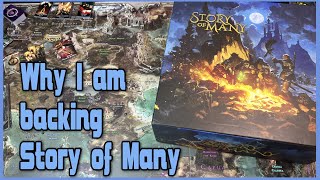
- Choice between miniatures or a base version with cardboard components.
- Multiple ways to play: large campaign with branching paths, dungeon crawls, one-off adventures.
- Respects player time with bite-sized play sessions.
- Huge open world sandbox with 50 distinct regions and organic discovery.
- World and encounters scale with character tier level.
- Rumors lead to additional quests and points of interest, populating the map.
- Persistent world and character progression through sticker placement and a light legacy element.
- Detailed adventures with exploration decks for dungeons, ruins, and villages.
- Modular dungeon generation with mix-and-match cards.
- Abstract skirmish combat system.
- 10 distinct classes and 16 unique races for character creation.
- Extensive skill system inspired by action RPGs with many specializations.
- Over 200 creatures in the bestiary with varied stats and reactions.
- Enemies and encounters make sense within their specific biomes.
- Time-gated events and keyword triggers add depth to gameplay.
- Achievements can lead to further discoveries.
- Concern about crowdfunding bloat and too many stretch goals.
- English is not the designers' first language, with potential for editing and translation issues in the extensive text.
- Rulebook is already massive (80 pages) and needs to be clear despite complexity.
- The game is a table hog, potentially requiring additional space.
- Hope that the early game tiers (1-2) are as exciting as the later tiers (4-5).
- dark fantasy
- an original open world
- Arkham Horror: Second Edition
- Hero Quest
- Descent
- Elden Ring
- Dark Souls
- Titan Quest
- Grim Dawn
- Seventh Continent
- Tainted Grail
- Bard's Song
Mechanics (from transcript analysis)
- Abstract Skirmish Combat — A combat system with tactical positioning on a small board.
- achievement system — Achievements can unlock rumors or other discoveries.
- Bestiary — A large collection of creatures with unique stats, attacks, and reactions.
- Campaign progression — Characters level up through tiers (1-5) and unlock new abilities and content.
- Character progression — Characters can be created or pre-generated, with progression through skills and equipment.
- Combat challenges — Involves tactical positioning and strategic setup.
- Dice Rolling — Dice are rolled and bonuses are added to those rolls.
- exploration cards — Decks of cards used to detail specific locations like dungeons or villages.
- Keyword System — Keywords on enemies and in the game can trigger certain events or interactions.
- Legacy Elements (Light) — Persistent world changes and unlocked content carry over between playthroughs, but nothing is destroyed.
- map movement — Exploration across a large open world map.
- Rumors — Rumors associated with locations point players to additional quests and points of interest.
- Skill trees — A system inspired by action RPGs with various schools of skills to learn.
- Stat Tests — Used for challenges and exploration.
- sticker placement — Removable stickers are used to mark discovered points of interest on maps.
- Story Text — Reading story text is a core part of the game.
- Tiered Difficulty — The game scales in difficulty and encounters based on character tier level.
- Time-Gated Events — Events that occur based on the progression of time tracked in the game.
Video topics + discussion points
Quotes (from this video)
- The entire focus of the dungeon dive is the phrase just like only different.
- Organic exploration of organic Discovery they want the players to feel like they are in this world wandering about looking for neat things to do looking for things to discover and kind of being in charge of that feeling of discovery.
- The whole world is open and it just depends on what level your character or your character party is at that will determine the level of the adventures and the level of challenges that you have available to you.
- So think of this as when you are playing Skyrim and you're walking you know you're you're walking to one of the major cities and all of a sudden you know you you see those uh things start appearing on your map like hey to the north there's a ruin uh to the south there's a cave and things like that.
- So the developers have told me the designers have told me that they want to uh keep like their website populated with a whole bunch of different pre-generated characters for people to pick.
- So there is just a ton of variety in how you will build out your different characters.
- So with the characters you can keep your characters in subsequent playthroughs as your characters grow stronger they will unlock certain things you will unlock uh certain uh types of treasure that you will be mixing together in this treasure bag and as you play all of this stuff is permanent all of this stuff will will carry forward will be persistent from one game one campaign one session to the next.
- So if you are into large bestiaries with different types of creatures with different abilities in different biomes with different ways to interact with them yeah this game definitely has you covered.
- I hope that Adventure tier system working through tiers 1 through 5 I hope that's not too throttling on the fun when you were starting I hope that tiers one and two are just as exciting are just as much fun with just as many things to do and discover as tiers 4 and 5 so hopefully I don't feel like I'm too th throttled at the beginning of the game hopefully I don't feel like I have to play for a really long time to finally get to the good part I want the game to be good from the very beginning.
References (from this video)
- Massive amount of text content
- Focus on character progression
- Potential for deep exploration and combat
- Impressive scope from a new company
- Risk associated with a first-time company
- Uncertainty if the ambition will be realized
- Character progression, adventure, hard choices
- Fantasy, lore-rich world
- Adventure text-heavy
- Dawn of Madness
- Trespass Odyssey
- Into the Unknown
Mechanics (from transcript analysis)
- Adventure game — Gameplay involves extensive adventure text and exploration.
- Character progression — Focuses on the advancement and creation of player characters.
- Combat — Challenges include storytelling, challenging combat, and exploring.
Video topics + discussion points
Quotes (from this video)
- On Trust Odyssey is a 10 out of 10 game for me. there was no reality where any of these other games were gonna surpass this.
- It'll I probably won't even [ __ ] get to it next year when it comes out because I still haven't finished my atto stuff
- This game is is the replacement. Like it's so it's it it is Netrunner. They just changed the terms.
- So in the uh in this game, you're both doing the same thing. They they found a way to merge the corp and the runner for each person to control at the same time.
- Michael Bogs is the creator of this and he was the one doing the last like third of Netrunner.
References (from this video)
- Unique fog-of-war adventure deck system with per-adventure variability
- Strong thematic integration of TTRPG and D&D-inspired elements
- Fast-paced, tactical combat with deep system depth
- Open-world exploration on a tabletop paired with long-form campaigns
- Narrative depth and decision-driven progression
- Production is ongoing; dashboard/art not final yet
- Not yet a finished product; potential changes during polishing
- High complexity may be daunting for new players
- co-op/solo exploration with a legacy/world-building frame, blending TTRPG, board game, and fantasy elements
- open-world tabletop fantasy exploration in a green world with settlements, enemies, perils, dungeons and adventures
- branching, text-driven, choose-your-own-adventure style with settlement-based decisions and adventure narratives
- The Witcher 3
Mechanics (from transcript analysis)
- Campaign — Three major campaigns, each with 60+ hours of play, offering extensive replayability and narrative depth.
- Campaign depth and length — Three major campaigns, each with 60+ hours of play, offering extensive replayability and narrative depth.
- Character positioning and class selection — Players allocate classes and positions via zones, influencing defenses and attack outcomes.
- Combat: Damage Based — Combat occurs across zones A, B, and C with enemy encirclement mechanics and zone-to-zone interactions.
- Combat: Dice — Enemies use a custom D6 to determine attacks; damages include slashing, piercing, bludgeoning, and nonphysical options.
- Custom dice and damage types — Enemies use a custom D6 to determine attacks; damages include slashing, piercing, bludgeoning, and nonphysical options.
- Dynamic, destructible environments and settlements — Adventure tiles reflect the state of settlements and environments, shaping encounters and strategy.
- Fog-of-war adventure decks — Each adventure uses a unique deck and tiles with fog-of-war, ensuring variability and that no two adventures look the same.
- Narrative Choice — Each adventure presents narrative text and choices that drive progression and outcomes.
- Narrative-driven adventures and text choice — Each adventure presents narrative text and choices that drive progression and outcomes.
- Open-world tabletop exploration — A true open-world experience on a board, with the option to explore freely or dive into structured adventures.
- Zone-based combat system — Combat occurs across zones A, B, and C with enemy encirclement mechanics and zone-to-zone interactions.
Video topics + discussion points
Quotes (from this video)
- it's like a sky Skyrim on your table but with like fighting fantasy and DND D elements in it
- our adventure system basically our exploration and is a very unique element
- three major campaigns 60 plus hours each
- you can literally do whatever you want just go wherever you like open world
- open world sound almost like Witcher 3