/pic7884117.jpg)
Striking Flint is a co-operative game that recreates the 1937 United Auto Workers (UAW) strike in Flint, Michigan.
John du Bois ... recreates a pivotal episode in American Labor History in Striking Flint. The 1937 sit-down strike in Flint, Michigan forced General Motors to address the abysmal working and living conditions of their employees, and to recognize the newly-formed United Auto Workers union.
In this cooperative game, players control five committees each with their own advantages, disadvantages, and prerogatives. GM has considerable resources at their disposal, including city authorities, deep pockets, hired thugs, and the sympathies of the press. To force them to make concessions, you’ll need to work together to weather the forces arrayed against you – fending off attempts at eviction, the effects of exhaustion, and the presence of strikebreakers – while occupying factories in the plant complex. Here, the game cleverly subverts the worker placement paradigm: by placing workers, you do not cause actions to take place, but prevent them.
With a deck of events each based on a real headline from contemporary reporting, this game for one to five players is both a compelling co-op gaming experience and a meditation on protest and solidarity – themes that are more resonant and important today than they were nearly eighty years ago.
– from the publisher

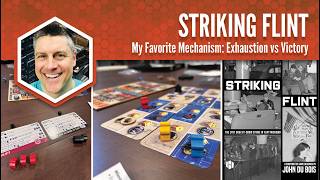
- Neat twist on worker placement where placing workers prevents bad things from happening.
- Favorite mechanism is the central track with intersecting paths for player and victory point tokens.
- Interesting way the track moves, creating a dichotomy between wanting to advance and avoiding triggering events.
- The limited supply of exhaust tokens adds another layer of strategy and risk.
- Added really great discussions and decisions.
- Might gain more exhaustion on your turn than anticipated, making it hard to math out.
- A strike in Flint, Michigan
- Flint, Michigan
- Arc Nova
- Rogers of the Ganges
Mechanics (from transcript analysis)
- cooperative play — Players work together to achieve a common goal, managing shared resources and coordinating actions.
- track movement — Player tokens and a victory point token move along intersecting tracks, with player movement influenced by exhaustion tokens and triggering events.
- Worker Placement — Players place workers in factories not for benefits, but to prevent negative events.
Video topics + discussion points
Quotes (from this video)
- Hey, I'm Jamie from Stonemire Games
- I'd love to hear your thoughts if you have played this game or if you've played another cooperative game with intersecting tracks like that or with a decision space that's in the same realm as striking flint. I'd love to know about it in the comments below. Thanks.