/pic5697068.jpg)
Studies in Sorcery is an engine building and drafting game in which players are trying to complete projects in Alchemy, Reanimation, and more to finally complete their thesis statement and graduate from the Academy of the Dark Arts.
Each field of study at the Academy of Dark Arts is different and requires different skills. Alchemy takes time but can grant you abilities instantly. Reanimation requires just the right ingredients if you want to really impress the professors and can help you build future projects even faster. Sorcery takes work, but can grant you new abilities depending on the phase of the moon.
On their turn, players can choose to scavenge for ingredients or to go get more projects to work on. At the end of each round, players can commit their ingredients to projects and hopefully finish a project so they can reap the rewards of a job well done.
The game ends after four semesters have passed and players present their projects for review. Choose your thesis and fields of study wisely and even you can get your degree in darkness!
—description from the publisher
- simple, elegant engine for a quick game night
- playable with family and partners
- played only once; more data would help gauge longevity
- contract fulfillment for magical projects
- academic focus on sorcery; thesis-driven projects
- card-driven projects with season/power effects
Mechanics (from transcript analysis)
- contract fulfillment — complete projects to gain powers and points
- Contracts — complete projects to gain powers and points
- hand/resource management — collecting resources to fulfill contracts
- rapid, accessible play — fast turns with simple core loop
- Real-Time — fast turns with simple core loop
- Resource Management — collecting resources to fulfill contracts
Video topics + discussion points
Quotes (from this video)
- the core game is basically the vcr and then you buy separate movies VHS tapes type things to put into your core box and you play different adventures
- this is a solo game dice rolling
- it's set collection very very simple and it's in its simplicity that it is so much fun
- this is jerry hawthorne's follow-up to aftermath
- it's an adventure book game but man does it pop
References (from this video)
- Was 'fine'.
- Not super impressed by it.
Mechanics (from transcript analysis)
Video topics + discussion points
Quotes (from this video)
- This has become like a sleeper hit for me.
- It is such a good two-player deduction game is trying to figure out the sequence of asking the right questions faster than your opponent asks the right question.
- Tranquility to the Scent is still an excellent version of it.
- It's basically an auto battler, but such a clever auto battler.
- I do not think it's a forever game.
- for right now, it has managed to persevere and we'll see how long it lasts.
- both have a uh I don't want to say permanent because nothing's permanent, but permanent spot in my collection.
- another easy win.
- Jungo was definitely a hit for me.
- that was a solid one that I definitely am happy I picked up.
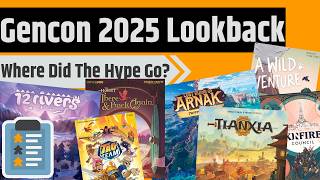
- Santorini Pantheon Edition and Arnuk Adventure Chest are easy wins over there
- Again, another iteration of a system I already have.
- I like it, but Lana is not my favorite game system.
- It is good to have, but if I got rid of it, it would not be the end of the world.
- If I didn't get it, I'd be fine.
- my kids like it, but my cats like it more.
- I'm uncertain of the longevity.
- Waddle is great. I don't think it's a mustave.
References (from this video)

- Clear demonstration of game phases and moon mechanics
- Two-player play loop with multiple strategic choices
- Diverse resources (vials, candles, bones) and project types
- Prototype copy subject to change before release
- Potential learning curve due to scoring complexity
- Preview components may differ in the final product
- Academic exploration of dark arts with occult and alchemical projects.
- A magical academy during the final semester.
- Array
Mechanics (from transcript analysis)
- Cram (assignment) phase — Automatically assign two additional resources to projects; optimize resource allocation.
- Digging grave cards — Explore three piles of grave cards, choosing to keep, pass or draw additional cards as piles are depleted.
- Hidden Victory Points — Each player has secret thesis cards affecting end scoring.
- Market buying and resource management — Buy projects and market cards using grants and grave cards; no change is given.
- Moon phase tracking — Four weeks per month across four months; progression triggers monthly cycle and end-game timing.
- Private objectives (thesis cards) — Each player has secret thesis cards affecting end scoring.
- Project actions and moon phase — Some projects grant moon-phase specific actions; effectiveness tied to the current moon phase.
Video topics + discussion points
Quotes (from this video)
- we're in school, we're trying to get our master's degree in the dark arts
- this is prototype so everything is subject to change
- the game ends after four months and four weeks each
- you can take this candle for free
- the final scoring is based on completed projects and thesis cards