/pic5115991.jpg)
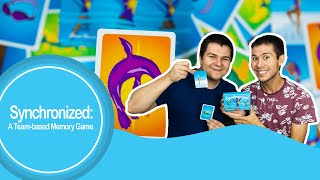
Two teams come face to face to perform the best routine in this synchronized swimming card game!
Memorize your routine, and recreate it all with cards. The team with the highest score after four rounds wins the game.
Every round is in three faces: Rehearsal, Competition, Performance.
In Rehearsal both teams will lay out a routine with 6 to 11 pose cards and memorize the sequence. Once a team has their routine memorized, they grab the whistle to end this phase for both teams, and cards are flipped face down.
For the Competition, a duplicate deck is dealt among team members. Players place cards face down below their corresponding rehearsal cards.
Once both teams are done, each team will Perform, flipping and comparing all their cards. For each matching rehearsal and competition card pose, they score a point.
Each round increases with one additional routine pose, and a Challenge card adding rules.
—description from the publisher

- No discussion during the competition phase creates a pure memory/recall challenge that feels authentic and focused.
- Strong memory-demand mechanic that remains engaging and can be practiced to improve recall over time.
- Offers a 2-3 player cooperative variant, broadening accessibility and social dynamics.
- Higher player counts introduce tense standoffs and strategic depth with card placement and timing.
- Thematic execution feels cohesive with the synchronization concept and adds fun flavor.
- Shines with repeated plays; players develop memory tricks and strategies over time.
- Heavy reliance on short-term memory may be challenging or frustrating for some players.
- Longer routines (especially with larger player counts) can be hard to memorize and require sustained focus.
- Certain components (like challenge cards) can be particularly tough and may deter casual players.
- Being a Kickstarter prototype, final production components or balance may differ from what’s shown.
- Limited direct interaction during the competition phase could feel slow for some groups.
- Memory, performance, teamwork, competition
- National synchronized swimming competition setting where two teams memorize and perform routines
- Competitive, rehearsal-to-performance progression with round-based play
Mechanics (from transcript analysis)
- Challenge cards — Optional cards drawn during rehearsal that impose extra tasks or complications in the subsequent phase.
- Face-down routine cards with held positions — During the performance, routine cards are placed face down in the original positions and are revealed/deployed in sequence as players select from their hands.
- Memory-based card placement — Teams memorize positions of routine cards laid out simultaneously during rehearsal, then attempt to reproduce the sequence during the performance phase.
- No discussion during competition phase — Players must rely on memory and self-trust rather than verbal coordination during the performance.
- Rehearsal phase — Cards are laid out for both teams at the same time; teams memorize quickly and prepare to execute.
- Scoring by matching cards — One point for every matching card; an additional point if the entire routine is executed perfectly.
- Team and player count scaling — The game supports variable team sizes; larger teams introduce more tension and memory challenges, while 2-3 players offer cooperative play with a 30-second mechanic.
- Two competition cards in one space — A strategic option allowing players to place two competition cards in the same space to increase odds of a match, at the risk of potential misalignment.
- water tokens — Penalty tokens awarded when a team scores fewer points; used strategically to flip a card in rehearsal and reveal information.
- Whistle token trigger — When ready, a whistle token ends rehearsal and begins the performance phase, guiding order and pace.
Video topics + discussion points
Quotes (from this video)
- my favorite part about this game is that there's no discussion in that competition phase
- you have to memorize at least five or … you have to get five of them right in the sequence
- this game shines the more that you play it too
- it's really funny because when everybody's trying to memorize their cards you can see them doing like their own little thing
- you really have to be confident in your playing
- I might just play for the fact that it could make my short-term memory better
- the two to three player variant you get 30 seconds solid
References (from this video)

- distinctive theme that stands out in a memory/trick-taking hybrid
- beautiful presentation and clever twist on a familiar mechanic
- memorizations may be tough for casual players
- thematic focus on synchronized swimming may be niche
- sports performance with card-driven decisions
- Two teams performing synchronized swimming routines
- memory/trick-taking hybrid with theme-driven flair
- The Crew (trick-taking with deduction vibe)
Mechanics (from transcript analysis)
- Hidden Roles — teams compete with potential role-based advantages
- hidden roles / competition — teams compete with potential role-based advantages
- Memory — teams must memorize a routine and recreate it from memory
- memory / routine recall — teams must memorize a routine and recreate it from memory
- Trick-Taking — cards determine actions in rounds and scoring
- trick-taking elements — cards determine actions in rounds and scoring
Video topics + discussion points
Quotes (from this video)
- this game takes place just after an evil overlord with ruthlessly poor decorating taste has died
- this is a flip and write game meaning that the active player reveals a card on their turn that has a polynomial shape and then everybody plays one of the monster cards
- llama land looks like a mixture of the game's gingerbread house and number nine
- the loop offers four different game modes in which altruistic agents gather powerful artifacts
- set in the whimsical world of alice in wonderland you and your teammates have been appointed as the new royal gardeners
- these objectives will bring players closer to the final showdown between the shadows and the shamans