

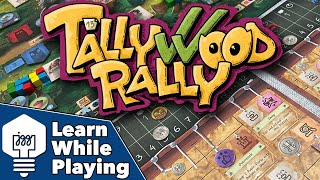

Tallywood Rally Deep Dive
What the Community Thinks About Tallywood Rally
Commentary on Tallywood Rally is still thin, and the most substantial coverage comes from the Getting Games channel. Its full rules tutorial plays a complete session while the host explains each step, and it closes by stressing that the game rewards players who watch their opponents closely. That is a teaching observation rather than a verdict, so the tutorial reads as a guide to the game more than a recommendation. The channel's monthly update offers a more tentative first impression. There the host had only read the rules, described the game as a cube rails title built around voting politics, and said they hoped to get it to the table "while it's fresh on my mind."
The Board Gaming Ramblings channel also mentions the game in a video about unplayed titles in its collection. The hosts had read the rules while hunting for another game to fill the table, and time never allowed a session. That discussion says little about how the game plays, so it tells you more about where the title sits on a busy shelf than about its design. The coverage so far is curious and detailed, but it consists of a teaching playthrough and a pre-play impression, so the community verdict on Tallywood Rally remains open.
Core Mechanics That Define Tallywood Rally
Strategy cards, string connections and actions
Each turn a player selects one strategy card from hand and places it into an empty column on their player board, choosing a top, middle or bottom slot. Icons on the card and on the board are joined by lines of string that run back to fixed nails, and only icons on a connected string activate. The tutorial host works through this placement choice on the first turn, settling on the middle slot because it connects two coins, while one alternative would have produced no coins at all. Position is therefore the first real decision of every turn.
Activated icons feed an action economy built around the assistant. A player sends an assistant to one of the colored districts or to the Plaza, and every action taken that turn targets that district. Public Works spends coins to build levelled tiles that supply strength, Celebrity spends coins and popularity to place a tile that adds a polling advance and draws voter cubes, Research flips a face-down tile to reveal it and can pull a cube from the Plaza, and Campaign spends popularity for polling. A wild action is always available and pays one coin for each strength in the chosen district. Assistants also block: after acting, a player can leave an assistant on a performed action space so no one else can use it for the rest of the round, and the leftmost blocker wins ties in strength.
Polling tracks, voter shares and the final tally
Polling advances move tokens left to right along each district's track, and reaching a voter share marker grants a share of that district's votes. Voter cubes are worth two votes apiece at the end of the game, and any cube still sitting in the Plaza migrates to the district matching its color. The final tally works like a dividing machine: a district's total votes are split among all the shares in it, and a table printed on the back of the rulebook converts votes into votes per share. Endorsement tokens add fixed votes on top, and round scoring keeps the pressure on because the strongest player in each district earns a polling advance and, in the last round's scoring, a full voter share. The host's worked example ends with the candidate far ahead of the rivals, showing how heavily a single district can swing the result.
The Tallywood Rally Experience
Watching the table as much as your own board
The tutorial's play-through is built around reading opponents. The host repeatedly notes when a rival has spread too thin or piled into one district, and the closing lesson is that the best moves come from capitalizing on the investments other players have already made. Blocking, strength majorities and certain cards that let players swap Public Works mid-game mean a plan rarely survives untouched. Early rounds are about spreading strength across districts, and later rounds narrow into contests over specific areas where a few extra cubes or a single tie-break can decide who holds the majority.
Turn order, timing and the final reveal
Initiative tokens change hands during cleanup, so the player who went first in one round can find themselves last in the next, and the host points out that going first can cost a player a strength majority. Face-down tiles are flipped during play or during final scoring in initiative order, and timing matters because a celebrity flipped while no matching cubes remain in the Plaza yields nothing. Cube colors rarely match the district they land in, so pulling cubes out of the Plaza becomes a race against rivals who want the same ones. The game comes with a dry erase board that keeps the arithmetic readable as the final votes add up.
What Makes Tallywood Rally Stand Out
A campaign theme with real political machinery
The premise casts each player as a campaign manager working to get a politician elected in Tallywood, which the host calls the birthplace of democracy within the five Realms. The word "campaign" refers to this political setting rather than to a legacy structure. The tutorial presents one standalone session that runs through a full set of rounds and ends in a vote, with no linked scenarios carried between games. Districts, celebrities, public works and endorsements all map onto campaign activities, so the theme is carried by the mechanics rather than pasted on top of them.
Market logic dressed up as an election
The update host first assumed Tallywood Rally was a racing game, then found that it is about voting politics built on something closer to a market. The host describes the voter shares as stock in four districts that behave like companies, and the tutorial's final tally uses the same language, labeling each district's totals as a company with its own votes-per-share figure. The update identifies Final Frontier Games as the publisher that sent the review copy, and the host plans to cover the game in a follow-up video.
Potential Drawbacks
Heavy end-game bookkeeping
Final scoring is the most demanding stage, and the host spends real time on it. Remaining face-down tiles flip in initiative order, cubes are doubled into district totals, unclaimed endorsement values are added, shares are tallied per district, and votes per share are rounded up to whole votes. The host also builds a deliberately lopsided example to show what happens when a district runs past the printed grid on the rulebook, which makes clear that the lookup table has limits. Players who dislike spreadsheet-style tallies will find this stage the least forgiving part of the game, and the emphasis on the timing of the final flips means small mistakes are easy to make.
Limited table time and no group verdict
Community momentum is limited more by time than by any specific design complaint. The update host had not yet played the game with other people when the update was recorded, and the Board Gaming Ramblings hosts describe reading its rules while searching for something else to play. Neither video reports a particular rules complaint, but the absence of a group verdict means prospective players should expect a learning curve around the bookkeeping and a long final reckoning rather than an established reputation.
If You Enjoy Tallywood Rally
Neither video draws a direct comparison to another title, so the most useful guide is the play pattern the transcripts describe. Players who enjoy tracking opponents and punishing overinvestment in one spot will find the tutorial's closing lesson most relevant. Players drawn to market-style share ownership will recognize the update host's stock framing, and the host noted that the cube rails and string-card design seemed like their kind of thing. Anyone comfortable with a demanding end-of-game reckoning should feel at home, while players who prefer quick turns may find the chain of connected actions and blocking choices slower going.
What Reviewers Are Saying
"this is very much a game where you want to pay attention to what your opponents are doing and make sure to capitalize on the various efforts they've put in"
— Getting Games
"the timing of when these get flipped is important if you flip over a celebrity and there are no matching cubes in the Plaza then you don't get any benefit for that"
— Getting Games
"the way you actually win elections is by getting voter shares AKA shares of stock and for their different districts the voters vote depending on how many voter Shares are out there essentially there are four different companies and you can buy stocks in them"
— Getting Games