



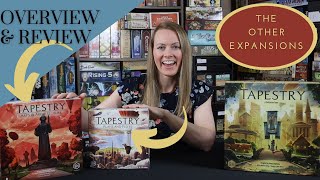


Tapestry: Fantasies & Futures Deep Dive
What the Community Thinks About Tapestry: Fantasies & Futures
Reviewers welcome Tapestry: Fantasies & Futures as the third and final expansion to Stonemaier Games' beloved civilization-building engine, bringing thematic breadth to the series without attempting to overhaul core mechanics. The expansion is positioned as a refinement and expansion of what players already love: more civilizations, more card variety, and the cohesion that comes from a comprehensive rulebook. While it does not introduce sweeping systemic changes like earlier expansions, reviewers consistently praise it as a solid addition that increases replayability and thematic variety, particularly through its sci-fi and fantasy flavor. The community consensus is that this is a worthy capstone to the Tapestry expansion line, best suited for players who already embrace the base game and want to deepen their engagement with it.
Core Mechanics That Define Tapestry: Fantasies & Futures
The Charm Mechanism
The charm system emerges as the mechanical centerpiece of this expansion, providing elegant one-time bonuses when tapestry cards are played. Reviewers describe how charms reward players who line up their plays strategically; each charm triggers when a card is placed, offering resources, victory points, or card draws. What excites reviewers most is how charms layer onto each other when multiple cards with charm icons are played in sequence, creating cascading engine-building moments. One reviewer noted that charm bonuses can activate on either side of a tapestry card when a new card is placed adjacent to it, meaning a single card play can unlock multiple small bonuses. This mechanic keeps the game's engine-growth feeling alive across the later game phases and rewards forward planning.
New Civilizations and Advanced Capital City Mats
The expansion delivers 10 new asymmetric civilizations, all themed around fantasy and sci-fi concepts, alongside six additional advanced capital city mats that introduce new board layouts and mechanics. Reviewers rhapsodize about the civilization variety: the Illuminati can place dice on their board to harvest rolls from other players; merfolk, artificers, and genies each offer distinct play patterns; and Elder Ones and psionics fulfill more esoteric roles. Reviewers note that even after playing Tapestry dozens of times, the new civilizations feel genuinely different and worth replaying for. The advanced city mats introduce spatial puzzles unique to each layout, such as Ley lines, unicorns in the savannah, and a city-in-a-bottle that reshapes the scoring grid entirely. These additions extend the replayability promise: there are now far more viable strategies available in each game session.
The Tapestry: Fantasies & Futures Experience
Thematic Immersion in Sci-Fi and Fantasy
The expansion draws players into parallel universes through its thematic architecture, weaving together science fiction, fantasy, and comic book aesthetics. Reviewers highlight the excitement of drawing cards that reference X-Men, superhuman abilities like teleportation and mind control, and fantasy tropes like genies and merfolk. This thematic coherence extends to the advanced city mats, each featuring evocative fantasy art. The flavor text speaks of dimensional breaches and magical forces, grounding the expansion in a clear narrative identity. For players who love the civilization-building spine of Tapestry, this thematic richness provides a reason to reach for the new components: every shuffle of the card deck holds the possibility of discovering an ability with narrative weight.
Engine-Building Satisfaction Through Cascading Bonuses
Reviewers consistently emphasize the engine-growth satisfaction that charms and new tapestry effects unlock. By clustering charm-bearing cards or chaining benefits across multiple cards, players can generate elaborate cascades of resources and victory points. One reviewer described this as the most exciting part of the expansion: watching a single well-timed card play unlock a chain of bonuses that accelerates progress toward victory. This mechanic appeals to players who love the "combo" side of board games, where preparation and timing intersect. The expansion also introduces late-game payoffs reserved for the final income turn, giving players incentives to plan several rounds ahead. Reviewers note this extends the puzzle-solving nature of Tapestry without complicating the turn structure.
What Makes Tapestry: Fantasies & Futures Stand Out
A Comprehensive Unified Rulebook
Reviewers single out the rulebook as unexpectedly thrilling, praising how Stonemaier Games consolidated the rules for the base game and all three expansions into a single, smaller, more manageable volume. This achievement addresses a pain point many players face: juggling multiple rulebooks across the table when mixing expansions. The new rulebook includes conditional setup instructions for each expansion combination, an icon reference guide, and clear guidance on which rules apply when certain components are in play. One reviewer called the rulebook "the most exciting thing from an expansion," highlighting how it removes friction from what is already a favorite game. This alone makes integrating the expansion worth it for players who own multiple Tapestry boxes.
Dramatically Increased Replayability
With 10 new civilizations, 6 new advanced capital city mats, 38 new tapestry cards, and 12 new tech cards, Tapestry: Fantasies & Futures provides a massive expansion of strategic options. Reviewers emphasize that even veteran players have barely scratched the surface of all available civilization combinations. One reviewer described the game as potentially becoming a "Desert Island game," the kind of experience that grows richer with each play rather than stale with repetition. The sheer number of new options means that shuffled decks feel meaningfully different from game to game, and players will spend years discovering new synergies between civilizations, capital mats, and card combinations. This expansion promises to keep the core game fresh for players who have exhausted the original offerings.
Potential Drawbacks
Less Transformative Than Prior Expansions
Reviewers acknowledge that Fantasies & Futures does not fundamentally reshape how Tapestry plays the way earlier expansions did. The second expansion, Arts and Architecture, introduced an entirely new track and new resource interactions; Fantasies & Futures instead adds breadth through more of the same systems already in place. Reviewers describe it candidly as a "stuff expansion," meaning it supplies more cards, more civilizations, and more capital mats rather than novel mechanics. For players seeking a transformative leap in gameplay, this expansion may feel incremental. However, reviewers note this is not a failing; it is simply the design choice appropriate for a final expansion that must remain compatible with the game's core identity.
Advanced Capital City Mats Require Strategic Literacy
While reviewers celebrate the advanced capital city mats for their innovation, they caution that first-time players should receive basic mats instead. The new mats introduce complex spatial logic and unique bonus tracks that demand familiarity with how the income phase rewards players. Reviewers recommend saving advanced mats for experienced players to avoid rules friction early in teaching sessions. Additionally, some reviewers note that while the thematic art on advanced mats is evocative, the mechanical clarity of their designs is secondary to aesthetics, meaning players must study them before play to understand their rules interactions fully.
If You Enjoy Tapestry: Fantasies & Futures
If Tapestry: Fantasies & Futures resonates with you, the natural entry point is the Tapestry base game, which provides the foundation upon which all expansions build. The core game's blend of multiple advancement tracks, asymmetric civilizations, and engine-building will feel familiar once you master the expansion. For further exploration of the Tapestry universe, Tapestry: Arts and Architecture introduces the arts track and a different flavor of cards, representing the second expansion in the series. Both prior expansions integrate seamlessly with Fantasies & Futures, and reviewers note that playing with all three expansions simultaneously creates an even richer decision space, though this approach is best reserved for experienced players.
What Reviewers Are Saying
"The thing I like about these cards is that there are charm bonuses. Oh, the charm bonuses are so cool. They're the coolest because you get to have the thing on the left or the right or both of them if you place down a tapestry card on that particular side of it."
— Tabletop Tolson
"I just like the themes as well because it draws on science fiction, it draws on things like from comic books as well. X-Men are in there, so anytime you get one of those cards it's really exciting. And I love that now everything is in one rule book which makes it so much more streamlined."
— Allies or Enemies
"There are 10 new civilizations, and the civilizations get you cool asymmetric abilities and bonuses throughout the game. There are six six Advanced city capital Maps. There are 38 new tapestry cards. One of the cool things, the new sort of mechanisms that it adds into the game, is there are charms on the some of the tapestry cards, and charms are onetime bonuses that you get when you play the tapestry card. So you'll get the benefit of whatever the tapestry card says, but then this charm icon will give you a cool special onetime bonus when you play the card. So I love bonuses, it's fun when you combo bonuses together."
— Grant Lyon