





































Tea Witches Deep Dive
What the Community Thinks About Tea Witches
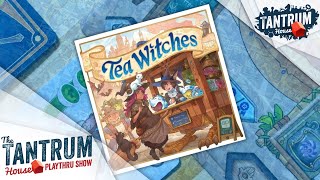
Tea Witches has sparked genuine enthusiasm among board gamers, though reactions are nuanced. The game is praised for its gorgeous artwork by Sandra Tang and its whimsical theme, but reviewers consistently highlight its surprising complexity beneath that charming aesthetic. Many players find it more demanding than its cozy presentation suggests, with some describing it as a cerebral puzzle wrapped in a delightful package. The consensus suggests Tea Witches appeals to a specific audience: those who enjoy spatial optimization and don't mind extended playtime with smaller player counts.
Core Mechanics That Define Tea Witches
Push Your Luck Summoning Phase
The summoning phase opens each round with genuine tension. Players flip cards from their personal decks to attract witches to their tea stalls, building their customer line with each reveal. However, flipping two witches from the same coven causes a "hex," forcing discard of unprotected cards. This risk-reward decision sits at the game's heart: push for more customers and resources, or play conservatively to preserve your current gains. The mechanic creates those thrilling moments where players decide whether one more flip is worth the risk, complete with the satisfaction of successful pushes and the genuine sting of busted hands.
Worker Placement with Teapots
The action phase sends teapots out as workers to various boutiques around the fair. Each boutique offers different actions, filling teapots, rotating the central tea fountain, gathering upgrades, purchasing special abilities. The teapots themselves are elegant workers: some have infinite tea generation built in, removing the scarcity that might otherwise punish players. Players place these workers to collect specific tea colors and toppings needed to serve their summoned customers. The system creates overlapping layers of decisions about which boutique locations to prioritize and how to efficiently chain actions across multiple teapots.
The Tea Witches Experience
Coziness Meets Crunchy Decision-Making
Tea Witches succeeds in marrying opposing tones. The artwork, theme, and pacing evoke relaxation and whimsy with its witches, celebrity puns, and charming teaquinox fair setting. Yet underneath sits a genuinely demanding game with meaningful trade-offs. Reviewers describe getting unexpected strategic depth from what looked like a light filler, with players building storage upgrade engines that generate multiple tea types simultaneously. The challenge feels rewarding rather than punishing, creating sessions where players leave feeling satisfied by the puzzle they solved, even if the time investment was larger than anticipated.
Beautiful Production That Demands Table Space
The game commands attention when set up, featuring evocative illustrations that transport players into Sandra Tang's enchanting world. Every card carries personality, from the witch customer designs to the themed celebrity parodies. However, the board footprint is substantial, requiring significant table real estate for the central fair layout plus individual player boards. Some colorblind players have reported difficulty distinguishing tea token colors in certain lighting, suggesting room for accessibility improvements. The production choices prioritize aesthetic appeal over compact design, making Tea Witches feel like an event rather than a casual filler.
What Makes Tea Witches Stand Out
Unique Mechanical Identity
Tea Witches refuses to fit neatly into standard category boxes. While it contains worker placement and set collection elements, the combination creates something distinct. The push-your-luck summoning paired with the spatial puzzle of filling storage upgrades generates decision space unlike most comparable games. The to-go order tracking creates additional layer where players must monitor shared objectives after every single turn. This complexity can feel administrative during multiplayer games, but when playing with one or two others, the puzzle becomes beautifully cohesive.
Sandra Tang's Collaborative Design Excellence
Sandra Tang, who previously illustrated the beloved Flamecraft, brings her signature style to Tea Witches alongside designer Manny Vega. The collaboration between designer and illustrator feels intentional and deep, with every thematic element earning its place. The magical teapots become functional game pieces while maintaining charm. Celebrity customer puns feel earned rather than forced. The whole world suggests careful world-building that extends beyond the necessary components, creating a game that players feel comfortable spending time with even during longer sessions.
Potential Drawbacks
Player Count and Playtime Scaling Issues
Tea Witches' greatest weakness emerges with larger groups. At two players, the game breathes, with downtime minimal and the puzzle space tight and satisfying. Adding a third or fourth player transforms the experience dramatically. Multiple reviewers noted that waiting between turns becomes increasingly painful as players carefully optimize their placements. The to-go order tracking mechanic, which requires checking after every player turn rather than just the active player's turn, compounds the downtime issue significantly. Sessions at four players routinely stretch toward three hours, with some groups abandoning the game before completion. The game genuinely improves with two-player dueling but suffers measurably in larger groups.
Rules Complexity and Accessibility Barriers
Despite the approachable theme, Tea Witches carries surprising rules overhead. Teaching sessions regularly exceed 40 minutes, with clarifications needed throughout early plays about interactions between mechanisms. Edge cases emerge regarding magical tea versus hut-stored tea, loyalty coupon usage, and generator upgrade interactions. Multiple reviewer groups experienced moments where a misunderstood rule invalidated significant portions of their strategy. The rulebook, while illustrated, requires careful reading that contrasts with the breezy theme. This accessibility gap means Tea Witches appeals primarily to experienced gamers comfortable with learning curves, limiting its utility as a gateway game despite its inviting presentation.
If You Enjoy Tea Witches
Fans of Tea Witches should explore Critter Kitchen, which shares Sandra Tang's artistic sensibilities and similar resource-gathering themes but plays significantly faster with a push-your-luck midnight market mechanic that creates tension without administrative overhead. Flamecraft, the predecessor, offers a lighter alternative with similar boutique-visiting action spaces. Those seeking deeper engine-building experiences should investigate Puerto Rico for its elegant role-selection system, or Delve and Gnome Hollow for more strategic creature-collecting experiences. Horrified offers cooperative puzzle-solving with faster pacing, while Calico and other Flat Out Games provide satisfying spatial puzzles with shorter play times.
What Reviewers Are Saying
"Tea Witches is gorgeous. Sandra Tang's art is instantly recognizable, soft, whimsical, and full of personality. It's like Flamecraft on steroids. The core of visiting shops is familiar, but there is so much more to consider. The push your luck of summoning, the teapot's infinite storage, and all the ways to combo your upgraded storage and your orders. It's cozy, but very crunchy."
— Let's Table It
"Tea Witches is a strange game. It doesn't really categorize like other games. What I really like about it is its unique nature. It's not worker placement how you think and it's not deck management like you think. It just does things differently. The first round, people are a little bit like what do you do here? Then after one round, you're like oh, okay, I get it, and you have to reprogram your brain to work around the strategy."
— Going Analog
"When we played Tea Witches at two players, honestly, it was a decent game. The downtime wasn't bad. But the moment we added a third and fourth player, the game collapsed under its own weight. Downtime increases linearly with every person. Critter Kitchen, we played that with three, then four, and the play time barely moved. Tea Witches is a solo puzzle that forces you to watch other people solve theirs."
— Board Game Critique