
/pic4740642.jpg)
/pic4298146.jpg)
/pic2564213.jpg)















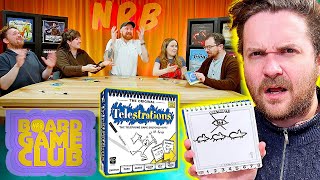


Telestrations Deep Dive
What the Community Thinks About Telestrations
Telestrations occupies a special place in the modern board game landscape. Reviewers across multiple channels consistently describe it as a classic, and for good reason. This is one of those rare games where the community sees almost total consensus, not because it's complex or strategic, but because it does one thing exceptionally well: it creates genuine, uncontrollable laughter through shared creative chaos.
Watch It Played and Foster the Meeple treat Telestrations as an essential introduction to tabletop gaming, while Grant from Grant's Game Rex ranked it fifth in his top ten party games of all time, praising it as "one of the first ones I played and probably always the one that I will come back to." The No Rolls Barred community found it reliably hilarious across multiple episodes, returning to it because, as Adam from No Rolls Barred noted, "it's an old favorite people really love it."
Core Mechanics That Define Telestrations
The Draw-and-Guess Loop
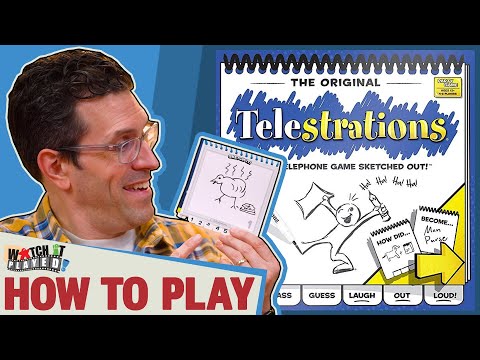
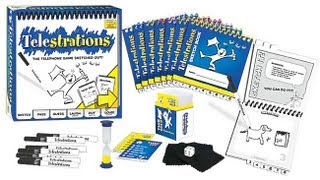
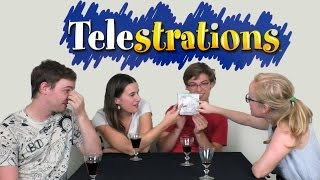
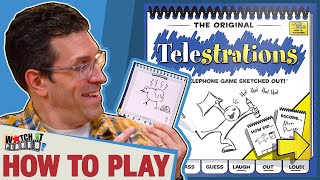
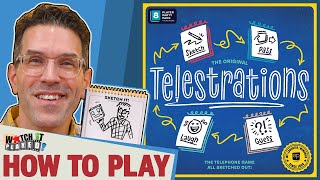
At its heart, Telestrations is a game about transformation through misinterpretation. One player writes a secret word, then passes their sketchbook. The next player draws what they think the word represents, without knowing what was written. Then comes the guess: the next player looks only at the drawing and writes what they see. This guess becomes the next drawing prompt, and the cycle continues. Rodney Smith of Watch It Played explains it plainly: players draw "based on what was written. So one person is going to write a phrase, then the next person is going to draw that, and then the next person is going to guess what they drew, and then the next person's going to draw what they guess." The beauty lies in the simple fact that each person only sees one piece of the chain. What you draw influences what others interpret, but you never know how your contribution shaped the result until the reveal.
The Pressure of the Timer
The 60-second sand timer creates urgency without stress. Foster the Meeple emphasizes that the game is "designed by the op," and the time constraint forces quick decisions that almost guarantee imperfect drawings. Grant notes the genius here: "I don't want artists in my game. I want a bunch of regular people that suck at drawing and then it's going to be hilarious." The timer prevents overthinking and produces the "bad drawings" that make the game work. As Adam from No Rolls Barred points out, "problems are kind of the point in this classic drawing and guessing party game."
The Telestrations Experience
The Hilarity of Miscommunication
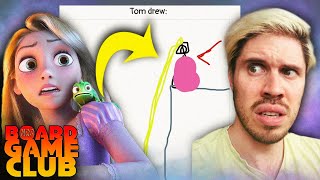
No Rolls Barred dedicates multiple episodes to Telestrations because it reliably delivers what Lori calls "the real fun of the game." When the books are revealed, players see the entire evolution from the original word to the final guess. Rodney Smith describes this moment as when "each one of the pages were filled in this will usually result in quite a few surprises as players get to see just how far from the original words or occasionally just how close to the original words that they got by the end of the book." The laughter comes from the gap between intention and interpretation. One player's earnest attempt to draw a hawk becomes a "penguin" that inspires another player to see a "bird's-eye view," which transforms again through the chain. The chain reveals not just how drawing got misunderstood, but how everyone's guesses compounded the confusion in ways nobody predicted.
A Welcoming Social Experience
Watch It Played frames Telestrations with a crucial promise: artistic ability is irrelevant. Rodney Smith tells potential players, "Are you maybe a terrible artist? Well, you know what that could be even better because we're about to learn a classic drawing and guessing party game that can be enjoyed no matter what your artistic ability may or may not be." Foster the Meeple reinforces this. Grant agrees: "I want a bunch of regular people that suck at drawing and then it's going to be hilarious." The game removes the barrier to entry that many drawing games create. There is no judgment about artistic skill because bad drawings are not a problem to overcome; they are the entire point. This makes Telestrations work at any gathering, from family holidays to office parties to conventions.
What Makes Telestrations Stand Out
It Works at Scale
Grant makes a deliberate point about group size: "This is a game I want to play with you know, eight players, ten players, twelve players all of the time." He explicitly states he would "never play Telestrations with four players and I honestly would hesitate at six players." Watch It Played includes a 12-player party pack, and Foster the Meeple notes that one version accommodates twelve players. The game is built to absorb more players, not fewer. Each additional person means more interpretations in the chain, more opportunities for divergence, and more voices to hear during the reveal. This scalability is rare and valuable for anyone hosting larger gatherings.
The Reveal Is the Game
No Rolls Barred notes that "for many players, this discovery is the real fun of the game," and nearly every reviewer echoes this. The scoring rules exist, but as Grant observes, "points don't really matter" because players rarely use them. "I could not tell you how you score the game. I haven't played with points in Telestrations in so long." The mechanical reveal, where each player shows everyone their book page by page from start to finish, is the climax. Adam from No Rolls Barred calls it "the big reveal," and Rodney Smith explains that this moment "is usually quite a fun process as each person gets a turn to show everyone beginning with the start of their book each one of the pages that were filled in." The visual chain from original word to final interpretation is where the story lives.
Potential Drawbacks
Scoring Can Confuse
While the game comes with two scoring methods (friendly and competitive), reviewers almost universally ignore them. Grant's explicit statement that he cannot remember how scoring works after years of playing reflects a broader pattern: scoring feels like bureaucracy added to a game that thrives on chaos. Watch It Played teaches the scoring rules thoroughly, but the community consensus is that the points system adds friction without value. The revelation of the drawings delivers the emotional payoff; tallying points afterward feels anticlimactic.
Requires the Right Crowd
Foster the Meeple notes that Telestrations succeeds best with people willing to embrace the chaos. Grant observes that "you definitely want to play Sheriff of Nottingham with people who want to be social, who want to bluff and lie," but Telestrations requires a different buy-in: people comfortable being publicly creative (or publicly bad at being creative). Someone who is self-conscious about their drawing ability or needs clear rules about what constitutes a "good guess" might feel anxious rather than amused. The game assumes everyone will laugh at imperfect interpretations, and that assumption does not always hold.
If You Enjoy Telestrations
Grant recommends exploring other drawing games. "Doodle Dash I love. Caution Signs is fun. Monstrosity is one of my favorite games," though he emphasizes that Telestrations "is the first one I played and probably always the one that I will come back to." For players who love the telephone mechanic without drawing, Grant also recommends Codenames ("one of the few games that adapts itself to the group that is playing it") and Wavelength ("another clue-giving game, but it also has a very fun physical element"). For players who love bluffing and social deduction, Grant names Secret Hitler and Skull as comparable experiences. If you want the party chaos without drawing, No Rolls Barred has played games like Wavelength and other clue-giving games that share Telestrations's core appeal: shared laughter through clever (or clever-adjacent) communication.
What Reviewers Are Saying
"There is a way to do points for them, but I don't remember what that is. This is essentially the game telephone where you're whispering a secret into someone's ear and it's going around the table and then it comes back to you but this is that version with drawing."
— Grant's Game Rex
"I don't want artists in my game. I want a bunch of regular people that suck at drawing and then it's going to be hilarious because I am definitely somebody that is bad at drawing and it's so much fun."
— Grant's Game Rex
"For many players, this discovery is the real fun of the game. And when you're finished, everyone can just erase their books and collect new cards to start again."
— Watch It Played