/pic5604048.jpg)
In The Court of Miracles, lead a guild of beggars, plot, use trickery and opportunism to build your renown and take over the old 16th century Paris.
Your goal is to establish your renown in Paris or to be the most influential when the Penniless King would have reached the end of his path...
At your turn, you may play a plot card, you have to place one of your (3) Rogue tokens, face down (secret ability), on any available spot in a neighborhood, and benefit from the effect of your spot (receive coins, draw plot cards or move the Penniless King forward along his path). You may then perform the action of the neighborhood.
When a neighborhood is fully occupied, settle a standoff revealing each player's Rogue(s) token to know which player takes control of the neighborhood. Controlling a neighborhood will reward you each time another player performs its action.
You will be allowed to buy a 4th Rogue, cards or move the Penniless King Forward at the Renown Square.
Unless the Penniless King reaches the last space of his path before, the first player to place their 6th Renown token wins. Otherwise, the player with the most Renown tokens placed on the board wins the game.

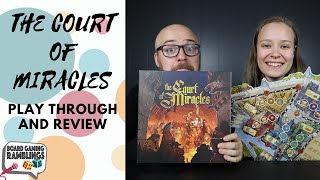
The Court of Miracles Play Through and Review

- very fast and flavorful action
- strong thematic flavor with clean visuals
- may benefit from a larger player count for full flavor
- learning curve for rules
- knife fights in a phone booth-inspired environment
- dense urban fantasy alleyway knife-fight atmosphere with area-control flavor
- fast, tense, quick rounds with tight decision-making
Mechanics (from transcript analysis)
- Area Control — contest control of zones to advance your position
- fast play — short, rapid rounds for high-pressure decisions
- solo bots — bot support for solo play
Video topics + discussion points
Quotes (from this video)
- this gorgeous pop-up book and it's its own story
- we played through the entire thing had a good time
- it's my game of the year two years ago
- I finished the rest of the story and it was a lot of fun
- it's just this knife fight in a phone booth area control style game, it's very fast very quick
- I played through an entire two chapters of the first era and I'm really excited to dive into more
- I'm going to take it with me on a trip and power through the rest of the era
- the cube Tower is actually in the box so you just put the Box on the side of the board
- you’re rolling Dice and using those dice to pick different actions
References (from this video)

- Fast, clean, fun
- Vicious but not backstabby
- Not explicit in transcript; but implied tight pace
- quick, vicious, but not backstabby
- knife fight in a phone booth vibe
- fast, aggressive but fair
Mechanics (from transcript analysis)
- fast, tactical play — Speedy rounds with high interaction; strong cutting-edge table presence.
Video topics + discussion points
Quotes (from this video)
- it's a fun interesting Twist on a word game I definitely enjoyed it
- it's a really fun game
- I beat him by three points
- this game is a knife fight in a phone booth
- it's pure chaos it is so much luck
- if you're looking for fun and smashing and driving and explosions this is your game
References (from this video)
- tight, fast-paced play with high interaction
- unique bidding/hidden information mechanic that creates constant decision pressure
- strong production values: board design, nice cards and wooden components
- scales well from 2 to 5 players and remains engaging with different player counts
- rules are concise and easy to teach
- two-player experience is notably less dynamic and can feel tighter or slower
- flipping tokens mid-game can be fiddly and a minor nuisance during play
- some may find the game feels brief and may want more depth with more players
- robbers, rogues, and beggars vying to become the city's king of thieves
- 16th-century Paris, France
- competitive, bid-based area control with hidden renown tokens and standoffs
Mechanics (from transcript analysis)
- Area Control — control of neighborhoods is determined by computed values on flipped tokens; players place renown tokens to claim control and gain rewards
- Area control / renown tracking — control of neighborhoods is determined by computed values on flipped tokens; players place renown tokens to claim control and gain rewards
- Card Drafting — each turn a player may draw and play from a small hand; cards provide situational bonuses and can alter future strategies
- card drafting / card play — each turn a player may draw and play from a small hand; cards provide situational bonuses and can alter future strategies
- Endgame trigger via King track and token management — a king-like track (the Pedaller's King) advances and reaching the end can end the game; players must remove or manage renown tokens to avoid loss
- Standoffs and bidding / power cards — turns can trigger a standoff in a neighborhood where different players' tokens compete, often aided by power cards drawn each turn that modify choices
- Token flipping / hidden information — when a area is exhausted, tokens are flipped to reveal values that influence who wins control in that neighborhood
- Worker Placement — players place rogue tokens on shared action spaces to trigger actions in their own turn and gain benefits in the surrounding districts; spaces have values that flip when fully used
Video topics + discussion points
Quotes (from this video)
- this board which kind of looks like the millennium falcon
- in decoder miracles you are placing these rogue tokens so basically it's a work replacement game
- it's very tactical
- it's a race game
- short game
- shines with more players
- the cards are really different and sometimes you get not the cards that you want