




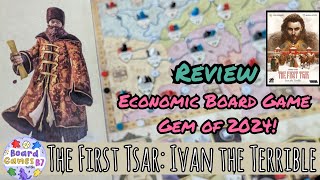
The First Tsar: Ivan the Terrible Deep Dive
What the Community Thinks About The First Tsar: Ivan the Terrible
Reviewers approach The First Tsar: Ivan the Terrible as an economic board game first, and the praise is strongest for how its systems fit together. Published by Hobby World and set during the reign of Ivan IV in sixteenth-century Russia, the game asks players to lead boyar families competing for power, wealth, and the throne. Board Games With B7 calls the mechanisms tight and engaging, describes the gameplay as extremely solid, and says the systems work together seamlessly. That same review places the game near the top of its 2024 list, and a later roundup by the same channel repeats the view that the game is very crunchy for an economic title.
The enthusiasm is not universal in tone, though. The reviewer warns that the game takes a while to learn and teach, runs at a normal pace, and usually fills two to three hours. Board Gaymes James recorded a full group session and captured the same tension: the game looked intimidating from the rulebook, yet the table found it manageable once the first round was underway. The consensus is that The First Tsar rewards players who enjoy planning across several linked systems, and that it asks more patience from groups than a lighter worker placement title would.
Core Mechanics That Define The First Tsar: Ivan the Terrible
Worker Placement
Each player starts with three workers, and every action is taken by placing one of them on a shared space on the board. Spaces can hold more than one player, but a single player cannot take the same space twice in a round. In the Board Gaymes James session, the table treated the choice of space as a choice about denial as much as gain, because a space that is already taken is no longer available to the next player. The payoff from each space ranges from producing goods in cities where a player holds influence, to exchanging two goods for one with a foreign good as a bonus, to maneuvering warriors along the rivers and picking up trade tokens.
The reviewers focus most on the popularity bid. A player can pay any amount of coins onto an action to become the most popular person in the village, which decides ties and unlocks a bonus. Since the bonus applies only twice out of a player's three actions, the choice becomes which action to leave without a bonus. Seals used for this bid return at the start of each decade, so the cost of popularity recurs throughout the game, and the table repeatedly worried about spending coins too early when the next round would come back to haunt them.
Area Control
Area control is the scoring framework that sits on top of the worker placement. Regions are scored at set points, and the player with the most influence in a region takes the largest reward while the second place player takes a smaller one. Influence comes from the pieces a player has on the board, with buildings and boyars counting for two influence and warriors counting for one. Ties are broken by the Tsar's favor, a track that the Board Gaymes James table set randomly at the start and that shifted heavily during play. The reviewer on Board Games With B7 points out that regional influence is one of several paths to victory, alongside trade and completed projects.
Reviewers are not sure how much weight area control should carry. During the session, a player on the Board Gaymes James table said the regional scoring felt less important than the contract cards, and a second player agreed while watching along. That gap between the mechanic on paper and the mechanic at the table is a useful signal for anyone deciding whether the influence system is the heart of the game or a supporting pillar.
The First Tsar: Ivan the Terrible Experience
Crunchy, Tight Economic Tension
The dominant feeling is of a tight economy. Resources are scarce, coins must be split between popularity bids, production, and trade, and every purchase has a downstream cost. The reviewer on Board Games With B7 says the game offers a satisfying level of complexity for an economic board game and describes it as very crunchy. The Board Gaymes James table captured the same squeeze in real time, with players debating whether a coin was better spent on a bid or saved for a future project and whether they had enough goods to produce before trading. That constant arithmetic is what makes the game feel engaging rather than fiddly.
Table Talk, Bribery, and Playful Rivalry
The game is also a social experience. The popularity track invites players to openly pay their way to the front, and the Board Gaymes James table turned that into running jokes about bribing the Tsar's court. Players teased one another about being the rich guy, complained about losing the most popular spot after a single bid, and laughed at moves that suddenly reversed a region's standing. The late game produced a comeback that the table compared to a Hail Mary, with a player who had been far behind finishing close to the leaders. For groups that enjoy ribbing each other across the table, the influence race becomes a source of drama as much as a scoring puzzle.
What Makes The First Tsar: Ivan the Terrible Stand Out
Art, Iconography, and Components
Presentation is one of the features reviewers return to most often. The Board Games With B7 review praises the illustrations and the use of color across the components, and singles out the game board, whose front is extremely clear while its back carries striking artwork. Iconography is described as well done and easy to read, which matters in a game where every card and space uses symbols for goods, influence, and bonuses. The wooden pieces get particular praise for their appealing look and good feel, and the box insert is called lovely as well as functional, fitting the components snugly.
Contract Cards as the Main Scoring Engine
The contract projects are the clearest source of points. The Board Games With B7 review describes completing contracts as the main point mechanic, and the Board Gaymes James session shows how that works in practice. Trade projects that require goods such as wood, stone, and fabric pay out nine points, while others pay eight, and a player can take one card and complete another in the same turn. Each card has an immediate effect and often a stronger end-of-game bonus. Because the contracts are drawn from a shared display and some refresh only at the end of a round, planning which project to pursue is a constant race against the other players.
Potential Drawbacks
A Demanding Learning Curve and Frequent Rules Checks
The most common concern is the time it takes to get comfortable. The Board Games With B7 reviewer says the game takes a bit of time to learn and teach, and the Board Gaymes James table spent a noticeable portion of its opening round checking rules. The group stopped to ask how free actions work, whether a second building can share a city, what the seals do, and how turn order is determined. The table's confusion over turn order is particularly telling, since players expected a bidding phase that did not match the way the Tsar's favor actually determines priority. Groups that prefer to learn by reading the rulebook once and playing straight through may find the early rounds slow.
Thin Solo Options and Standard-Quality Components
Two practical concerns come up as well. The Board Games With B7 review notes that no solo mode is included, which narrows the game to group sessions and leaves solo players with nothing to do between tables. The reviewer also says the cards, boards, and player pads are of standard quality, and that thicker components would have been nicer, even though the wooden pieces were well made. For a game with this much tracking and card flow, reviewers would welcome a deluxe edition with sturdier materials and a way to play alone.
If You Enjoy The First Tsar: Ivan the Terrible
Board Games With B7 links The First Tsar to Endless Winter and Nova Roma through their shared designer, which makes both natural next steps for players who enjoy the crunchy economic tension this game delivers. Endless Winter fits readers who want another title that combines planning with tight resource management, while Nova Roma suits players who like building a strong economic engine across several linked systems. Both are the logical follow-ups for a group that finished this game wanting more of the same balance between careful arithmetic and table-level interaction.
What Reviewers Are Saying
"I must say it is one of the best economic board games I have played in 2024 and for quite some time too."
— Board Games With B7
"I feel like the area control is really not that important, much more in these contract cards."
— Board Gaymes James
"It's a very simple worker placement resource collection with some area control."
— Board Gaymes James