


The Hare and the Tortoise Deep Dive
What the Community Thinks About The Hare and the Tortoise
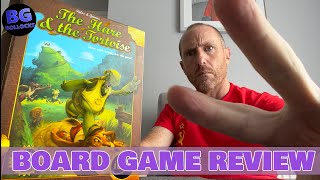
Reviewers describe The Hare and the Tortoise as a light, quick racing game whose main strength is its theme. BoardGameBollocks, in a dedicated review that asks whether the game is still worth playing, concludes that it is, while being frank that it is small and simple. The reviewer calls it a very quick game that nobody will agonize over, one that is over before you know it and that gives a couple of thrills now and then. The modern edition under discussion was first released in 2015, according to that review.
The Chairman of the Board takes a more reserved view. In a year-end round-up of games played for the first time, Chairman of the Board gives the game a 5 out of 10 and describes it as an older game, adding that the reviewer tends to score harsher than BoardGameGeek. The channel reviews the title only briefly, so that score reflects a quick impression rather than a full discussion.
BoardGameBollocks also covers the game in a run-through of its collection, calling it a wonderful racing game in which players bet on fairy-tale animals, move them with cards, and try to finish first, second, or third while hindering rivals. The shared view across these discussions is that the theme and the table presence are appealing. The main reservations concern how much control players have over the outcome. Coverage is concentrated in one channel, so this consensus is a narrow sample rather than a broad critical verdict.
Core Mechanics That Define The Hare and the Tortoise
Card-Driven Animal Movement
Each player is dealt a hand of racing cards and, on a turn, plays one to four of them face out before drawing back up to six. A racing phase is triggered once eight or more cards have been played, or once four cards of the same animal have appeared. During that phase each animal moves by its own rule. The hare advances two track tiles when one to four hare cards are played, but when four are played while the hare already leads, it takes a nap instead. The tortoise moves one tile on zero to three tortoise cards and two tiles on four. The wolf advances one tile on one or two wolf cards and as many tiles as the number played when three or four are used. Howl cards allow only the wolf to move in the next racing phase. The fox moves by the number of fox cards played, and the lamb moves its land cards plus one, although it must stop at water.
BoardGameBollocks points out that these rules are where the source fable lives. Each animal's movement echoes its character in the story, and the reviewer treats that link between mechanism and narrative as the reason the racing system works.
Hidden Animal Bets and Podium Scoring
Each player receives a betting card and places one of their racing cards face down, which can match the animal on the bet. The race continues until three animals occupy the three podium spaces. Players then reveal their betting cards, and a player earns 5, 3, or 1 points when the animal on their card finishes first, second, or third. Because the bet is chosen before the cards are played out, the scoring rewards reading which animals are moving well as the race unfolds.
The Hare and the Tortoise Experience
Lighthearted Fairy-Tale Charm
The table feel is playful and unpretentious. Reviewers praise the chunky animal pieces, the artwork on the track, the small three-dimensional podium where finishers are placed, and the finish marker that adds to the sense of occasion. Players can arrange the track tiles into any linear shape they like. The reviewer admits this changes nothing mechanically, but it adds a little pleasure to setting up the course. The overall mood resembles a children's story brought to the table, with the arrogant hare, the plodding tortoise, the howling wolf, and the nippy fox all reading clearly on the board.
Quick Tension Built on Luck
The game runs briskly, and its tension comes from hoping the right cards arrive at the right moment. Players typically back one or two animals and then wait for the draw to carry them home. BoardGameBollocks describes the satisfying moment when a fox can be powered through the opposition to take the first podium place, and frames the game as a tight race that does not demand much thinking. For players who want a fast game with a clear finish, that rhythm of anticipation and sudden reversal is the point.
What Makes The Hare and the Tortoise Stand Out
Movement Rules That Match the Source Story
BoardGameBollocks names the theme as the first thing it likes about the game. The reviewer praises the way the design takes a fairy-tale style setting and makes each animal's movement reflect its role in the story. The hare's overconfidence produces a nap, the tortoise's slowness produces single steps, and the wolf's howl changes which animal is allowed to act. The reviewer argues that this alignment of mechanism and theme is exactly what players should want from a game of this kind.
Components That Support the Theme
The second thing BoardGameBollocks likes is the production. The large, chunky animal pieces, the attractive track artwork, the three-dimensional podium, and the finish marker all receive praise. The reviewer says the components are matched well to the theme, which reinforces the sense that the game was built around its fable from the start.
Potential Drawbacks
A Box That Does Not Hold Its Contents
The most physical complaint concerns packaging. BoardGameBollocks describes the box as a book-shaped design with nothing to keep the lid closed, so that picking it up can spill the components across the floor. The reviewer compares the annoyance to tin-style games such as Forbidden Island, where the lid does not stay shut. The practical advice is to handle the box carefully when lifting it from the shelf.
Luck and Dead Cards Late in the Game
The most substantive criticism is that the outcome depends heavily on the card draw. Players cannot discard or redraw to mitigate a poor hand, and none of the animal abilities soften that randomness. The problem sharpens near the end of the game. Once the fox has finished, fox cards drawn into a hand are effectively useless, because nothing can be done with them. The reviewer concludes that a player who receives the right cards at the right time will likely win, and treats this as a real weakness.
If You Enjoy The Hare and the Tortoise
Reviewers did not name a direct comparison game for this title, so the qualities that define it offer the best guide. Players who enjoy The Hare and the Tortoise tend to appreciate short, low-commitment racing games with a clear, recognizable theme. They are comfortable with a game in which the draw matters more than any single decision, such as which animal to back or when to push a leader. Fans who enjoy seeing fairy-tale characters turn into distinct movement rules, and who take pleasure in chunky pieces and a podium finish, are likely to find the same satisfactions here. Groups looking for deeper strategy or tight control over outcomes will probably want something else.
What Reviewers Are Saying
"The first thing that we really like about this is the theme. They've done really well to take a fairy tale style theme and make the movement of each of the animals sort of thematic in terms of what they do in the fairy tales."
— BoardGameBollocks
"There's nothing you can do to mitigate what you've got in your hand. You can't say you've discard a certain number of cars and pick up new ones."
— BoardGameBollocks
"I tend to skew a little bit harsher than something like Board Game Geek, where normally a six for me is like a seven for Board Game Geek."
— Chairman of the Board