




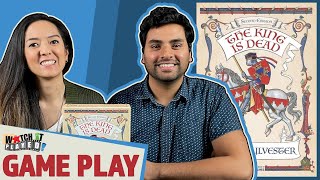




The King Is Dead: Second Edition Deep Dive
What the Community Thinks About The King Is Dead: Second Edition
Reviewers and play channels largely agree that The King Is Dead: Second Edition, designed by Pierce Sylvester and published by Osprey Games, is a short, sharp game that delivers more tension than its size suggests. Board of It gave it their "Game of Thrones in under 45 minutes" award and described it as an instant hit in their group, praising how the table goes quiet while players agonize over which two cubes to swap. The Cardboard Herald placed it among the games most often taught on the channel, noting that newcomers tend to underestimate it until the end of their first session.
The strongest point of disagreement concerns whether the game is more satisfying as a puzzle or as entertainment. Rolls in the Family listed it among games they had decided to part with, arguing that the design is clever but that the play often feels more interesting than fun. Watch It Played keeps its rules teach neutral, focusing on how the three factions compete for influence. The reviewers who enjoyed it most tend to be the ones who relish the fluid, reactive decision making, while those who did not connect with it usually cite abstraction and a lack of memorable moments. Table size is another common theme, since the four-player format draws the most concern.
Core Mechanics That Define The King Is Dead: Second Edition
Negotiation
Negotiation in this game is less about table talk than the term might suggest. Instead, it runs through the Negotiate action card, which lets a player swap the positions of two face-up region cards along the outside of the board. The player then places a white negotiation disc on one of those regions, which prevents that region from being swapped again. In their playthrough, Watch It Played showed how one early Negotiate play rearranged the contested order and protected a region from being undone, which made the card feel like a timing tool rather than a bargaining chip. Pierce Sylvester's design uses this card to reward players who think ahead about which power struggles they can influence and which they should let resolve on their own terms.
End Game Bonuses
The game's final scoring is the element reviewers return to most often, because the ending determines the winner. The game can end in a coronation, where the faction controlling the most regions takes the throne and the winner is the player with the most influence over that faction. Or it can end in a French invasion, where the winner is the player with the most complete sets of Scottish, Welsh, and English followers. Board of It noted that the tiebreakers are easy to overlook and that players need to know all of them, because ties are common. Reviewers agree that this endgame structure is what turns ordinary cube placement into a long-term plan.
The King Is Dead: Second Edition Experience
Tense
Tension is the feeling most reviewers describe. Because each power struggle resolves in a fixed order, and because the regions that remain are visible to everyone, players spend most of the game calculating how many action cards they can afford to commit before the next region resolves. Board of It described the experience as walking a very thin line, where the more influence a player builds over one faction, the fewer cubes remain to win the other regions. In the Watch It Played playthrough, the two players ended on a tie-break decided by the most recent power struggle, and the hosts were openly anxious about running out of cards with the final region still unresolved.
Political
The game is political in the sense that players never represent a faction directly. They instead manipulate the strength of the three factions so that the one that wins is the one they have influence over. The Cardboard Herald described the feeling as making them feel Machiavellian, since every turn involves speculation and manipulation of the board rather than straightforward combat. Reviewers who enjoy this atmosphere tend to appreciate that the game rewards subtle positioning over open aggression.
What Makes The King Is Dead: Second Edition Stand Out
Quick to Teach, Hard to Predict
The most consistent praise concerns how easy the game is to explain compared with how much it holds attention. The Cardboard Herald noted that the game can be explained in about five minutes, yet players finish a session wanting another. Board of It made a similar point about the rules, praising how a board of three colored cubes can still produce a game where no one can reliably forecast the board state on their next turn. That combination of low setup friction and high unpredictability is what reviewers repeatedly cite as the reason the game gets pulled off the shelf.
Design with Checks and Balances
Reviewers also single out the balancing act at the heart of the design. Rolls in the Family praised the design as fascinating, pointing to the fact that every cube you add to help one faction also weakens it when you remove a cube from the board, and that every move risks accidentally aiding an opponent. Even reviewers who found the game less fun than they hoped acknowledged that the internal logic is unusually elegant.
Potential Drawbacks
Abstraction Can Outweigh Fun
The most common criticism is that the game can feel more interesting than enjoyable. Ryan of Rolls in the Family placed it in a category of games that are fascinating to read about and to analyze, but which did not produce enough fun to justify keeping them. Because the game is so abstract, there is little theme to hold onto between turns, and some players find that the tension of the endgame arrives only after a long stretch of careful but unemotional calculation.
The Four-Player Format
Reviewers consistently prefer the two- and three-player games. Board of It described the four-player version as a strange team game in which teammates cannot communicate, which makes the already complex shifting board even harder to navigate. The reviewer recounted a four-player game where a teammate's misread of the win conditions led to frustration, and concluded that the team format works best only for experienced groups.
If You Enjoy The King Is Dead: Second Edition
Players who enjoy the area control and influence tracking of The King Is Dead: Second Edition should look at King of Siam. John Gets Games explained that this edition is a re-implementation of King of Siam, the 2007 design by the same designer, so the two share core ideas about manipulating faction strength through card-driven actions. Players who appreciate the way The King Is Dead rewards careful timing and punishes overcommitment will find King of Siam a useful companion for comparing how the original approached the same tension.
What Reviewers Are Saying
"It's a game where I can explain it in about five minutes to anyone and they're going to be like, I don't know that there's really that much game in here, and then by the end of the game they're like, dude, we gotta play that again."
— The Cardboard Herald
"The design is fascinating. It's really mind melting because it's such a fine line between helping yourself and accidentally helping other people."
— Ryan, Rolls in the Family
"The best thing to do will change non-stop, and you very likely will start by pursuing one strategy and then you'll throw it away and do something else, and then in the last moments of the game you'll be doing a totally different thing as well."
— Board of It