/pic4147965.jpg)
In AD 1096, hope fills the air like a bird's song after a long winter, the seeming endless road of the Dark Ages may soon come to an end. For years now, warlords have roamed the land, every surface is covered with filth, and disease has ripped through towns like great tornadoes. King Sivolc has dreamed that building a great gothic structure is the answer to leave this Dark Age behind forever. But for the last decade, there has been a massive decline in the building activity, and hardly any great cultural achievements have been made.
Recently, while on one of his crusades, King Sivolc met a master architect named Elias. Elias told the King about his devotion to the mortar arts and how he longed to build a structure so great that people would travel hundreds of miles just to gaze at it. This meeting created a spark that ignited the King’s dream with a fire that would burn away even the darkest of days forever. King Sivolc looks on from his castle and watches with great expectation as his dream becomes a reality. With Elias’ help, he has hired some of the greatest architects and monks in the land to complete this task. He waits patiently for this great abbey to be raised from the earth, filled with people, changing the course of history forever!
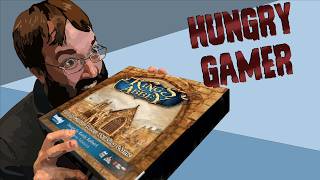
The King's Abbey is a worker placement/resource management game in which each player has their own player board that represents the abbey they have been tasked to build. Players take charge of monks that are represented by ten dice as they go out and gather resources, go on crusades, construct buildings, train clergy, bring in peasants, and defend their abbey against the darkness. Each player does this by rolling their dice and then assigning each die (monk) to different places on their player board, resource boards, and crusade cards. The places on the player boards will bring in peasants and train clergy. The places on the resource boards will give them wood, grain, stone, and sand for building the various parts of their individual abbeys.
Each player receives prestige (victory points) for completing crusades and constructing various things in their abbey such as towers and different kinds of buildings. The game proceeds over a total of seven rounds where the "darkness" becomes greater each round. The darkness represents things like depression, famine, raiders attacking, and other things that the Dark Ages brought with it. You fight the darkness by keeping the defenses of your abbey strong. Players are trying to have the most prestige than any other player by the end of the seventh round.
After seven rounds, players add up all prestige earned. Whoever has the most prestige wins the game!

- Enjoyable dice placement mechanics
- Many options for actions on a turn
- Mostly plays on individual player boards with less direct competition
- Clever use of dice for crusades
- Resources are hard to get, requiring planning and precise number placement
- Numbers on dice really matter and require math
- Enjoyable defense against despair mechanic
- Option to temporarily boost defense
- Large variety of buildings
- Clever building doubling up mechanic
- Enjoyable crusade opportunities
- Satisfying solo game mechanics
- Solo game has clever resource management using opponent's dice
- Solo mode is only 'beat your own score' with no scoring chart
- Low-end production with thin cardboard chits and wooden cubes
- Game feels a little unfocused with multiple elements (Vikings, darkness, crusades, buildings)
- Viking attacks lack variety
- A lot of phases and a strict order to remember
- Building variety can cause downtime as players look up card effects
- Building an abbey to defend against loss of hope, faith, and external threats.
- Medieval times, facing darkness and Viking attacks
- Euphoria
Mechanics (from transcript analysis)
- Area Control — Competing for resources on the main board and potentially for bonus points during Viking attacks involves an element of area control or priority.
- Dice Placement — Players place dice on various spots on the board or their player board to gain resources, recruit peasants, advance on the religion track, or go on crusades. The specific numbers on the dice often matter.
- Push Your Luck — The Viking attack mechanic where failure to match dice results in losing peasants or buildings could be seen as a push-your-luck element.
- Resource Management — Gathering resources like stone, sand, and wheat is crucial for building and advancing.
- Set Collection — Collecting certain buildings, potentially doubling up on them for better rewards, is a key scoring mechanism.
- Variable player powers — Advancing on the religion track grants new powers or bonuses.
- Worker Placement — Peasants are used to man buildings after they have been recruited and moved forward in the church.
Video topics + discussion points
Quotes (from this video)
- Oo, that looks tasty.
- The Hungry Gamer is back with another mini review
- You know what? We're sending you some stuff already. Can we send you this too? Will you check it out?
- There is a bit of a charm about an older game that's still in print.
- So, what this game is is this is a game where you are essentially building your abbey, though each player is kind of building their own abbey. And you're building this abbey with a mind to defending against the darkness.
- Most of the time something bad is going to happen.
- If you can't do that, you have to sacrifice one of your peasants forever.
- This is not a game like one of my dice placement favorite games, Euphoria, where the numbers matter, but you have some kind of leeway in those. In this game, the numbers really matter. You are doing the math and it has to add up exactly or you get an overage.
- It's a little bit disappointing. Next thing I'll say is it's a pretty low-end production.
- I think the game is better than its production.
- It feels a little bit unfocused.
- I wish there was a little more variety to it.
- There's a kind of a lot to remember.
- But really, that's it. I think the game is doing some clever stuff. It has a pretty low rating on BGG right now and I don't think it is a game that should be rated as low as it is.
- I enjoyed playing it and I particularly actually enjoyed playing the solo mode even though I wish it did have at least a chart.
- But there you have it, folks. That is The King's Abbey game 2016, which maybe deserves a little more love than it's gotten in the past.
- As always, thank you so much for watching. Have a wonderful, wonderful day.