



Tonga Bonga Deep Dive
What the Community Thinks About Tonga Bonga
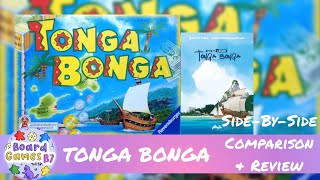
Tonga Bonga occupies a unique place in the modern board game landscape as a small-box design that has earned a second life through a recent re-implementation. The original game, released in 1998 by Ravensburger and designed by Stefan Dora, was recognized immediately with a recommendation for the prestigious SPI d'Or award. A new edition released in 2024 by Plate, a Korean publisher, brought the game back with refreshed artwork while preserving the elegant core mechanics that made the original resonate.
The comparison between editions reveals something important about enduring game design. Reviewers find both versions visually appealing and well-crafted. The original boasts charming, colorful illustrations that give the game warmth and character. The new edition's fresh visuals from Plate elevate the aesthetic without stripping away the game's personality. Beyond appearances, the 2024 version introduces new elements like a pirate ship token that adds disruption opportunities and the option to re-roll dice for a monetary cost, layering strategic depth onto the existing foundation. Yet the essential experience remains unchanged: what made Tonga Bonga work in 1998 still works today.
Core Mechanics That Define Tonga Bonga
The Dice Assignment Auction
The genius of Tonga Bonga lies in its dice economy and the elegant bidding system built around it. Each player pilots a ship and needs sailors represented by dice to move and take actions. The twist is that players never roll dice for their own benefit. Instead, all players roll their dice each round and then assign them to other players' ships, competing for the most valuable placement. Before assignment happens, a bidding phase occurs where players spend money to entice other players to place high-value dice on their ships. If you want another player to put a five on your board, you cannot offer just two coins; you will need to bid higher, perhaps five or more coins, to make it worth their while. This creates immediate tension: every coin spent to accelerate your movement now is money you will not have at game's end, when the player with the most money wins.
This mechanism generates what reviewers call a remarkable push-and-pull dynamic. Players must constantly weigh whether to invest aggressively to race to islands early or conserve funds for the final scoring. Do you overpay for a high die now, knowing it costs you dearly later, or take what other players begrudgingly assign you and adapt? The beauty is that your opponents are making the same calculations, and your decisions directly influence their resources and movement options. The system feels like you are literally auctioning your own ship's progress to the table, creating both humor and genuine strategic depth.
Dice Rolling and Strategic Sabotage
Randomness in Tonga Bonga comes from rolling dice, but the game refuses to let luck dominate. Players assign dice to opponent ships, and that assignment acts as a form of strategic sabotage. You might deliberately assign lower dice to a leading player's ship to slow them down, knowing it also reduces their earning potential at that island. Conversely, you might gift a high die to a rival if it serves your long-term interests, or to avoid alerting the table to your true intentions. The randomness of the roll is real, but the choice of where to apply each roll sits entirely in players' hands. One reviewer noted that the element of randomness is balanced by this potential for strategic sabotage, which adds a competitive edge that keeps the game engaging and unpredictable.
The Tonga Bonga Experience
Tense, Interactive Negotiation
Tonga Bonga feels tense because every money decision has weight, and every die assignment matters. Reviewers describe the gameplay as filled with moments where players are constantly calculating whether other players will do what they expect or pivot to something unexpected. Alliances form and dissolve within single rounds. You decide whether to trust that another player will assign you a decent die, or whether their incentives have shifted and they will block you out of self-interest. The game lives in these interpersonal moments, turning a simple mechanic into a table of engaged, reactive players who are laughing, second-guessing, and occasionally groaning when they get assigned a one instead of the five they bid for.
Deceptively Ambitious Scope
A remarkable characteristic that reviewers highlight is that Tonga Bonga feels significantly bigger and more strategic than its small box suggests. The game plays in under an hour, fits easily on any table, and requires minimal components, yet it creates the tension and depth of games that look far more complex. One reviewer emphasized that Batam is a game that kind of feels bigger than it actually is, noting the satisfaction of repeated plays and the engagement each session brings. This is partly due to the elegant auction mechanism and partly because so much of the game happens at the table through player interaction and negotiation. The compactness becomes an asset: players learn the rules quickly and jump into meaningful decisions within minutes. There is no fiddly bookkeeping or downtime between turns; every action on the board is a choice made by the group.
What Makes Tonga Bonga Stand Out
The Box Becomes the Board
One of Tonga Bonga's most distinctive physical elements is its innovative packaging. The game box itself unfolds to become the game board, a design choice that Plate emphasizes in the new edition as one of the publisher's signature productions. This approach solves a common problem in board gaming: how to fit a game with meaningful spatial play into a small footprint. The result is clever, sustainable, and practical. Players open the box, unfold it, and suddenly have a proper board for sailing and island-hopping. The art direction of both versions makes this transformation feel natural and visually coherent rather than like an afterthought. It is a design decision that contributes to the "feels bigger than it is" quality reviewers consistently mention.
A Money Mechanic That Actually Matters
The economic layer of Tonga Bonga is described by one reviewer as pure genius. Many games have money, but few make it as central and consequential as this one does. Money serves simultaneously as a bidding tool during the auction phase and the ultimate win condition. This double duty creates constant tension throughout play. Every coin you spend is a calculated risk because the player who finishes with the most money wins, not the first to visit four islands and return. This inversion of expectation means that speed and conservation are always in conversation with each other. You might reach an island first and claim the $25 bonus, but if you paid $15 in the auction phase to get the high die that got you there, your net gain is only $10. A player who invested modestly, took their assigned dice, and conserved cash might edge you out at game's end. The genius is that this system encourages multiple viable strategies rather than a single dominant path to victory.
Potential Drawbacks
Dice Randomness and Mitigation Costs
Randomness is built into Tonga Bonga's DNA through the dice rolls. While reviewers credit the game with balancing this through the auction and assignment system, some players find the variance frustrating. If the dice roll against you in a critical round, you are stuck with what the table assigns you. The 2024 edition introduces a rule to mitigate this: players can pay money to re-roll their dice. This adds strategy but also underscores the reality that luck plays a role. For players who dislike relying on dice outcomes, even with mitigation options, Tonga Bonga may feel like it gives randomness too much say in key moments.
The Temptation to Overpay in the Auction
The auction mechanism, while elegant, can lead to a painful decision trap. Players desperate to move quickly or reach an island before others may get caught in a bidding war where they overpay for a die. Reviewers emphasize that overpaying for dice is a critical pitfall: the desire to move quickly can easily lead players to bid far more than necessary, such as offering sixteen coins for a low-value die when eight coins might have sufficed. This decision calculus, where aggressive spending depletes the funds needed for final scoring, represents the game's central tension. Newer players or those caught in the heat of competition may find themselves outspending their resources for marginal gains. The game is unforgiving to poor auction decisions, which is part of its appeal but also a source of regret for some players.
If You Enjoy Tonga Bonga
Tonga Bonga appeals most to players who love the auction and bidding genre and who appreciate games that feel strategically substantial despite their compact design. If you have enjoyed games centered on negotiation and economic pressure, or games where interaction between players is the main event rather than a side benefit, Tonga Bonga belongs on your shelf. The game resonates with the old school German design philosophy that Stefan Dora exemplifies: simple rule sets that yield highly interactive experiences, where elegant mechanics create surprising depth. The weight is light, the box is small, but the table talk and decision-making are genuine and engaging. It is the kind of small-box game that proves you do not need complexity or length to deliver meaningful play.
What Reviewers Are Saying
"I absolutely love Tonga Bonga. The gameplay is incredibly entertaining and the way money functions in the game is pure genius. While there is an element of randomness, the potential for strategic sabotage adds a competitive edge."
— Board Games With B7
"Batam is a game that kind of feels bigger than it actually is. And I've just had a lot of fun playing it. I played it probably four or five times in 2025, and I'm excited for it to come out and for people to check it out."
— Grant Lyon
"You are basically going to give up coins to try to get good dice from other players. But at the end of the game, the person with the most coins wins. So you don't want to overpay. I don't want to I don't want to, you know, offer 16 coins and get a six die back when I could maybe offer eight coins and get a six die back, you know? You're it's that balance of that economy of like, ah, I want to move faster so I need to auction off my spaces, but also I don't want to overpay for these spaces and stuff."
— Grant Lyon