
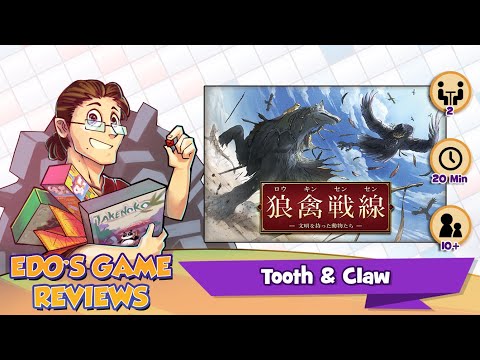

Tooth & Claw Deep Dive
What the Community Thinks About Tooth & Claw
Tooth & Claw: Animals with Civilization is a niche Japanese import, and coverage of it is very thin. The only reviews available come from a single channel, Gaming with Edo & Jessica, which has featured the game in a dedicated review and in a 2022 year-end list. Both videos are favorable, and the reviewer treats the game as a quick, tactical two-player card battler with a strong visual identity.
The praise centers on pace and feel. In the dedicated review, the reviewer sums it up by saying, "It's fast, it's fun, it works, it's interesting." The reviewer adds that it teaches quickly while still giving players interesting decisions. In the year-end list, the reviewer describes it as a fine tactics game for two players and says they enjoyed it as one.
The criticisms are mild and mostly practical. The reviewer points to the Japanese text on the box and to the difficulty of finding a copy. The reviewer does not raise any serious complaints about the gameplay itself. Because only one channel has covered the game, these opinions reflect one reviewer's experience rather than a broad consensus.
Core Mechanics That Define Tooth & Claw
Hidden Formation Building
Each player works with a three by three formation grid, and the game is built around filling it. Players choose a formation card, which is one of three types (bow, shield, or sword), and the reviewer notes that each type has its own play dynamics that you learn over time. Cards are placed face down, and the reviewer describes a small set of placement symbols. A normal placement is a card taken from your hand, a wild placement uses a token that lets the card count as either color, a flip draws the card from the top of the deck so you do not know what it will be, and an X means that space stays empty.
Because placements stay hidden until both players are finished, the formation becomes a guessing game about what your opponent has set up. The reviewer says the process makes them think "very hard" about each placement. The Fukuroudou import keeps this grid-building at the center of the design, and the reviewer treats it as the reason the game holds interest.
Front-Line Attacks and Suit-Matched Defense
Combat is built on a simple comparison. The attacker chooses a unit from the front row to strike at the opposing front line, and the defender must answer with a unit of the same type, either wolf or raptor. The reviewer says the comparison comes down to color and number, and that a defender who cannot match the suit loses the exchange. The winner takes the cards involved, and the victory points printed on the cards decide the final result. When a unit is removed, reinforcements move up from the back, which keeps the front line changing throughout a battle.
The reviewer calls the core rule "super simple," but argues that the formation layer is what makes it interesting. Attacks and defenses are resolved immediately, so each exchange has a clear outcome and the pace stays brisk.
The Tooth & Claw Experience
Fast, Tense Head-to-Head Play
The reviewer describes the game as quick and engaging from start to finish. The reviewer ties this to its place among small, tight tactical card games, a style the reviewer says was popular a few years ago, and the reviewer says that Tooth & Claw "works really well" within that style. Each turn gives the player a clear attack or defense decision, so the two players are constantly reacting to each other.
The restrictions of the formation system produce moments of real decision-making. The reviewer describes the thought process as a series of questions: "Should I go for that one? What's behind?" The head-to-head format keeps those questions at the front of every turn.
Hidden Information and Re-Evaluating After Reveals
Much of the tension comes from information that arrives in stages. Placements stay face down, flips introduce cards that neither player can predict, and reveals change the picture. The reviewer says that once both formations are visible, "with a little more information," the reviewer can see what is happening and adjust their plan. That shift from uncertainty to clarity is what gives the game its back-and-forth feel.
What Makes Tooth & Claw Stand Out
Formation Cards That Change Each Setup
The three formation types are the feature the reviewer returns to most often. Because each card carries different dynamics, the same basic rules lead to different positional problems. The reviewer also mentions cubes that grant bonus ranks depending on the formation, which adds another layer to how a formation is built. The reviewer says that "the formation really makes it interesting," and that the combination of formation and card reveals is what keeps the game from feeling flat.
Artwork, Aesthetics, and Clear English Rules
The reviewer praises the look of the game, saying they "really dig the aesthetic" and describing the cards as "really some fabulous looking cards." The English rules are also a highlight. The box includes a rule booklet or rule sheets along with a one-page reference card, and the reviewer describes them as "really well done," "easy to read," and "very clear." For an import, that makes the game much easier to learn than the packaging might suggest.
Potential Drawbacks
Japanese Packaging Limits Its Audience
The reviewer is upfront that the box carries a lot of Japanese text, and the reviewer acknowledges that "not everyone wants to buy games in other languages from other countries." Buyers who are uncomfortable with imported games may want to consider that before ordering. The included English rules soften this issue, but they do not change the packaging.
Hard to Find and a Formation Learning Curve
In the year-end video, the reviewer says that "the hardest thing to find here would probably be Tooth & Claw," though the reviewer believes it can still be bought from the publisher's store. The reviewer also notes that the different formation dynamics are something you "sort of get used to," so the first few games may take some adjustment. Neither point is a major complaint, but both affect how easily new players will get into the game.
If You Enjoy Tooth & Claw
The reviewer's own recommendations point toward other two-player, head-to-head games. If you enjoy the fast, tactical duels and the sense of planning against an opponent, you may also like:
- Air Land and Sea, which the reviewer calls a "super fun fast head-to-head two-player game" with a card-driven, three-location structure.
- Splendor Duel, which the reviewer describes as having the same fun as its multiplayer parent but being "one notch easier" to teach and learn.
- Other small, tight tactical card games, the style the reviewer links Tooth & Claw to and says was popular a few years ago.
What Reviewers Are Saying
"It's fast, it's fun, it works, it's interesting. I really dig the aesthetic."
— Gaming with Edo & Jessica
"The combination of the formation cards with the restrictions of the mechanics create interesting moments. Oh, should I go for that one? What's behind? You know, that kind of thing."
— Gaming with Edo & Jessica
"I love the artwork and style, and it was just a really — I really enjoyed it as a two-player tactics game."
— Gaming with Edo & Jessica