






Top Tier Deep Dive
What the Community Thinks About Top Tier
Top Tier has struck a chord with party game enthusiasts for embodying something genuinely modern: it taps into the wildly popular internet culture of tier lists and turns that social phenomenon into a table game. The consensus is strongly positive, with nuance about accessibility and player agency. Reviewers see Top Tier as a genuinely fun, lightweight addition to the party game shelf that works especially well with groups who already know each other, or in situations where physical participation is limited. While some wish for slightly more control in the setup phase, none dismiss the game outright, recognizing it as a fresh take on discussion-based party games that succeeds at what it sets out to do.
Core Mechanics That Define Top Tier
Secret Ranking into Tiers
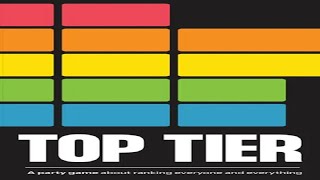
At the heart of Top Tier lies a deceptively simple mechanic. One player, designated the "tier wizard," ranks a set of contenders into tiers, from S (best) down to D (worst), without revealing those rankings to the other players, based on a category drawn from the deck. For example, if the category reads "How good would they be at a hot dog eating contest," the tier wizard looks at all eight names the group has written down and decides which tier each belongs in. The tier wizard uses clue tokens to show the group how many names fall into each tier, but not which specific names occupy which tier, and that hidden information becomes the puzzle everyone works to solve together. Top Tier is designed by Amomar Zoma, Dom Kaki, and Tyler Osuji, published by Indie Boards and Cards in 2025. The mechanic draws its power from creating an information gap that feels fair and manageable, giving the group something concrete to work toward without the task feeling insurmountable.
Collaborative Guessing and Discussion
Once the tier wizard has placed the clue tokens and revealed the category, the remaining players engage in open discussion to figure out the ranking. This is where Top Tier becomes a social game in the truest sense: players openly debate whether a given character would rank high or low, challenge each other's assumptions, and build consensus until they believe they have matched the tier wizard's thinking. Reviewers emphasize that this discussion phase is where the game shines. One reviewer noted it requires "almost no hands at all" because players can verbally direct others to move cards, making it ideal for situations where physical engagement is limited. Another highlighted that the game generates "absolutely hilarious" moments as players reason about bizarre pairings. The core satisfaction comes not from scoring points, but from the act of reasoning together and the revelation that follows.
The Top Tier Experience
Humorous Social Discussion
The strongest experience reviewers describe is the social discussion itself. Because players write down contenders without knowing the category, they end up with wildly eclectic lists: historical figures, fictional characters, celebrities, Pokemon, even abstract concepts like "Queen of England." When the category is revealed, these odd combinations create absurd scenarios to reason through, and reviewers consistently note moments of laughter as the group imagines how Batman, Pikachu, or Churchill would perform in various challenges. One reviewer called it a "free flowing kind of party game" that thrives on this off-the-wall reasoning. Another emphasized that "a big part of this game is rationalizing and explaining why you chose this versus that." This isn't a game where players calculate optimal moves; it's one where players narrate their logic out loud, discovering how their groupmates think along the way.
Accessible and Inclusive Participation
A distinctive strength of Top Tier that reviewers highlight is how little physical participation it demands. Multiple reviewers recommended it for situations where players are occupied with other tasks. One proposed it as one of the best games to play while holding a baby, since a player can direct others to write, move cards, and rank entries while contributing fully through speech alone. This accessibility extends to cognitive load as well: the rules fit on a single panel of the rulebook, making the game trivial to teach and quick to learn, with no complex state or hand management to track. For groups in transition or with mixed ability levels, Top Tier offers genuine inclusivity.
What Makes Top Tier Stand Out
The Inverse Reveal: Category After Ranking
Most discussion-based party games ask players to complete a task while knowing the challenge up front. Top Tier inverts this structure: players write down contenders before knowing what category the tier wizard will use to rank them, and only after the ranking is secret does the category get revealed. One reviewer noted this creates "an inverse of itself compared to a lot of these types of discussion party games" and found it "unique" in its implementation. Because players don't know the category when they brainstorm names, they can't strategically choose contenders designed to make the category obvious; the ranking comes first, the logic comes second. This means players have less upfront agency in shaping how the game unfolds, which one reviewer found slightly frustrating, but the same mechanic keeps the game fresh and unpredictable on every round.
Tier Lists as a Cultural Bridge
Top Tier succeeds in bringing an authentic piece of modern internet culture to the tabletop. Tier lists have become ubiquitous online across gaming, anime, YouTube, and social media. Reviewers acknowledged this resonance explicitly. Tom Vassel from the Dice Tower noted that ranking things into tiers "is a very popular thing on the internet" and observed that the game "is especially popular with young people because they like the whole idea of putting things into tiers." Another reviewer stated: "tier lists are as popular as ever" and praised Top Tier as "a really cool implementation of that as a party game." Rather than asking players to engage with an abstract party game concept, Top Tier hands them a cultural touchstone they already understand and enjoy. This familiarity makes the game immediately resonant without requiring explanation or buy-in of an unfamiliar structure.
Potential Drawbacks
Reduced Player Agency at Setup
One reviewer raised a design concern that deserves attention. Because players write down contenders before learning the category, they have no way to influence how the ranking challenge will unfold. Most discussion party games let players see the challenge first, then respond strategically. Top Tier removes this agency. The reviewer stated: "I would rather have a little bit more agency at the very beginning. I think I'd like to know the category before trying to give a hint." For some players, this inversion feels limiting rather than liberating. It transforms the naming phase into a blind guessing game, which some groups may find frustrating. This design choice works for groups who enjoy spontaneity and surprise, but it won't appeal to players who prefer to construct their responses strategically.
Uneven Participation with Fewer Than Eight Players
Top Tier is designed for exactly eight contenders, which means not every player gets to contribute equally in all group sizes. A reviewer noted: "with not eight players, not everyone is able to pitch in a bunch of ideas. So it's kind of like, how many do you want to write? Do I want to write two? Do I want to write three?" Groups smaller than eight can adapt by having players contribute multiple contenders, but this feels like a workaround rather than an intended design. Additionally, because eight fixed slots exist, the game's scalability is limited. The game supports 4 to 10 players, but the contender set remains eight, meaning larger groups have some players sitting out the naming phase or contributing extras. This asymmetry works fine for the intended audience, but groups expecting perfect balance will notice the constraint.
If You Enjoy Top Tier
Top Tier shares DNA with two games specifically mentioned by reviewers: Spectrum and Ido. Like Spectrum, Top Tier centers on players openly ranking and discussing a range of contenders. Like Ido, Top Tier uses ranking as the core mechanism and leverages player discussion to drive engagement. Both games work for similar audiences and occasions. If you enjoy the social negotiation and laughter that comes from defending why you'd rank Batman above Churchill in a specific category, you'll likely enjoy Spectrum as well. If you appreciate games built around matching your guesses to someone else's logic without direct competition, Ido offers a similar satisfaction. Beyond ranked games, Top Tier will appeal to anyone who enjoys lightweight party games where discussion and storytelling matter more than complex rules or components. Games like Rhymes with Duck, which asks players to find words that rhyme with a given word and match each other's answers, share that same accessible, laugh-driven sensibility. For groups specifically looking for games playable while occupied or holding an infant, Top Tier becomes a genuine standout, alongside games like Deception: Murder in Hong Kong, where players can fully participate through speaking alone.
What Reviewers Are Saying
"It's fun. It's entertaining if you're with a group of player folks who know each other and like will enjoy trying to guess like really good with extended family and people who like know each other but, you know, don't see each other every day or whatever."
— Gaming with Edeto
"Absolutely hilarious. It requires almost no hands at all. You can actually even tell someone else to write down what you want someone to write for a clue. Everyone can rank them and tell people to rearrange them for you or whatever. There's a lot of help that can be given."
— Ryan and Bethany Board Game Reviews
"It's a fun group talking activity, and it's silly and fun, and I found it especially is popular with young people because they like the whole idea of putting things into tiers."
— Tom Vassel, The Dice Tower