



Toy Story: Obstacles & Adventures Deep Dive
What the Community Thinks About Toy Story: Obstacles & Adventures
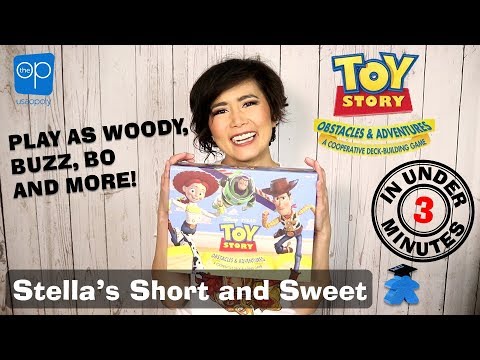
Reviewers across multiple channels describe Toy Story: Obstacles & Adventures as a thoughtful refinement of a proven cooperative deck-building system, tailored specifically for family audiences who may not connect with other licensed takes on the same mechanics. The game earns consistent praise as an accessible entry point into deck building that respects both the theme and the gameplay experience. Reviewers note that the Toy Story license carries genuine weight: the game channels iconic moments from the films in ways that feel thematic rather than arbitrary. Channel reviewers emphasize that this is not a lazy reskin but a deliberately gentler, safer design that introduces strategic depth without overwhelming younger or newer players. Multiple sources confirm the game works well across family groups and game clubs alike, with players finding the difficulty curve and scenario progression satisfying across multiple plays.
Core Mechanics That Define Toy Story: Obstacles & Adventures
Cooperative Deck Building
At its heart, Toy Story uses personal deck building where each player starts with a small, identical deck and gradually acquires cards from a shared market. Players cycle through their decks repeatedly, purchasing new cards with the currency they generate. The genius of the system lies in its constraint: at the end of each turn, unspent currency vanishes, forcing players into meaningful allocation decisions. The game provides character-specific starting cards and item tokens that create light asymmetry within the cooperative framework. Reviewers praise the pacing of card acquisition, noting that new cards enter play at a rate that feels rewarding without overwhelming the learning curve.
Escalating Hazards and Progress Tracking
Players collectively face hazards drawn from Toy Story canon, each requiring a set amount of insight to overcome before a moving van token reaches the end of its track. Meeting requirements collectively becomes the shared win condition, while the advancing moving van clock creates constant urgency. The hazard system is flexible: some hazards impose passive effects, while others trigger active effects each turn that affect player health and options. Reviewers highlight how this design keeps the game from becoming a simple arithmetic exercise. The system forces decision-making about whether to focus firepower on clearing current threats or spreading resources across multiple approaching obstacles.
The Toy Story: Obstacles & Adventures Experience
Family-Friendly Cooperative Gameplay
Reviewers consistently position this game as gentler and more welcoming than its mechanical predecessor. The Toy Story IP creates thematic coherence that helps newer players understand why they are gathering insight and managing health, and the scenario progression mirrors narrative beats that fans recognize. The cooperative structure means players share responsibility for success or failure, eliminating the downtime or player elimination that can frustrate younger participants. The turn structure flows smoothly: each player draws cards, plays them to generate currency, spends currency to buy cards for future turns, then draws back up. The system minimizes rules overhead while maintaining meaningful choices.
Six-Scenario Campaign with Strategic Progression
The game comes packaged with six scenario boxes that unlock sequentially, each introducing new cards, mechanics, and obstacles tied to specific Toy Story films and shorts. Reviewers praise this structured escalation as an elegant teaching tool that adds complexity gradually without overwhelming players or requiring separate rulebook sections. Early scenarios introduce core mechanics in isolation. Later scenarios layer multiple active hazards on the board simultaneously and increase the rate at which danger cards appear. The modular approach ensures that learning feels natural and that groups can always return to earlier scenarios if they need practice. The scenario structure also means each play session has clear narrative shape tied to Toy Story canon.
What Makes Toy Story: Obstacles & Adventures Stand Out
Thematic Fidelity Without Gimmickry
The game makes deliberate choices about how it translates Toy Story moments into mechanical effects. Hazards like Trapped in a Crate and Playtime with Sid feel consequential not because the theme is pasted on, but because the mechanical effects reinforce the narrative threat. Character decks include items like Woody's cowboy hat and Buzz's laser light, each providing mechanical hooks that encourage thematic play. Reviewers appreciate that the Toy Story aesthetic does not dilute the game design. Instead, it creates a coherent space where theme and system reinforce each other.
Mechanical Refinement Over Its Predecessor
While the game uses the same core engine as Harry Potter: Hogwarts Battle, reviewers note that it has been enhanced and changed up, with card interactions and hazard mechanics that feel fresh. The system avoids some deck-thinning friction present in introductory scenarios of other games in the same family, instead allowing decks to grow naturally without excessive filtering. The integration of track advancement as a primary threat creates tension without requiring campaign-level consequences. Reviewers highlight that the game distills what works about scenario-based cooperative deck building and applies it with precision.
Potential Drawbacks
Derivative Design Philosophy
The game borrows heavily from an established game system rather than innovating mechanically from first principles. For players who have logged dozens of plays through the comparable licensed title, Toy Story may feel more like a thematic variation than a meaningfully different experience. The core loop, hazard structure, and scenario progression follow a formula that experienced deck-builders will recognize immediately. Some players seeking novelty in cooperative game design may find the refinements incremental rather than revolutionary.
Limited Player Count and Complexity Ceiling
The game accommodates two to four players in base form. Groups expecting to scale to five or six at the table will need to plan around this constraint. Additionally, while later scenarios introduce credible difficulty spikes, the game's complexity plateaus below the heaviest cooperative experiences. Some players drawn to intricate economic systems or multi-faceted decision trees may find the strategic depth limited compared to longer campaign games or more involved deckbuilders. The game is deliberately designed not to overwhelm, which makes it excellent for teaching and family play but potentially limiting for those seeking maximum tactical density.
If You Enjoy Toy Story: Obstacles & Adventures
Players who connect with Toy Story: Obstacles & Adventures almost certainly enjoy Harry Potter: Hogwarts Battle and should explore that game if they have not already, understanding that the systems are mechanically similar but thematically distinct. Both games serve as excellent on-ramps for players new to deck building, offering gradual complexity escalation and clear narrative structure. The two games create a logical pairing for families or casual groups: one plays through the other's scenario campaign, then can return to familiar mechanics through a different licensed lens.
This game is designed for families with children old enough to understand turn sequence and resource management but young enough that simpler, friendlier themes matter. It works well for game clubs introducing cooperative games to newcomers. It suits groups who value narrative progression and shared victory conditions. The game is not designed for players seeking a sandbox economy game or a deeply asymmetric experience, nor for those playing exclusively with experienced gamers hungry for maximum intellectual challenge.
What Reviewers Are Saying
I think Harry Potter is fine, but I love Toy Story. So, this is a deck builder that if you don't like the Harry Potter theme for whatever reason, you should consider hunting this one down.
— The Dice Tower
I feel it's a good introduction to deck building it has similar mechanics of other deck building plus ball tokens to help keep track of how much you can spend this turn to buy more cards
— Meeple University
it plays out of our Harry Potter Hogwarts battle engine but if we kind of enhanced it and change it up a little bit and so we're you're playing as the Toy Story characters and you're playing through each of the movies the animated movies and the animated shorts
— Board to Death TV