




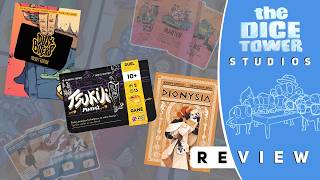

Sukiji Market Deep Dive
What the Community Thinks About Sukiji Market
Sukiji Market draws a genuinely split reception from reviewers. The Dice Tower found it a satisfying pocket-sized auction game with clever mechanics packed into 20 cards, awarding it a solid 7 out of 10. Chairman of the Board, however, took issue with its core design, feeling the bidding system created more problems than it solved and concluding the game offers too little depth compared to stronger set collection alternatives. This disagreement is honest and worth understanding: reviewers appreciate different things about the same game, and that matters if you are deciding whether to bring it to your table.
Core Mechanics That Define Sukiji Market
Simultaneous Bidding with Finger Reveals
Sukiji Market wraps its auction in a playful gimmick. Each round, two cards are revealed face-up. Both players count "wasabi" together and simultaneously flash between one and four fingers. The player showing more fingers wins the right to claim one of the two cards. This mechanic creates a constant push-and-pull: bid high and you risk feeding your opponent cards through the scale imbalance system, bid low and you cede control. The tension lives in that calculation, the moment of mutual reveal.
Set Collection with Wasabi Doubling
Players collect fish cards in four colors, aiming to assemble sets and trigger special bonuses. The wasabi symbol is the game's most elegant flourish: if you collect two wasabi cards in a single color, all fish of that color double in final scoring. This creates a secondary layer of pursuit, encouraging players to think not just about which sets to build but which sets to enhance through wasabi discovery. Alongside the wasabi mechanic sits a sudden-death trigger: collect four knife symbols and the game ends immediately in your victory.
The Sukiji Market Experience
Tense Back-and-Forth Bidding Combat
The simultaneous finger reveal creates a pressure-packed moment each turn. You must predict what your opponent will bid, weigh the value of the cards at stake, and decide whether to overcommit. Push too hard and you tip the scale, giving your opponent a free card steal. Hold back too much and you lose cards you actually wanted. Reviewers noted this push-pull dynamic as one of the game's genuine strengths, capturing the feeling of two players locked in quiet economic conflict across a small card table.
Quick, Portable Tabletop Snack
At roughly 15 minutes per game, Sukiji Market feels like a palate cleanser between heavier games or a travel companion. It fits in a wallet, requires minimal setup, and asks for nothing beyond two players and the cards themselves. The game runs short enough that if a play session lands flat, the hurt is minimal. If it lands well, the compressed decision-making and frequent reveals keep both players engaged end-to-end.
What Makes Sukiji Market Stand Out
A Lot of Game in Minimal Space
Reviewers marveled at how much the designers packed into 20 cards. The wasabi mechanic, the sudden-death knife condition, the special card abilities that modify the scale, the tiebreaker rules, the four-color set collection with multiple scoring paths all coexist in a box no larger than a deck of playing cards. The Dice Tower called it a game with "a lot of game packed into a little wallet," and that density is genuinely impressive for the footprint.
The Wasabi Doubling Mechanic
The wasabi symbol stands out as Sukiji Market's most memorable innovation. Rather than treat it as just another icon to collect, it functions as a multiplier that doubles all scoring for its color. This creates tactical decisions: do you chase wasabi cards to double your green collection, or build a robust set across multiple colors? The mechanic rewards both patience and opportunism, giving players multiple valid strategies within the same game.
Potential Drawbacks
Frequent Tied Bids Fill the Discard Pile
When both players bid the same number, the cards go to the discard pile instead of entering anyone's collection. Chairman of the Board noted that this happens "annoyingly" often, particularly in early-game exploration when players have not yet read each other's bidding patterns. The result is a growing stack of rejected cards that never enter play, feeling wasteful and slowing momentum. This ties directly to the next criticism: a game with so few cards cannot afford to lose many to discard.
Game Feels Slight Despite Clever Mechanics
Chairman of the Board conceded that the bidding system itself is "cool" in concept, but felt the game overall was "a bit too slight," lacking enough going on to hold interest across multiple plays. The criticism boils down to this: the rules are intricate, but the strategic depth is shallow. Set collection games offer many stronger experiences, and despite Sukiji Market's creativity in the auction wrapper, it does not quite justify another spot on the shelf next to Calico or other tighter designs.
If You Enjoy Sukiji Market
Players drawn to Sukiji Market tend to appreciate simultaneous-reveal bidding games and compact two-player card experiences that reward reads and counterreads. If you enjoy the moment of mutual revelation in games like Rock-Paper-Scissors or Coup, or if you like set collection games that can finish in a handful of minutes, Sukiji Market offers something real. It works best as a travel game or as a quick opener before longer plays, where its brevity becomes a feature rather than a limitation. The Dice Tower recommended it specifically for players seeking "bidding and set collecting" in a wallet-sized form factor, suggesting it finds its truest home in a collection built around portability and two-player depth.
What Reviewers Are Saying
Sukiji market here has a lot of game packed into a little wallet. Uh, there's a a lot going on in here. I like the different abilities. I like the the the sort of back and forth, the fighting, the simultaneous bidding.
— The Dice Tower
I like that you have to be careful with how much you bid or you're basically feeding your opponent your own cards.
— The Dice Tower
Annoyingly, a lot of the time in this game, you end up bidding the same. So, a lot of cards get discarded.
— Chairman of the Board