





Valheim Deep Dive
What the Community Thinks About Valheim
Community reception for Valheim remains decidedly mixed. One Stop Co-op Shop's reviewer finds the game engaging at first but ultimately repetitive, while The Broken Meeple expresses cautious optimism tempered by concerns about translating the beloved video game to tabletop form. This divide reflects a real tension in the game's design: it delivers on accessible, approachable cooperative adventure gameplay, but struggles to sustain long-term engagement through varied scenarios. Rob's Tabletop World has the game in circulation and sees value in it as a shelf title. The consensus is not that Valheim is bad, but that it appeals to a specific audience seeking a beer-and-pretzels cooperative experience rather than deep strategic play.
Core Mechanics That Define Valheim
Boss Battler Combat with Dice Resolution
Valheim positions boss encounters as its climactic moments, but reviewers consistently identify this as a design weakness. Each scenario culminates in a final confrontation, yet the boss combat board and mechanics feel underdeveloped. Combat itself uses a quick dice-rolling system where players roll based on weapons and defensive items they've crafted, then resolve simultaneous attacks. The system is mechanically sound for speed, but offers limited strategic depth, there are few abilities that meaningfully alter outcomes, and movement around the boss arena rarely matters. Most scenarios, players discover, allow them to simply stand in place and roll dice without tactical positioning, draining these encounters of tension.
Exploration and Resource Gathering with Terrain Variation
The strongest mechanic and the aspect reviewers consistently praise is turn-based exploration. Players spend their actions moving across uncovered map tiles, discovering enemies to fight and resources to gather. Later scenarios introduce islands requiring boats to traverse, and tougher terrain where riskier paths lead to better resources. This creates genuine tactical tension: players must weigh how to spend limited actions moving, gathering, fighting, and returning to their house for healing. The variety in scenarios, islands, different terrain types, changing map layouts, ensures exploration stays fresh far longer than other systems.
The Valheim Experience
Approachable Cooperative Adventure with Accessible Rules
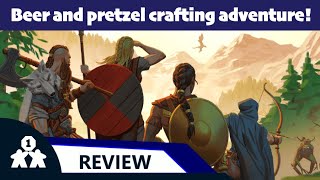
Valheim delivers the fantasy of cooperatively exploring a Norse world, gathering resources, and building toward a confrontation with a powerful foe. The fantasy translates well: players genuinely enjoy crafting armor and weapons, building furniture for their shared house, and watching their characters grow more capable. Younger players especially gravitate toward the crafting loop, finding intrinsic satisfaction in building new items and seeing their effects in play. The game moves quickly, turns resolve smoothly, the event card system keeps things flowing between rounds, and teaching is straightforward. It functions well as a family experience where players of different skill levels can participate meaningfully.
Repetition Sets In Quickly
After multiple scenarios, the novelty wanes. While each scenario theoretically offers new bosses and terrain, the underlying gameplay loop remains consistent: explore, gather resources, craft items, face the boss. Different scenarios fail to deliver substantially different challenges. The boss encounters, despite having unique event decks, often feel mechanically similar. Event cards provide occasional surprises and keep pacing smooth, but the sameness of what players actually do across scenarios, the same actions, the same crafting priorities, the same dice-rolling patterns, becomes apparent by the third or fourth play.
What Makes Valheim Stand Out
Theming That Honors the Video Game Source
Valheim's greatest strength is faithful translation of the video game's core loop to tabletop. The combination of exploration, gathering, crafting, and building captures what makes the digital original compelling. The presentation reinforces this: Norse mythology, Viking aesthetics, and a sense of gradually taming a hostile world. For players who love the video game, the tabletop adaptation offers an enticing novelty, the chance to experience familiar mechanics in analog form with others.
Cooperative Focus with Shared Resource Management
The game commits fully to cooperation. There is no player elimination, no traitor mechanics, no zero-sum competition, players sink or swim together. Shared crafting resources and a communal house where everyone benefits from furniture create genuine interdependence. This makes it accessible for families and casual groups who want to collaborate rather than compete, distinguishing it in a market often saturated with either competitive or semi-cooperative experiences.
Potential Drawbacks
Scenarios Lack Meaningful Differentiation
Reviewers report that despite different bosses and maps, scenarios feel broadly interchangeable in practice. Players perform nearly identical actions, craft nearly identical items, and execute nearly identical strategies regardless of scenario. The variety that teases itself on the box, islands, tougher terrain, new enemies, fails to fundamentally alter how the game plays from session to session. One reviewer noted putting the game down after four or five plays, finding the scenarios too similar to sustain interest.
Boss Combat Feels Underwhelming
Boss encounters are meant to be the payoff, the climactic moment toward which exploration and crafting build. Instead, they tend to feel anticlimactic. The combat board and special boss mechanics create minor spatial considerations, but often do not matter. Players frequently opt to simply stand still and roll dice, negating positioning entirely. Even with different bosses, the underlying experience, rolling dice, taking damage, rolling again, fails to deliver the dramatic confrontation the game's setup promises. Reviewers describe these encounters as fairly anticlimactic and really underbaked, suggesting the boss design was left underdeveloped.
Crafting System Becomes Routine
The crafting system begins as the favorite aspect for many players, the joy of building new items and watching them impact combat. But across scenarios, the optimal path becomes obvious. Certain furniture becomes an automatic include every game. Weapons and armor upgrades follow predictable arcs. The system is not robust enough to sustain meaningful variation: by the endgame of any scenario, most parties have crafted largely the same items and rolled largely the same dice, undermining the sense that different strategies matter. Reviewers report this reducing the system from exciting to rote.
If You Enjoy Valheim
Players drawn to Valheim's cooperative adventure loop and accessible mechanics should consider Deep Rock Galactic, the board game from the same publisher, Moop Publishing. Deep Rock Galactic also emphasizes cooperative exploration and gathering resources under pressure, appealing to fans of Valheim's core fantasy while offering distinct mechanics and spatial puzzle-solving that provide the tactical depth Valheim's boss battles lack. If the video game IP and Norse theming are key draws, Valheim remains the more authentic translation, but for those seeking deeper cooperative gameplay with more varied challenges, Deep Rock Galactic may deliver greater long-term satisfaction.
What Reviewers Are Saying
"So, it's really smooth mechanic to keep player turns moving and just have something interesting happen after each turn. But on the negative side, while each of the bosses has a completely different event deck, a lot of the effects are very similar or minor enough that it won't feel that different. So playing one boss versus another isn't as exciting and varied as I would like."
— One Stop Co-op Shop
"The game just in my opinion barely changes in different scenarios. You're doing the same stuff over and over again. Yes, the terrain is a little bit different and the map can be a little bit different. But other stuff like the boss combat especially feels really underbaked to me."
— One Stop Co-op Shop
"I did enjoy it, but you join the demo at a late stage of the game. I need to play it through the full game to really see what it's like, but I'm looking forward to doing more on that."
— The Broken Meeple