




Vines and Flowers Deep Dive
What the Community Thinks About Vines and Flowers
Vines and Flowers invites players into a zen, peaceful space where they take on the role of expert landscapers building a shared floral pergola together. Reviewers consistently describe the experience as relaxing and meditative, offering a beautiful respite from more confrontational game styles. The game combines elegant three-dimensional tile placement with a unique scoring twist that rewards balance and diversification, creating a strategic puzzle that feels less cutthroat and more like tending to a garden alongside friends. The 3D interlocking cardboard mechanic is something players rarely see, making the physical act of building the trellis as satisfying as the scoring that follows.
Core Mechanics That Define Vines and Flowers
3D Tile Placement and Flower Connection
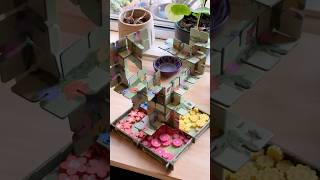
The heart of Vines and Flowers is its three-dimensional tile placement system. Players draft tiles from a central market and place them into notches on the growing pergola structure, building upward, outward, and along the z-axis simultaneously. Every placement must match: flower tiles go into flower slots, vine tiles into vine slots. When a placement completes a flower of a particular color, the player scores petal tokens matching that color. The clever part comes in chaining, that is connecting your new flowers through existing vine paths to score multiple flowers in a single placement. Reviewers emphasize how tactical this becomes; leaving an opening can often mean setting up a massive scoring opportunity for an opponent, creating interesting decision-making tension even though the overall experience feels zen.
Creature Tiles and Hummingbird Timing
Several flower and vine tiles feature preprinted creatures, each with a unique bonus effect when placed. Bees grant an extra action, letting you take three actions on your turn instead of two. Butterflies give you a wild flower token that blocks off a path but can be placed into any flower slot, though it does not extend the pergola's dimensions. Ladybugs become wild petals you store behind your player screen, counted at game end toward any flower color you choose. Spiders let you immediately grab a tile from anywhere in the market without paying the usual cost. These creatures add variation and strategic timing; choosing when to activate them becomes part of the puzzle. The hummingbird tiles, however, introduce a timing tension that escalates as the game progresses. When the rightmost tile in the market is a hummingbird, all players resolve its effect. Some hummingbirds trigger negative event effects that impact everyone; others can be claimed by a player in the fulfillment phase to gain personal benefits. When the fourth hummingbird enters the market (or the cloth bag runs out of tiles), the game ends immediately, creating a real sense of pressure as the endgame approaches.
The Vines and Flowers Experience
A Zen, Peaceful Gardening Meditation
Reviewers repeatedly speak to the emotional experience of Vines and Flowers as a moment to step back from high-conflict games and find calm. One reviewer framed it as finding that zen space on a Sunday afternoon, tending to plants while drinking coffee, building a beautiful structure out of cardboard. The theme is not just flavor but felt in the pacing and aesthetic. The flowers themselves, represented by colored petals and the physical beauty of the interlocking tiles, invite admiration. This is a game where success does not hinge on crushing opponents but on your own ability to construct something elegant and diverse.
Strategic Tension from Contract Fulfillment and Timing
Beneath the zen surface runs a current of genuine tension. Contracts require players to accumulate four, five, or six petals of a single color and display them sequentially to claim hummingbirds and their associated ladybugs, which are powerful late-game tools. However, once a color is used to fulfill a contract, that same color cannot be used for future contracts, forcing all players into a competitive race. Whoever fulfills the first contract gets the advantage of claiming the ladybugs first. But there is a cost: each contract fulfilled adds a hummingbird tile to the bag, bringing the endgame closer. This double-edged sword decision creates moments where players must balance their desire for powerful rewards against accelerating the game ending. The hummingbird tiles themselves introduce another layer: the timing of when they appear in the market can dramatically shift the state of play, forcing quick pivots in strategy.
What Makes Vines and Flowers Stand Out
The Lowest-Score Victory Condition
Vines and Flowers borrows its scoring philosophy from classic games like Tigris and Euphrates. At the end, players reveal their petal collection and compare their four flower colors. The player with the highest lowest-color score wins. This elegant constraint forces a fundamental shift in player behavior: you cannot succeed by dominating one flower color. Instead, you must diversify your collection across all colors, developing a balanced portfolio. Reviewers note how this creates a distinctive puzzle. Players must think about not just maximizing points but ensuring no single color falls too far behind. Ladybugs become critical tools for shoring up weak colors at the eleventh hour. This scoring system is rare in modern games and gives Vines and Flowers a unique identity.
Innovative 3D Tile Interlocking Mechanism
The physical construction of the pergola is genuinely memorable. Most games with vertical building tend to be one-off moments (like building a tree in Everdell) or require dexterity. Vines and Flowers makes 3D tile placement the core puzzle throughout the game without dexterity risk. Reviewers highlight their surprise at this mechanism, noting they have rarely seen interlocking cardboard tiles used so effectively as a central gameplay element rather than a gimmick. Placing a tile vertically into a new level grants a bonus petal, creating an incentive to build up as well as out. This spatial problem-solving aspect gives the game a tangible, almost meditative quality as players physically construct something beautiful.
Potential Drawbacks
Hummingbird Effects Can Punish All Players Unpredictably
While hummingbird tiles create timing tension, their negative effects can feel arbitrary when they activate in the main market phase, affecting all players. If an unlucky hummingbird appears when you are building toward a specific goal, the event effect might derail your plans entirely without warning. Reviewers acknowledge this as part of the game's design but note it can feel frustrating, especially for players who dislike swinginess. The inability to fully control when hummingbirds enter the market means luck plays a supporting role, which fits the zen aesthetic but does introduce moments of randomness that not all strategic players will embrace.
Sequential Contract Constraints Create Blocking Situations
The requirement to fulfill contracts in order with different colors can lead to situations where the second or third contract becomes nearly impossible for trailing players. If early competitors claim the two easiest colors for the first and second contracts, latecomers might find themselves needing to assemble a six-petal set in an awkward color just to stay competitive. This can create dead-end scenarios where a player feels locked out of the contract system entirely. Reviewers mention this as an interesting but occasionally frustrating puzzle; the competitive element of contract racing can at times clash with the game's otherwise peaceful vibe, creating moments where players feel cornered rather than peacefully gardening together.
If You Enjoy Vines and Flowers
If Vines and Flowers resonates with you, Everdell offers similar relaxation through beautiful production and a tree-building central mechanic, though with less strategic depth. Queen's Garden appeals to the same player who loves flower-themed games, though it approaches scoring and strategy differently. For players drawn to the Tigris and Euphrates scoring philosophy, exploring classic games in that family will deepen your appreciation for Vines and Flowers' elegant constraint. And if the 3D puzzle aspect captivates you, seeking out other tile-placement games with spatial complexity will scratch that itch. Vines and Flowers ultimately sits at the intersection of peaceful play and genuine strategic puzzle, a rare combination that appeals across experience levels.
What Reviewers Are Saying
"Find that zen space on a Sunday afternoon to tender to your plants, drink a cup of coffee, or even build your very own pergola out of cardboard. This is a game called Vines and Flowers."
— Board Game Sanctuary
"It's a battle of balance as players earn petals in four different colors, but when the game is over, score only for their weakest color. Whoever has the highest lowest score when the game is over will be the winner."
— Meeple University
"It's a tile laying game, but look at those tiles. They have vines that grow up on the walls, and you're three-dimensional. I don't think I've seen this where the tiles interlock and go up or down. I've seen it as like a part of building the Everdell tower tree or something, but not as the mechanic of the game that you stack with the interlocking cardboard."
— Good Time Society