


Ward: Trading Card Game Deep Dive
What the Community Thinks About Ward: Trading Card Game
Ward: Trading Card Game, published by Ward Trading Card Company, is a 2023 release that solo reviewers have picked up mainly for its solo mode and its look. AzureDeath | Solo Board Gaming, whose host Robert has followed the game for some time, describes it as a game that plays heavily on nostalgia, starting with a Yu-Gi-Oh! style card frame and a colorful, old-school comic book art style. Across Robert‘s coverage, the recurring verdict is that Ward is a lightweight, enjoyable card game rather than a deep one.
The reviewer is clear about where the game sits. Robert frames it as a "beer and pretzels" experience and warns viewers not to expect the depth of Lord of the Rings LCG or Arkham Horror LCG. Praise and caveats come together: the game is easy to learn and fun to build decks for, but its boss content and pricing are the points that need the most qualification. The overall tone is warm and positive, with the reviewer saying Robert has had a blast playing it and that it is a very enjoyable card game, solo or not.
Core Mechanics That Define Ward: Trading Card Game
Dice-Driven Combat Against Armor Levels
Combat in Ward is resolved entirely with dice. Each turn, a player can choose to initiate an attack, and the creature with the higher speed attacks first. The attacker rolls to hit, with two dice as the default count plus a combat modifier, and the total must meet or exceed the defender‘s armor level. A successful hit then triggers a damage roll, and the defending creature is forced to counterattack in turn. The reviewer notes that rolling more than two attack dice creates real swings, because a critical hit or critical miss requires every die to land on a six or a one. Ward Trading Card Company keeps the core loop simple, which the reviewer contrasts with the more involved resolution of other games, while still letting the dice produce occasional dramatic results.
The Always-a-Creature Rule and Armor-Tiered Summoning
Ward has no mana. Instead, a player must always have a creature in front of them. If that creature is defeated, the next one must be summoned immediately from hand. If no creature is in hand, the player reshuffles their hand into the deck and draws until a creature appears. Summoning cost depends on armor value: creatures with an armor level of six or less can be played for free, creatures from seven to 11 require sacrificing one creature from hand or in play, and creatures with an armor level of 12 require sacrificing two. The reviewer calls this a pretty interesting mechanic because it keeps players from being stranded without a creature, while the armor tiers add a meaningful choice about which creature to sacrifice and when to do it.
The Ward: Trading Card Game Experience
Top-Decking Tension
Ward offers very little card draw, deck manipulation, or tutoring, so players spend much of the game top-decking. The reviewer argues that this is where much of the excitement comes from, since a single well-timed draw can supply exactly the card needed to overcome an opponent. Combined with the dice, the game produces suspenseful moments that feel out of proportion to its simple turn structure. Players who want steady, predictable sequencing may find this frustrating, but the reviewer treats the randomness as the source of the game‘s charm.
Beer and Pretzels Ease
The reviewer describes the game as very much a beer and pretzels experience, meaning a casual, low-stakes session built around opening a few packs and battling a boss. Most turns follow a familiar rhythm: draw a card, attack, let the opponent counterattack, and repeat. Robert suggests it works well as something to play while a football game runs in the background. That relaxed feel is intentional, and the reviewer does not present it as a flaw; Robert simply wants viewers to set expectations accordingly, since there is not a meaningful puzzle to solve in solo play.
What Makes Ward: Trading Card Game Stand Out
Nostalgic Comic Art From a Single Illustrator
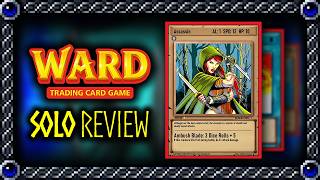
The art is the feature the reviewer returns to most often. The first edition relied heavily on AI-generated art, but the second edition brought in a proper artist, Fabricio Vainer, who gives the game its distinctive comic book look. The reviewer points out that using one artist for every illustration is unusual for a trading card game and calls that dedication. Robert appreciates how consistent the game looks as a result, and Robert praises the 90s comic book style as top-notch. The reviewer also says Robert loves the classic Yu-Gi-Oh! card frame from the earlier printings, which Robert says is a real selling point for the game, even though Robert understands why the newer edition moved to its own frame.
A Low Table Footprint
Ward is compact enough that a full game fits in roughly the space of a standard trading card game play mat. The reviewer notes that players ordinarily need more room for up to five magic cards in play, but those cards can be stacked to save space. Robert considers it one of the lowest footprints among soloable trading card games Robert has played, which makes it a good fit for small tables and quick sessions. The footprint is a practical advantage that complements the lightweight rules.
Potential Drawbacks
Most Boss Decks Are Not Practical Solo
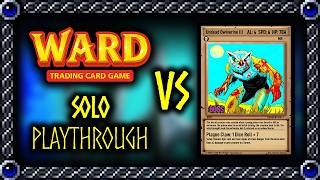
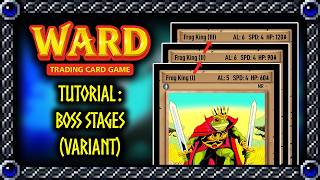
The official boss decks are the biggest solo concern. The reviewer says that four of the six bosses are basically not playable solo, because they are built as enormous health pools meant for a raid party of players. Of the official options, Robert sees only the Frog King and the Ember Knight as realistically viable for a single player, with the Frog King being the most straightforward and the Ember Knight requiring a constructed deck. Chrono Dragon, in Robert‘s assessment, is effectively out of reach for a solo player without an infinite combo. To address this, the reviewer created an unofficial stage boss module that splits each boss into three stage cards with separate health totals, a difficulty-adjustable red side, and adjusted magic resistance. Without that mod or a printed tiered boss reference, many of the bosses are difficult to enjoy alone.
Premium Pricing and Randomized Boosters
Ward requires buying randomized booster packs to build a 30-card deck, and the reviewer notes that many players dislike that model. The value proposition is the other major concern. To play solo, Robert says, a player would need at least the Frog King boss deck, which costs $30 or more, plus at least three booster packs, bringing the total to roughly $50 to $60 for about 70 cards and no dice or rulebook. Robert compares this unfavorably with a $50 core set of Marvel Champions, Lord of the Rings, or Arkham Horror, which offers far more content. Robert also points out that there are no theme decks, which Robert misses, and that the game‘s cards are made in the USA, a choice Robert respects but which likely raises the price. The reviewer considers Ward a deluxe product that is a tough sell once boss decks are no longer on sale.
If You Enjoy Ward: Trading Card Game
- Marvel Champions: The reviewer names it as the obvious alternative for a soloable game at a similar price, since a core set offers far more content for the money.
- Lord of the Rings LCG: For players who want more strategic depth than Ward offers, this is the game the reviewer points to as the deeper experience Robert contrasts Ward against.
- Arkham Horror LCG: Like Lord of the Rings, it offers the deeper, campaign-style play that Ward does not aim to provide, and it also comes with substantially more content in its core set.
- Magic and Yu-Gi-Oh!: Ward borrows its frame and its booster-pack spirit from these classics. Fans who miss the pack-opening excitement of early Magic or the frame style of Yu-Gi-Oh! will likely find Ward appealing, especially with the comic book art and dice-driven fights.
What Reviewers Are Saying
"Ward plays heavily on nostalgia starting with its Yu-Gi-Oh! card frame but also it‘s gorgeous old-school colorful comic book art style."
— AzureDeath | Solo Board Gaming
"Four out of the six bosses that they offer are basically not playable solo. They‘re just huge damage sponges and they‘re so strong that they‘re virtually impossible to beat solo no matter how degenerate your deck is."
— AzureDeath | Solo Board Gaming
"When you roll multiple dice more than two, all of them have to hit six or one in order to critically miss an attack or do critical damage."
— AzureDeath | Solo Board Gaming