



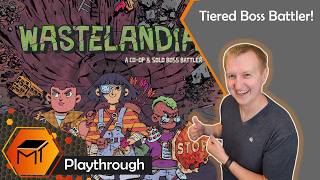
Wastelandia: A Co-op & Solo Boss Battler Deep Dive
What the Community Thinks About Wastelandia: A Co-op & Solo Boss Battler
Board game reviewers have embraced Wastelandia as a delightfully charming boss battler that merges thematic coherence with mechanically sound design. The consensus centers on a game that leans heavily into its post-apocalyptic, kids-on-bikes aesthetic while delivering genuine strategic depth beneath the whimsical surface. The Dice Tower praised the game's trajectory and pacing, while The Dungeon Dive highlighted how the game avoids being a simple luck-fest despite its dice-rolling core. There is near universal appreciation for how the game delivers a complete four-battle campaign in roughly two hours, making it accessible for casual gaming sessions without sacrificing decision-making complexity. Reviewers do acknowledge that Wastelandia's appeal is theme-dependent; players who embrace the narrative of teenage friends fighting mutated creatures and improvised robots will find far more satisfaction than those seeking a purely mechanical exercise.
Core Mechanics That Define Wastelandia: A Co-op & Solo Boss Battler
Dice Placement and Power Cube Management
Wastelandia's primary engine is a dice placement system where players roll five dice each turn and assign those results to various character abilities and items. The game provides a shared pool of power cubes that all players can spend to reroll any dice, creating a fascinating tension: players want to use rerolls to optimize strategy, but exhausting the pool leaves the group vulnerable. Reviewers highlighted how this shared economy encourages teamwork, as one player might sacrifice a good roll to refill the reroll pool so another player can attempt a powerful combo on their turn. The game begins players with twelve power cubes and provides multiple ways to replenish them through character abilities, keeping the currency flowing and allowing skilled play to mitigate dice-rolling luck.
Fear: The Mechanic That Makes Weak Hits Feel Powerful
Fear is the mechanical heart of Wastelandia, and reviewers consistently singled it out as the game's most innovative system. Both player characters and enemy bosses accumulate fear tokens throughout a battle, and fear amplifies all damage dealt to and received by the fearful character. Critically, fear does not decay between rounds; it persists and stacks up to a maximum of ten. This creates a dynamic where a player might stack fear on an enemy over two or three turns through specialized abilities, then deal a single point of damage with a basic stick attack that somehow inflates into eight or nine damage because of the accumulated fear. Players must balance managing their own fear to avoid taking amplified damage while strategically stacking fear on enemies to turn weak attacks into devastating blows. The fear mechanic also creates resource management across the four-battle campaign, since fear carries over between fights and players must decide when to use a courage ability to shed fear versus when to embrace it as a resource.
The Wastelandia: A Co-op & Solo Boss Battler Experience
Charming, Deliberately Silly Aesthetic
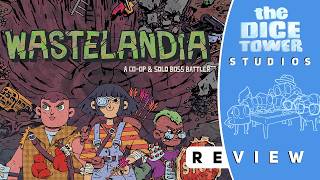
The art direction in Wastelandia is one of its defining strengths. Reviewers described it as having a childlike quality that somehow manages to be both skillfully executed and genuinely engaging. The visual design mirrors the game's narrative: kids improvising weapons from household items, building robots out of kitchen appliances. One reviewer noted the art feels like it was drawn by a child but with remarkable technical skill, creating a nostalgic impression of 1980s suburban adventure. The distressed, hand-drawn style of the game art carries this theme throughout, from the character designs of the protagonists to the absurd enemy creatures. This visual commitment means players who engage with the theme find themselves genuinely invested in the narrative beats between battles, enjoying story moments that would fall flat in a more generic game.
Quick, Satisfying Cadence
Wastelandia's pacing was consistently praised for delivering a complete campaign in two hours. Each battle lasts at most six rounds, creating a sense of forward momentum. More importantly, the rhythm of fight, loot, next battle gives the game excellent cadence. After defeating a set of enemies, players move to a loot phase where they draft new weapons and items, apply reward cards that heal or provide bonuses, and then roll a die to determine which boss they face next. This procedural beat-by-beat structure keeps players engaged without requiring a lengthy campaign commitment, making it ideal for a casual evening with friends. The randomization of which boss appears next adds unpredictability without introducing excessive chaos, since players have already drafted items and rewards to prepare.
What Makes Wastelandia: A Co-op & Solo Boss Battler Stand Out
Genuine Teamwork Through Shared Resources
Wastelandia feels like a cooperative game in practice, not just in label. Because the reroll power cubes are shared and regenerated through group effort, players naturally find themselves supporting each other's turns. One player might sacrifice a powerful attack to refill the cube pool, knowing the next player's turn will generate the big payoff. Another character might use a support item to boost a teammate's dice, creating synergies that wouldn't exist in a purely competitive game. Reviewers noted that this cooperation is organic rather than forced, emerging naturally from the game's economy rather than requiring explicit cooperative mechanics.
Strategic Depth Through Combo Building and Sequence
While Wastelandia features dice rolling, the game is decidedly not a simple luck-fest. The true skill lies in understanding how to build combos across available abilities and items. Some abilities manipulate dice values up or down, others trigger only when certain numbers are showing, and some activate only if a specific die is placed first. The order in which abilities are used matters tremendously because resolving one ability might change which dice are available for the next. Reviewers appreciated that the rulebook explicitly teaches this concept, explaining that strategic sequencing can turn mediocre rolls into powerful turns. Each character's starting item suite is unique, and the weapons and items drafted between battles further customize options, meaning character combinations feel genuinely different across playthroughs.
Potential Drawbacks
Component Quality Issues
The deluxe edition of Wastelandia includes unconventional dice with sculpted protrusions molded onto the die faces, and reviewers expressed concern that these dice may not roll fairly, though actual play testing did not reveal obvious imbalance. More problematically, the dark pips on the dice are difficult to read on camera and potentially challenging to read during play. The health tracker dial is also oversized and can shift during play if the table is bumped, requiring careful placement. These production issues appear to stem from the publisher being relatively young and early in manufacturing partnerships, but they were noted as minor friction points that detract from an otherwise solid game.
Game Length and Pacing at Higher Player Counts
Even at two players, one reviewer noted Wastelandia feels slightly long. At four players, turns accumulate and downtime increases, though the fixed four-battle structure prevents runaway game time. Since each player gets a turn per round and battles last up to six rounds, a four-player game could stretch closer to three hours. The game is not broken at higher player counts, but reviewers who prefer snappier pacing noted this as a mild concern.
If You Enjoy Wastelandia: A Co-op & Solo Boss Battler
Players who enjoy Wastelandia's dice-placement mechanics and combo-building will find similar satisfaction in Dice Throne, which shares Wastelandia's focus on rolling dice, manipulating outcomes, and triggering character abilities through clever placement. For those drawn primarily to the post-apocalyptic, kids-on-bikes thematic aesthetic, Ghost B Twix occupies the same cultural moment, though with different mechanics.
More broadly, Wastelandia appeals to players who want their games to deliver both thematic coherence and mechanical substance in roughly two hours. It is ideal for groups that enjoy cooperative decision-making, appreciate charming art and humor, and don't mind a bit of randomness tempered by strategic choices. Solo players can enjoy the full experience by controlling two characters, and the game scales gracefully from one to four players without requiring special rules.
What Reviewers Are Saying
"You can stack up to 10 points of fear on a baddie, do one point of damage with a stick, but end up doing 11 points of damage. I think that's really neat. I do really like that concept a lot."
— The Dungeon Dive
"As you can stack that up, that's so exciting. I love that mechanism. And it just it makes those weak hits feel really powerful without giving you these ridiculous weapons."
— Dice Tower
"I can feel the kids' personalities come out of the artwork. You know what I mean? And then, of course, everything else, the the distressed look of so many things in the game art-wise, the the look of this game is very very charming to me. I find it very, you know, very cute."
— Dice Tower