




Xi'an Deep Dive
What the Community Thinks About Xi'an
Reviewers who covered Xi'an tend to describe it as an underappreciated game that delivers more than its profile suggests. Chairman of the Board calls it a very quick game that has been thrown under the radar, and says they rate it highly despite its low visibility. The Dice Tower's Tom Vasel offers a more measured nod, calling it a pretty nifty game with neat statues and a painting theme worth exploring. Watch It Played is the most enthusiastic of the three, highlighting how the game's systems combine into a smooth playing experience.
The shared praise centers on pace, presentation, and integration. Frustrations are rarely raised, and the criticisms that do surface are mostly suggestions for what the design could add rather than complaints about what it already does. The consensus is warm, though it rests on relatively brief first impressions rather than extended play reports, so readers should expect an enthusiastic overview rather than a settled verdict on long-term depth.
Core Mechanics That Define Xi'an
Initiative-Based Card Play
Each turn, players draw four cards from a personal worker deck, choose two to play in the first round, and keep the other two for the second. Chairman of the Board explains that the number printed on each card sets its initiative, so higher values activate earlier and win ties on the initiative track. The cards are the engine of the game. Some act as tax collectors that produce money, others grant lasting powers, and Chairman notes that the timing of each play is a trade-off: a card played late loses some of its power but earns more points for the turn in which it is played. Watch It Played's Timothy W describes the same foundation as hand and resource management, which gives the card choices their weight.
Worker Placement and Statue Painting
Between card rounds, each player places a worker on one of the modular action spaces around the board. Chairman of the Board describes spaces that advance the Mausoleum track, let players trade clay for terracotta soldiers, paint soldiers with pigments, and buy equipment sets. Capacity on each tile is limited, and a player who arrives after an opponent may have to pay that opponent a coin. The Prime Minister marker rewards the first worker on a tile with a point and a coin. Painting is the thematic core. Soldiers placed in matching colors score points as they line up, and each section's area majority pays out larger bonuses as the sections move farther up the board.
The Xi'an Experience
Brisk Pacing
Reviewers repeatedly describe a game that moves quickly. Chairman of the Board says the six rounds fly by, and the rhythm of drawing, choosing two cards, then placing a worker keeps each turn compact. Tension comes from initiative. A player may need to decide whether a card's power is worth the activation position or whether to take a pigment instead. Chairman frames this as a steady, small pressure where planning ahead about tile access and turn order keeps the game from feeling idle between decisions.
Theme-Forward Crafting
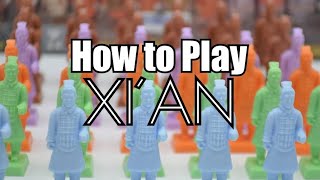
Watch It Played emphasizes that Xi'an feels thematic rather than attached to its theme after the fact. Viewer Timothy W's description of the systems tying into the work of crafting the Terracotta Army captures the way the design reads at the table. Tom Vasel responds to the visual side, finding the statues cool and the idea of painting them appealing. Chairman of the Board points to the board tiles, which form a panoramic drawing across the top row once they are placed. The miniatures reinforce the sense of building something physical on the table.
What Makes Xi'an Stand Out
Varied Endgame Scoring
Chairman of the Board highlights that the end-of-game objectives open different routes to victory. These include points per resource, bonuses for matched sets of equipment such as a horse, a chariot, and a crossbow, points for unused Mausoleum tiles, and extra points for equipping statues with cards. Chairman describes these as different strategies to work toward, so a player can pivot late without abandoning the board.
Smooth Integration of Euro Mechanisms
Watch It Played gives the strongest praise to how the many systems interlock. Timothy W lists hand and resource management, worker placement, set collection, and area majority, and says they combine into a smooth playing experience. The hosts also found the premise intriguing and the presentation visually appealing, which suggests the integration is what turns those first impressions into a smooth game rather than a set of separate ideas.
Potential Drawbacks
Room for More Interaction
Watch It Played's hosts were drawn to the miniatures and suggested the game could lean further into Ameritrash or dexterity elements, such as flicking pieces onto the board. Their comment reads more as a wish than a complaint, but it points to a design space that Xi'an does not currently occupy. Players who prefer loud, physical, or reaction-driven games may find the current design more cerebral than they want, particularly since the hosts framed their suggestion as a way to add more energy to the table.
Tight Action Spaces and Sharing Costs
Chairman of the Board notes that several worker spaces are restricted, so late arrivals may be shut out or must pay a coin to the player who got there first. Chairman of the Board describes the spaces as tight, which means players must move quickly to secure access. Winning a Prime Minister bonus can also swing a close race. Newcomers may find that the early rounds are spent managing tile access and turn order rather than exploring the wider strategy, which is a learning curve worth anticipating.
If You Enjoy Xi'an
Players who enjoy Xi'an's card-driven planning and the physical energy that Watch It Played's hosts wished the design had should look to Crocodile. Matthew of Watch It Played jokingly suggested mixing Crocodile into Xi'an, and described the game as a Canadian classic that everyone grew up playing. Players who enjoy the quick, tactical rhythm of Xi'an's six rounds will find that Crocodile offers a lighter, more immediate take on the same playful tabletop spirit, with the dexterity element the hosts felt Xi'an could use.
What Reviewers Are Saying
"It's a really good game. Check out my review if you haven't seen my review of it, because I really do rate this, and it's a really nice game that's kind of thrown under the radar."
— Chairman of the Board
"This game has all the euro mechanisms including hand and resource management, worker placement, set collection and area majority which all impressively fit together into a smooth playing experience that seamlessly ties into the theme of crafting the historic terracotta army as an artisan under the employ of the Chinese emperor."
— Watch It Played
"Xi'an here is about the Terracotta Army and painting them. It has some neat statues. I thought it was a pretty nifty game."
— Tom Vasel, The Dice Tower