

You're Bluffing! Deep Dive
What the Community Thinks About You're Bluffing!
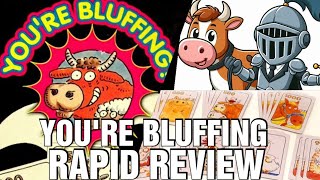
Reviewers who discuss You're Bluffing! tend to treat it as a light, playful bidding game that rewards a sharp read of the table. The most detailed commentary in this set comes from the Chairman of the Board channel, which has returned to the game in several videos. In a ranking video, the host places it second among the games most recently played and says the game has "aged very well," pointing to its quirky art style and its tension. In a separate games day video, the same host plays a four-player game with a variant that bids for two animals at a time, and still finds the game too long, despite enjoying the gameplay.
The consensus is that the core appeal holds up. Reviewers describe the game as a silly card game that still has real tactics once the table understands the bluffing, and the host of the ranking video notes that the game can land well with groups that might otherwise find the theme too wacky. The main point of disagreement is pacing. Some reviewers treat the length as a minor complaint that fades when everyone plays with urgency, while others see it as a real obstacle to returning to the game often. Both views accept that You're Bluffing! works best when the table is attentive and willing to commit to its bids.
Core Mechanics That Define You're Bluffing!
Set Collection
The deck is built around sets of farm animals, with four cards per animal, and the value of those sets varies dramatically. In the ranking video, the Chairman of the Board host explains that the chickens are only worth about 10 points per set of four, while the horses can be worth around a thousand points for each set of four a player holds. That spread gives every auction and trade a different weight. A single horse set can decide the game, while a chicken set barely moves the total. Players can also trade for the animal they need to complete a set, which turns acquisition into an ongoing negotiation rather than a simple draft.
Blind Bidding and Counteroffers
Trading in the game runs on a hidden bid. When one player holds an animal the other needs, both place a money card face down and reveal them at the same moment. The receiving player must either accept the offer or make a counteroffer for their own animal of the same type, and the host describes the outcome plainly: whoever bid more takes the cards, but the amounts are swapped. Because neither player knows the value of the other's money until the reveal, every offer carries a bluff. The host of the ranking video summarizes the result as "that real double think going into the game," where a player has to wonder whether an opponent is trying to rip them off or simply making a counteroffer of their own.
The You're Bluffing! Experience
Double-Think Tension
Reviewers describe the feel of the game as a constant contest of second guessing. Every money card placed face down invites the question of what it really holds, and the player on the other side has to decide whether to accept or push back. The host of the ranking video notes that the opponent is usually running the same calculation, which makes each trade feel like a small psychological duel rather than a math exercise. The tension builds most when players have already invested in a particular animal and must decide how far they will go to protect it.
Silly, Quirky Fun
The theme and presentation are deliberately playful, with a quirky art style and a light card game feel. The Chairman of the Board channel calls the game a lot of fun, and the host's comments suggest that the humor of the animals keeps the mood loose even when the bidding turns serious. The experience sits closer to a party game with real tactics than to a heavy auction game. Players who expect a dry strategy title may be surprised by how much laughter the table produces, and that combination of silliness and sharp decisions is a large part of why reviewers keep coming back to it.
What Makes You're Bluffing! Stand Out
A Closed Economy Without Change
Reviewers praise the way the money works. The denominations are fixed, and nothing is hidden about the total supply. The ranking video host explains that players can never get change from those cards, which means the amount of money in play is always known. That closed economy gives players the freedom to hoard cash if they choose, and it also creates pressure, because a player who lacks the small denominations may be forced to overspend. The host calls this a very enjoyable experience, and the transparency of the economy is one of the features that most separates the game from other card-based trading games.
Lands With Groups That Are Unsure
The Chairman of the Board host admits to apprehension that the game might be too wacky for the group, with no certainty how it would be received. In practice, it went down well. That willingness to embrace the silliness is a notable strength, because it turns what could be a gimmick into a game that a varied table will actually want to play again. Reviewers who favor lighter games in particular seem to value that accessibility, since the core decisions remain interesting even when the rules are simple.
Potential Drawbacks
Length at Higher Player Counts
The most consistent criticism is that the game can run long. The host of the ranking video says it can go a little long, feeling the game had already played out before the end. The risk grows when players drag their heels, particularly at higher player counts, and a table without a sense of urgency can fall into that trap. In the games day video, the host reports a four-player game that took 37 minutes and 36 seconds even with the speed-up variant, and says it would have been better to see it come in around 20 minutes, suggesting the game could benefit from a second edition that speeds up play.
Strict Denominations Force Overspending
The second concern is the fixed money system. Because the cards come in set values and can never be broken into change, players sometimes have to pay more than they intended. Reviewers who appreciate the closed economy still acknowledge that this rigidity can sting, particularly for a player who has been saving smaller denominations for a specific trade. The tradeoff is clear: the transparency of the money makes the game easier to read, but the lack of change can make an offer feel more costly than it should.
If You Enjoy You're Bluffing!
Players who enjoy the bidding and bluffing at the heart of You're Bluffing! may want to try QE, which the games day host praises as a great auction game. In QE, a player can bid whatever they want, but spending too much money automatically disqualifies them from winning. That pressure to bid carefully mirrors the money management of You're Bluffing!, and it adds a different kind of restraint to the same style of bidding.
The Bunk is another title that reviewers would likely enjoy for its wagering tension. The host describes it as a game in which players place double tokens or bluff tokens on different gambling tables and move their pawns around hoping to land the jackpot. Like You're Bluffing!, it asks players to read the intentions of others while committing resources to uncertain outcomes, and it rewards the same willingness to take a calculated risk.
What Reviewers Are Saying
"But what I do love about this game is this bluffing mechanism where if you and an opponent have the same type of animal in your scoring Tableau then you can actually try to get or try to almost bribe your opponent to give you that card by playing these money cards face down in front of them."
— Chairman of the Board
"The money comes in very strict denominations as well, ranging from 10 up to 50, up to 100, up to 200, up to 500, and you can never get change from those cards. So sometimes you are forced to overspend because you simply do not have the smaller card denominations."
— Chairman of the Board
"And this one, I really like the gameplay, but it is too long, even with the variants to speed up the gameplay. I would have loved to see this one come in around 20 minutes. I think, despite me really enjoying it, I think this one could use a second edition just to speed it up."
— Chairman of the Board