


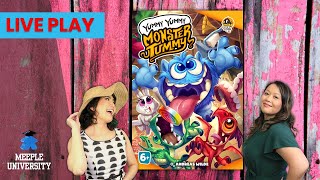




Yummy Yummy Monster Tummy Deep Dive
What the Community Thinks About Yummy Yummy Monster Tummy
Reviewers largely agree on what Yummy Yummy Monster Tummy is: a bright, quick, app-assisted cooperative game about mixing colors, aimed squarely at families. Published in 2021 for two to four players, it places children in a grandparent's attic, where friendly but hungry monsters must be fed the right color blends. Most commentary treats it as a family title first, and the strongest praise comes from how well it works for young players while still holding the attention of adults.
The warmest response came from The Dice Tower, where Tom Vasel, The Dice Tower named it their favorite kids game in a Pile of Mid Games episode. Tom Vasel described it as a kid-friendly re-implementation of Soviet Kitchen Unleashed and was surprised by how well the group-blending system works. Rolls in the Family, the channel run by Ryan, included it among its recommended kids games for four-year-olds, valuing the way it introduces color theory without requiring much explanation. Stella, Meeple University found the game harder than its box suggests, failing the hard setting several times before settling into medium difficulty, while still calling it a game Stella would happily bring to adult friends.
The most measured take came from Board Gaming Ramblings in its Keep or Call episode, where the hosts chose to let the game go. They described it as closer to a little activity than a game they would return to, and they found the 3D monsters on the app more menacing than adorable. Their Essen vlog was warmer, noting that children responded well to the slowly filling scale that shows whether a feeding succeeded.
Core Mechanics That Define Yummy Yummy Monster Tummy
Hand Management
Each player holds a hand of item cards, such as a fish, a pair of underwear, or a rocking horse, and each round every player must contribute one card to feed the current monster. Players draw only one replacement card per round, so the table must decide which colors to spend immediately and which to hold for a harder monster. Rolls in the Family's Ryan and Toby both described this as a genuine decision point once special rules enter the picture. Vitamin cards are the clearest example: monsters dislike vitamins, so feeding one starts a meter that blocks another vitamin for a few cards, while certain rabbits in later levels require them. Dragons add another twist because they prevent the hand from refilling, so a run of them forces the team to work with whatever colors remain. Meeple University identified the publisher as Lucky Duck Kids, the kids' line behind the title.
Cooperative Game
The table wins or loses as a single unit. When the blended color lands too far from the monster's shade, the whole group fails and must restart the level, which turns every feeding into a shared decision rather than a personal one. Meeple University's players called the experience basically cooperative, and their attempts on the hard setting showed how quickly a level can slip away when one card misses. Story Mode unlocks new places, cards, and abilities across its levels, while Party Mode opens everything at once for a single session. Reviewers also noted that a wild candy card always matches the current creature's color, giving the group a safety valve when no other option fits.
The Yummy Yummy Monster Tummy Experience
Collaborative
Talking is part of the design. Meeple University's hosts explained that conversation is not only allowed but encouraged, although simply holding up a card to the table is not enough to make a match clear. The result is a chatty, collaborative table where players negotiate which shades will blend, joke about their colors, and react as a monster either purrs its approval or fails to finish a feeding. When the group tried a round in silence to focus, they reported that the tension rose noticeably. The shared outcome means a failed monster lands on everyone, which produces groans and laughter rather than blame.
Gateway and Accessible
The app carries much of the load, so the rules feel light even for beginners. Rolls in the Family called it a really quick, easy game, and the family's five-year-old Toby, who joins the channel's video on their favorite games, noted that three or four players make the color mixing more forgiving when one player is missing a shade. A symbol at the bottom of the screen shows how many items still need feeding, and sound effects give each success a playful reward. The scanning step asks for patience, but the overall atmosphere is cheerful and low pressure, which is why reviewers consistently place it among their first recommendations for children who are new to tabletop games.
What Makes Yummy Yummy Monster Tummy Stand Out
Learning Color Mixing Through Play
Reviewers repeatedly highlight the educational angle. Rolls in the Family explained that players learn to approach a shade, such as orange, by combining red and yellow even when no orange card is present. Ryan's wife, who has a background in color, enjoys the way the game teaches which colors can combine to create other colors. The game does not announce these lessons, which is why parents and reviewers describe it as learning that happens through play rather than instruction. The Dice Tower also praised how reliable the blending feels, noting that the group-driven approach surprisingly works well.
Special Cards That Shake Up Every Session
Rainbow monsters take the color of the first card played, dragons stop the hand from refilling, and wild candy fills any gap, so no two sessions unfold the same way. Toby's Top 20 video showed how children track these rules and talk about them at the table, while Board Gaming Ramblings noted that the campaign unlocks new cards with new abilities as it progresses. Reviewers appreciate that these twists are simple enough for children to grasp yet still change strategy in a meaningful way.
Potential Drawbacks
Scanning Friction and App Dependence
The game depends on the phone or tablet camera, and reviewers ran into real friction. Meeple University's players repeatedly adjusted their devices, held cards five to ten inches from the lens, and wondered whether a heavy skin-care routine was interfering with the camera. Board Gaming Ramblings felt the scanning process turned the session into more of an activity than a game. Players who prefer a traditional card game may find the reliance on hardware tiresome.
Limited Replay Value for Experienced Players
Reviewers consistently frame Yummy Yummy Monster Tummy as a kids' game, and that framing shapes how well it holds up for adults. Board Gaming Ramblings decided it would not be replayed in their collection, while Meeple University's group enjoyed the challenge but noted that the hard setting's added shades can make matches genuinely difficult to judge. Players who have outgrown family titles may find the core loop of feeding monsters less compelling after several sessions.
If You Enjoy Yummy Yummy Monster Tummy
Players who enjoy the cooperative color matching of Yummy Yummy Monster Tummy will find a close cousin in Chronicles of Crimes (Kids Edition), which Meeple University compared directly for its app-guided, phone-scanning family play. Those drawn to the color mixing itself should look at Soviet Kitchen Unleashed, the game The Dice Tower identified as the original behind this kid-friendly version. Players who want a cooperative step up after the kids' version will find Kraken Attack a natural next game, which Rolls in the Family described as a stepping stone to lighter cooperative titles. For families building out a broader kids collection, the My First Games line offers another accessible starting point for young players.
What Reviewers Are Saying
"It's an app assisted game, so we play this with an iPad that has an app on it, but then it also has a deck of cards, and this is a game that you're cooperatively using color theory to feed these monsters."
— Rolls in the Family
"Everyone puts in their colors and hopes that it evens out to be that color. It surprisingly works really well."
— Tom Vasel, The Dice Tower
"Yeah, basically cooperative, and we just match, we match the monster colors, and it's harder than we thought."
— Stella, Meeple University