


Zombie Tower 3D Deep Dive
What the Community Thinks About Zombie Tower 3D
Zombie Tower 3D divides reviewers sharply. Board to Death TV and The Dice Tower embrace the game's ambitious design and cooperative puzzle, while BoardGameBollocks rejects it outright as fundamentally broken. This isn't a case of niche taste; the gap reflects genuine disagreement about whether the game's central mechanic succeeds or fails.
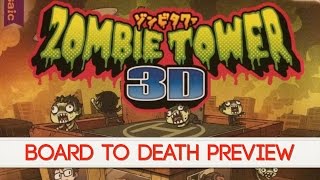
Board to Death TV, represented by John Carlo and Felicia, leans hard into the game's production value and creative ambition. They describe it as a prototype that rivals finished products in craftsmanship. The Dice Tower's Tom Vasel, who ranked it in a top 10 zombie games list, praised the hidden information mechanic as an elegant solution to a specific gameplay problem. By contrast, BoardGameBollocks, in two separate videos from their comprehensive collection review, calls the game a disaster. Their language is unambiguous and unapologetic: disappointing production choices, fundamental design problems, and a game that doesn't work in practice despite its promising concept.
Core Mechanics That Define Zombie Tower 3D
The 3D Tower and Vertical Movement
The physical centerpiece is a standout. Players build a vertical tower on a two-sided board during setup, one configuration for three players and another for four. Each player occupies their own side of the building, with characters moving through rooms and climbing fire escapes and stairwells to navigate the structure. Items drawn from the search deck (weapons, tools, and survival gear) become central to progression. The production quality of this 3D element impressed Board to Death TV, who noted that the prototype quality exceeded many finished games on store shelves. The construction is robust enough to survive repeated handling and plays as part of the experience, not an afterthought.
Hidden Information and Cooperation Under Communication Pressure
The game enforces a crucial constraint: each player can see only their own side of the tower. This separation creates a cooperative puzzle where survival depends on describing situations, calling for help, and sharing critical information. Tom Vasel identified this mechanic as solving a classic board game problem: the alpha gamer, the player who tends to quarterback everyone else's moves. With hidden information, natural communication becomes mandatory. Players slip items through small slits between the walls to help teammates they cannot directly observe, introducing both a thematic detail and a practical constraint on how quickly help can arrive. Reviewers who engaged deeply with this system saw it as a clever integration of theme and mechanism.
The Zombie Tower 3D Experience
Cooperative Tension and Blind Collaboration
Playing Zombie Tower 3D places players in a genuinely cooperative situation where communication replaces direct control. Teams must evacuate the building before it collapses, rescue survivors, and fend off zombies that appear via the emergence deck. Each round, zombies move according to predictable rules, turning civilians into new threats if they occupy the same rooms. The fog of war, each player blind to the other's crisis, creates a distinctive emotional arc. Teams experience both the satisfaction of coordinating across physical barriers and the frustration of miscommunication or unexpected emergencies on unseen floors. Tom Vasel's description of the gameplay captures this blend: the fun of thematic combat against zombies, balanced with the real challenge of staying coordinated when sight lines don't exist.
Emergent Narrative and Risk-Reward Choices
Survivors trapped in the building represent both assets and liabilities. Players can rescue civilians and carry them toward the escape point for victory points, but those same survivors become targets for zombie attacks. A player facing a zombie wave can sacrifice civilians to reduce incoming damage, turning allies into ammunition. These grim choices create narrative moments where the mechanical ruleset intersects with theme. The system generates stories: desperate last stands, unexpected cooperation, and tragic losses. Whether these moments land as thrilling or frustrating depends heavily on how well the game's underlying systems perform, a point on which reviewers disagree sharply.
What Makes Zombie Tower 3D Stand Out
Innovative Take on Cooperative Friction
Most cooperative board games either assign roles with clear information separation or use a timer to create pressure. Zombie Tower 3D achieves both simultaneously through physical separation. The hidden information is not a puzzle to solve; it's a permanent condition of play. Tom Vasel specifically highlighted the game's solution to the alpha gamer problem as distinctive in zombie games, which typically pit teams against predictable AI-controlled threats. Here, the unpredictability comes not from the zombie AI but from not knowing what your partners face on their sides of the tower. This forces genuine interdependence and conversation.
Production Design That Commits to the Concept
The 3D tower is not window dressing. The vertical board, the slots for passing items, the player barriers that enforce the hidden information rule, and the overall component quality all reinforce the central idea. Board to Death TV's emphasis on the prototype quality matters because it signals confidence in the design. When reviewers note that a prototype looks like a finished game, they're acknowledging that someone invested in the physical expression of the ruleset. This level of craftsmanship is rare in Kickstarter prototypes and suggests the designer understood that the hidden information mechanic needed physical, not just narrative, support to feel legitimate.
Potential Drawbacks
Emergence Deck Depletion and Game Balance
The game includes a loss condition: if the emergence deck runs out twice during play, the team loses. Board to Death TV mentions drawing too many cards from the search deck as a risk, suggesting that resource management and luck can converge to create runaway failures. The team can thin the civilian and zombie population, but random draws power progression. This creates a tension between the cooperative puzzle (coordinating across hidden information) and the resource puzzle (managing card draws). Reviewers who embraced the game see this as acceptable friction; those who rejected it saw it as evidence of incomplete design.
Complexity and Accessibility Issues
BoardGameBollocks' persistent criticism points to a game that promises innovation but delivers frustration in practice. The gap between the concept (hidden information, cooperation, thematic zombie survival) and the execution (the actual rules, pacing, win conditions) appears to be where the game fractures. One reviewer called it a "disaster waiting to happen," suggesting that while the idea is sound, the implementation creates problems in actual play: perhaps pacing drags, perhaps the hidden information creates unresolvable conflicts, perhaps the balance between easy and impossible is broken. Without specifics, the nature of this criticism remains opaque, but its consistency across two separate reviews signals something systemic rather than subjective.
If You Enjoy Zombie Tower 3D
Players drawn to Zombie Tower 3D's cooperative hidden information mechanic will find similar satisfaction in other games that separate player knowledge. Space Base and Pandemic explore cooperation, though without the information barrier. The Resistance and Coup create hidden information in the social deduction space. For the 3D or vertical board appeal, Descend: Legends of Dark and Gloom of Kilforth offer dungeon exploration with shifting challenges. The specific combination of zombie theme, communication pressure, and 3D construction is harder to find; Dead of Winter captures the zombie apocalypse cooperative tone, and Escape: The Curse of the Temple delivers time pressure and frantic cooperation, but neither matches the physical barrier to information that defines Zombie Tower 3D's most distinctive feature.
What Reviewers Are Saying
"It's a really nice prototype. This is probably the best pro I've seen. I've seen finished games that look worse than this."
— Board to Death TV
"And this is a neat way to get rid of that alpha gamer where someone a quarterback or telling everyone what to do. But you can slip items to each other through little slots in the walls. And you're helping each other, but y'all got to survive as these zombies are going and you're going up and down fire escapes and through stairwells and stuff. And I found it to be kind of a fun thematic way to fight them."
— Tom Vasel, The Dice Tower
"I know it looks absolutely fantastic on the back of the box, but believe you me, this is a disaster waiting to happen. In fact, I'm hoping that somebody burns this tower down into the ground. This is an absolute steaming pile of dump and I'm gonna burn it in my garden when I'm finished with this video."
— BoardGameBollocks