



The Elder Scrolls: Betrayal of the Second Era Deep Dive
What the Community Thinks About The Elder Scrolls: Betrayal of the Second Era
Reviewers who already knew Chip Theory Games from Too Many Bones tend to land somewhere between impressed and won over. Board Games UnLocked framed an entire comparison episode around how directly the new game grows out of Too Many Bones, while BoardGameCo called it an excellent game that borrows the older title's dice-management system and makes it very much its own by leaning into the Elder Scrolls license. On the Hungry Gamer channel's annual bracket, co-host Mark argued for it as a modern masterpiece against a rival campaign game, and the hosts noted it had already won the group's game of the year honors before.
Not everyone lands on unqualified praise. Shelfside published a two-scorer review that split between a six out of ten and a four out of ten, with one voice calling the whole design a flawed gem and the other describing a personal history with the game that swung from wanting to give it a ten after one session to considering it among the most disappointing games played that year. Beyond Solitaire, whose host disclosed editing the game's rule book and having a financial and personal connection to its development, is the most consistently glowing source and should be read with that relationship in mind. That reviewer still frames the piece as an honest comparison against Too Many Bones rather than pure promotion, but the disclosed connection sets it apart from the other channels covering the game.
Core Mechanics That Define The Elder Scrolls: Betrayal of the Second Era
Freeform Character Building Instead of Fixed Gear Locks
Where Too Many Bones hands every gear lock a printed mat with specific slots for specific skills, Beyond Solitaire explained that every character in this game shares the same blank mat and everything else comes from choices the player makes, including race, starting stats, and how far to build into any given skill line. Board Games UnLocked framed the same difference as freedom versus structure, noting that a player can pour points into stamina for an archer build or spread them differently on a second attempt with the same character, since the game is built around a single mini-campaign per character rather than a fixed, repeatable mat. That same freedom is also what the channel pointed to as a teaching challenge, since a new player can be met with open-ended choices instead of a pre-set path.
Cooldown Tracks, Clashes, and Delves
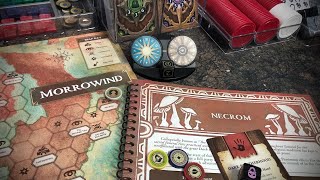
Shelfside broke combat down into engagements where dice from a character's skill lines are rolled against enemies, with spent dice landing in a cooldown row that returns a set number each turn according to a character's cooldown stat, and status effects and fatigue dice competing for the same limited space. Beyond Solitaire singled out that cooldown row as one of the most interesting things about the design because it keeps dice cycling in and out of play in a way that Too Many Bones's simple exhausted-or-not dice never did. Shelfside also detailed that battles come in more than one form, the most common being a clash fought on its own mat, alongside delves that rearrange tiles and enemies differently every time, which Board Games UnLocked separately compared to a hybrid of Too Many Bones and Cloudspire battle staging.
The The Elder Scrolls: Betrayal of the Second Era Experience
A Costly, Table-Hogging Commitment
BoardGameCo ranked the box among the biggest on their shelf and said the only real problem with the game is that it costs over two hundred dollars just for the base box, with everything else requiring an all-in pledge to access. Board Games UnLocked backed that up with numbers from the game's own crowdfunding campaigns, pricing the first campaign's all-in pledge at roughly four hundred dollars and a second campaign at around three hundred eighty. Beyond Solitaire, who already considered Too Many Bones a table hog, said this one takes up even more space.
A Long Campaign With Real Peaks and Valleys
Shelfside logged roughly ten to twelve hours to finish a single campaign and described the experience as genuinely conflicted, with sessions spent rolling dice, leveling a character, and finding new items feeling great, while sessions spent reading the story felt cartoonish and confusing. Board Games UnLocked raised a related concern about teaching the game, pointing out that even the simplest characters can leave new players facing decision fatigue over open-ended build choices, in contrast to Too Many Bones's more guided character sheets.
What Makes The Elder Scrolls: Betrayal of the Second Era Stand Out
Component Feel Reviewers Keep Praising
Shelfside called it the most physically pleasant game ever played, citing the amount of neoprene used across the mats and the tactile satisfaction of moving chips and dice, and said the components alone were pulling the overall score upward. Beyond Solitaire likewise pointed to the chunky dice and upgrade slots inherited from Too Many Bones as some of the most enjoyable parts of the design to physically interact with.
Deeper Customization Than Its Predecessor
Multiple channels circled back to the same core selling point: this game lets a player shape a character far more freely than Too Many Bones ever did. Hungry Gamer's Mark argued that the game lets someone build an unconventional combination, like turning an orc into an acrobatic, two-handed-sword-wielding character, when most campaign games hand out a narrower archetype, and praised the dice mitigation and story systems that come with that freedom. Beyond Solitaire framed this as watching Chip Theory's design ideas mature, with battle stances letting a character switch roles mid-campaign instead of being locked into one lane for the whole game.
Potential Drawbacks
A Story That Reviewers Found Thin or Cartoonish
Shelfside was the most direct about the narrative, saying the plot rarely explained why the party was doing what it was doing and that the writing leaned on dated pop culture references and puns that undercut the seriousness of the world in turmoil. That same review suspected the team built the system outward from Too Many Bones first and applied the Elder Scrolls license afterward, arguing that some enemy abilities do not match how those creatures behave in the source material.
A Steep Price of Entry and a Lot to Teach
BoardGameCo's central complaint was the cost, suggesting the game deserves a smaller, cheaper entry box the way Too Many Bones eventually got with Unbreakable, so newcomers are not required to buy in at the full all-in level just to try it. Board Games UnLocked echoed that the sheer number of build choices can overwhelm a table being taught the game for the first time, since even the easiest character in the box still asks a new player to make decisions without the guardrails Too Many Bones provides.
If You Enjoy The Elder Scrolls: Betrayal of the Second Era
Nearly every channel that covered this game came to it through Too Many Bones, and Board Games UnLocked, Beyond Solitaire, BoardGameCo, and Hungry Gamer's Mark all frame it as that game's direct successor, built on the same dice-management chassis with a deeper character-building layer on top. Board Games UnLocked also compared its battle staging to Cloudspire, describing the combat as feeling like the two Chip Theory systems merged into one. On the Hungry Gamer bracket, Mark argued it over Aridia specifically for players who want to build unconventional characters rather than pick from a narrower set of premade heroes. Shelfside pointed players who want a stronger story and more Awakened Realms-style overland exploration toward Tainted Grail, and suggested fans of nuanced dungeon-crawling mechanics look at Gloomhaven instead if the plot here does not land.
What Reviewers Are Saying
"So, there are dice that just leave combat until the next battle, but typically they're going to come down to this row. And actually, I think this cool down row is one of the most interesting things about Elder Scrolls as a game."
— Liz Davidson, Beyond Solitaire
"It's a flawed gem. It's not a flawed diamond or a flawed ruby. It's more like a flawed opal. It's not as nice as a diamond, but it does come in a really nice jewelry case."
— Shelfside
"You can replay and replay Elder Scrolls as many times as you want. You will have a different journey and just as rewarding a journey every time you play it."
— Mark, Hungry Gamer