










































The White Castle Deep Dive
What the Community Thinks About The White Castle
The White Castle has quickly become one of the most talked-about Euro games since its 2023 release by Devir, climbing rapidly in board game rankings and drawing passionate responses from reviewers. The game presents a fascinating paradox: widely acclaimed with outstanding components and elegant design, yet deeply divisive in how reviewers experience its core gameplay loop. Some view it as a masterclass in mechanical efficiency, while others find it conceptually hollow despite its beautiful presentation.
Core Mechanics That Define The White Castle
Dice Drafting and Placement
At its heart, The White Castle deploys a deceptively simple act, selecting one die from either end of three color-coded bridges each turn, that carries profound consequences. Players draft from a limited pool where die position locks out options: only the highest and lowest values of each color remain available, forcing continuous tactical choice about which die to claim and from which bridge. The value difference between placed die and board space generates or costs coins, creating a resource puzzle that interweaves with every subsequent action. This mechanism brilliantly compresses worker placement territory into nine total turns across three rounds, making each decision weight heavily on the trajectory of the entire game.
Cascading Engine Building
The player board's lantern action evolves as reviewers place courtiers in the castle, collecting cards that stack into an increasingly powerful action. Early turns feel constrictive; by the endgame, triggering the lantern unleashes a chain of bonuses that can feel genuinely triumphant. Placing gardeners, warriors, and courtiers in different castle zones unlocks synergies: courtiers unlock cards that replace board actions, warriors multiply their points based on courtier count, and gardeners grant bonus actions at round end. This interlocking design ensures that even simple placements compound into satisfying combos where one turn's setup cascades into multiple beneficial chains.
The White Castle Experience
Satisfyingly Tight and Economical
The game maintains extraordinary economy throughout. Resource caps at seven units force constant tradeoffs; reviewers cannot hoard for future turns but must spend immediately or accept opportunity cost. This tightness eliminates dead turns: every action generates multiple resources or points, creating the sensation of doing far more in nine turns than seems physically possible. The puzzle-like nature of squeezing maximum value from scarce actions feels genuinely rewarding for players who embrace the optimization challenge.
Quiet and Contemplative
Conversely, the experience tends toward silence. Turns involve lengthy chains of internal calculation where players mentally navigate resource conversions without visible dramatic moments. No betrayals, reversals, or shocking plays punctuate the session. Instead, reviewers describe a meditative state of conversion puzzles: acquire resources, convert them into placed workers, then convert worker placement into points. Some embrace this focused problem-solving; others find the muted table energy and lack of memorable moments leave the experience feeling emotionally flat despite mechanical engagement.
What Makes The White Castle Stand Out
Astonishing Component Quality
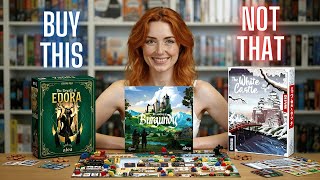
Reviewers uniformly praise the production as exceptional for the price point. Three distinct wooden meeple types with clear silhouettes, beautiful hand-painted castle artwork, elegant wooden markers, and crystal-clear iconography create immediate visual appeal. The 3D bridges function perfectly: tall enough to separate available dice without blocking sightlines. Card quality ranks among the finest in hobby gaming, no sleeving required after dozens of plays. The entire package feels premium while remaining accessible in cost and storage footprint.
Elegant Brevity with Surprising Depth
The nine-turn structure means games finish in 45-90 minutes despite feeling mechanically rich. Players rarely feel like they accomplished everything they wanted; the ending lands at precisely the moment when the engine peaks. This creates the delightful desire to replay immediately rather than exhaust satisfaction. Yet brevity masks genuine strategic variety: three paths through the game (castle courtiers, gardens, or warriors) offer distinct point sources, and variable starting cards, random castle action assignments, and different garden card distributions reshape viable approaches each session.
Potential Drawbacks
Theme Disconnection and Abstract Presentation
Despite the Japanese castle setting and historical inspiration from Himeji Castle, the gameplay remains resolutely abstract. Theme application feels thin; mechanisms could function identically with any aesthetic. The art and presentation carry the thematic weight while the mechanics ask purely mathematical questions about resource optimization. Reviewers note no memorable narrative moments or thematic triggers that reinforce the setting during play, making the game feel conceptually hollow regardless of visual polish.
Variable Setup Impact on Balance
Two-player and solo experiences suffer from setup variance. Random starting card pairings and castle action distributions occasionally create unbalanced configurations where first-player advantage becomes overwhelming or specific resource pathways dominate viable strategies. Solo mode against a simplified AI opponent generates excessive consistency, allowing players to exploit robust strategies while the bot makes deterministic, unresponsive moves. At higher player counts, card turnover and open spaces mitigate these issues, suggesting the game finds its best expression at three or four players rather than its nominal two-player mode.
If You Enjoy The White Castle
Readers seeking similar experiences might explore Castles of Burgundy for worker placement with dice but longer play, Puerto Rico for action drafting and economic tightness, Splendor Duel for two-player Euro competition at similar length, or Red Cathedral by the same design team for a slightly meatier experience in comparable footprint. Brass: Birmingham, Gaia Project, and Imperium offer richer thematic integration if the mechanical polish of White Castle appeals but its thinness disappoints.
What Reviewers Are Saying
"This game has nailed the feeling of how am I going to do anything with only nine turns, and then you do so many things and holy cow. There's so many of these fun combos where you get this and it gets you this action and then this castle gets you a card and then getting that card gets you that action and that does something else."
— Allies or Enemies
"The resources are unbelievably tight. Every single time you're using like you don't have change; you're anytime you're doing anything really you're basically using the maximum amount of resources. The trick is doing that thing and then hopefully getting some resources out of the thing that you did to set you for the next thing you're doing."
— Allies or Enemies
"There's something to say for a game where there's very simple instruction yet very deep decisions. By the end of the game you're making these connections like oh this is connected to that and that garden's very powerful but I really needed to go to the yard, those aren't worth anything unless I'm moving courtiers up the castle, but now I'm making this really powerful action on my board."
— Neon Gorilla