/pic6079108.png)


/pic6079108.png)





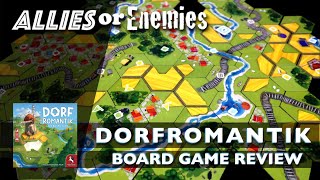
































Dorfromantik Deep Dive
What the Community Thinks About Dorfromantik
Dorfromantik stands out as one of the most beloved cozy board games in recent years. Reviewers consistently praise its ability to deliver a uniquely relaxing experience while maintaining genuine engagement. Across gateway, solo, and cooperative rankings alike, the sentiment remains remarkably consistent: Dorfromantik excels at creating a calming, satisfying puzzle that draws players back again and again.
The game's appeal transcends traditional player preferences. 3 Minute Board Games notes that this is one of the few board game adaptations that genuinely captures the feel of the video game remarkably well, while Allies or Enemies describes it as their current favorite game of all time. The combination of accessibility, depth, and sheer pleasantness makes Dorfromantik feel like a rare achievement in modern tabletop design.
Core Mechanics That Define Dorfromantik
Tile Placement with Purposeful Constraints
At its heart, Dorfromantik is a tile-placement game where each turn players draw a landscape tile and place it into a growing hexagonal map. The elegance lies in the simplicity of the core rule: tiles must connect by terrain type and follow basic connectivity rules for rivers and trains. There are very few placement rules or restrictions compared to other games in the genre, which reviewers identify as one reason the game feels so cozy and forgiving.
The decision space in tile placement revolves around which region to grow next. Players always have three active objective tiles showing them which terrain type and which specific region size they need to complete to score. This creates a natural rhythm: grow a forest cluster to size four, then abandon it to start a grain region, all while a river builds slowly in a third area. The puzzle emerges from deciding when a region is large enough to complete and move on, versus holding out for one more tile that would increase the scoring bonus.
Legacy Campaign and Progressive Complexity
After each game, players advance on a campaign track based on their score. Reaching certain milestones unlocks boxes containing new tiles that fundamentally alter the game. Each new module introduces fresh mechanics gradually. Allies or Enemies observed that as you go through the campaign and unlock new tiles, all of them add just a little bit more to the game like one more mechanic, but it never feels like too much. Totally Tabled's solo review praised how these modules keep things fresh, with real delight in opening each new box. The legacy structure provides long-term progression while respecting the game's zen aesthetic by introducing complexity in carefully measured doses rather than all at once.
The Dorfromantik Experience
Cooperative Serenity and Social Puzzle-Solving
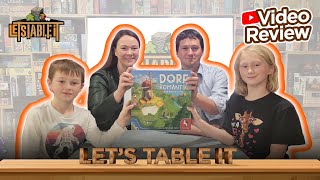
Dorfromantik is a cooperative game where all players win or lose together, though technically there is no losing condition; players simply track their score and try to beat it on future plays. The cooperative nature removes player elimination and competitive tension. Instead, players discuss placement strategy, weigh options together, and celebrate when a difficult objective clicks into place. Let's Table It noted that this cooperative design is one of the game's greatest strengths: it is a tile-placement game but it is also cooperative, unlike most tile-placement games.
Reviewers describe the emotional experience as uniquely calming. Allies or Enemies calls it a warm blanket and a hot chocolate as a board game. The satisfying way players make things match, combined with the pleasant theme and colorful artwork, creates an almost meditative quality. Totally Tabled placed Dorfromantik at the far low end of the stress spectrum, virtually eliminating the mechanical sources of tension endemic to modern board games. The experience is fundamentally about shared problem-solving in a beautiful, low-stakes setting.
Addictive Replayability and Solo Mastery
Despite being cooperative, Dorfromantik works exceptionally well at player counts from one to six. Solo play transforms the game into a pure optimization puzzle where the player controls all placement decisions and faces only the puzzle itself. Let's Table It reported playing the game at least six times in three days, driven by a puzzly nature and wanting to see if they could get a better score and see what is coming next. The luck in tile draws can feel frustrating when suboptimal objectives appear, but this same randomness ensures no two games ever play quite the same.
Allies or Enemies noted that even after playing through the campaign multiple times, they can see themselves playing through it five or six times before getting close to being bored of the game. Each new module in the campaign changes the puzzle just enough to feel fresh.
What Makes Dorfromantik Stand Out
Accessibility Married to Genuine Depth
Dorfromantik is immediately teachable to newcomers, yet offers enough strategic meat for experienced gamers. But beneath this simplicity lies a genuine optimization puzzle. Let's Table It described playing as super addicting, not because the game has complex rules, but because the light game with simple rules hides real strategic decisions about scoring priorities and regional development. Allies or Enemies included Dorfromantik in their top 10 gateway games specifically because it teaches nothing but delivers real satisfaction.
The art design and component quality reinforce accessibility. The theme is immediately clear: you are building a charming village landscape. There is no chrome or unnecessary complexity. Every element serves the puzzle. The cute and colorful artwork, as Totally Tabled noted, reinforces the cozy feeling without requiring thematic buy-in.
Emotional Resonance and Player Agency
Dorfromantik succeeds emotionally where many cooperative games fail. Players make every meaningful decision. No game state is ever truly lost; only future scoring potential is. Instead, players remain engaged because their choices matter and recovery is always possible. Allies or Enemies described this as hitting the mark on providing enough little guidance, with three active objectives giving direction without prescribing a single correct path.
The legacy system provides narrative arc and surprise without feeling cheap. Allies or Enemies emphasized that you can reset the game completely and playing it again is almost as good as it was the first time. The campaign structure ensures veterans and newcomers each find something new on subsequent plays.
Potential Drawbacks
Luck Variance and Frustration Spikes
Dorfromantik is not immune to the randomness inherent in tile-draw games. When the game serves up objective tiles in poor sequence (for instance, a six-length objective before completing a five-length objective), players can find themselves boxed into suboptimal regions or forced to discard valuable objectives. Let's Table It noted that success depends not just on which tile you draw but on which goals arrive in which order; with the right sequence you are set up well, otherwise it can feel like battling uphill. Reviewers acknowledge this can create frustration on individual turns.
However, they also note that this frustration differs fundamentally from loss-state frustration in competitive or heavily punishing games. Totally Tabled's gateway-games review observed that these frustrations make you want to keep playing and do a little better next time; the game is light enough that it never reaches put-it-away frustration. The frustration is motivational rather than demoralizing.
Solo Play as Stronger Experience Than Multiplayer
While Dorfromantik accommodates groups, some reviewers prefer it as a solo experience. When multiple players are present, the puzzle is shared but the decision-making can feel diffuse. Totally Tabled's cooperative review explained that with more players you are just taking turns solving the same puzzle, and the puzzle is light enough that players might prefer to make the decisions themselves rather than debate outcomes as a group. Its simplicity, a strength solo and at two players, can feel thin at higher counts.
Additionally, players reported minor friction around resetting campaign boxes when running simultaneous campaigns at different player counts. Let's Table It noted difficulty figuring out which tiles were opened in which boxes when resetting the game to start a two-player campaign parallel to an existing family campaign.
If You Enjoy Dorfromantik
Reviewers recommend several games that capture different facets of Dorfromantik's appeal. For cooperative village building with slightly heavier mechanics, try Hamlet or Suburbia, both of which offer competitive variants of the same satisfying landscape-building puzzle. 3 Minute Board Games specifically suggests Sprawlopolis as a lighter alternative focused purely on individual optimization.
For those wanting to deepen the cozy-game experience, Dorfromantik: Sakura (the follow-up to Dorfromantik itself) escalates complexity while preserving the meditative tone. Allies or Enemies noted that Sakura knocks it all up a notch and is a good chunk more complicated puzzle, but recommends mastering the base game first before stepping up. Players seeking other cozy tile-layers should explore Cascadia, a nature-themed drafting tile game with similar low-stress aesthetics, or Cartographers Heroes, a flip-and-write alternative that replaces physical tiles with pencil drawing and achieves coziness through artistic expression rather than puzzle depth.
What Reviewers Are Saying
"The choice to make it a cooperative or solo game was the correct one here and it creates a real pleasant vibe of just building out the village while discussing the best ways to score points."
— 3 Minute Board Games
"It's a tile-placement game but it's also cooperative, unlike most tile-placement games. It's pretty relaxed, there isn't some kind of win-lose condition, and it's almost relaxing in that respect. This is one that is going to have to admit I was completely wrong about; I thought that this game was not going to be for me but we got the game and we tried it and I think over the course of 3 days we played it at least six times and I just can't stop."
— Let's Table It
"This has got to be the coziest of all the cozies. This is just such a cozy game. This is like a warm blanket and a hot chocolate as a board game because Dorf Romantic you're just building this lovely little town, you're building it cooperatively, and it works so perfectly with two people."
— Allies or Enemies