























Dorfromantik: The Board Game Deep Dive
What the Community Thinks About Dorfromantik: The Board Game
Reviewers describe Dorfromantik: The Board Game as a gentle, cooperative tile-laying game that is easy to teach and hard to put down. The consensus is that the game earns its replay value through a campaign that unfolds over many sessions, while the core turn stays simple enough for almost any table. Meeple University introduces it as a cooperative tile placement and village building game, designed by Michael Palm and Lucas Zach and published by Pegasus Spiele, in which the team scores by completing tasks and objectives. Board Games for One calls it a relaxing puzzle that is easy to learn but grows more challenging as the campaign advances.
Opinions diverge mainly on player count and depth. Allies or Enemies argues the game is fully playable alone but is most enjoyable with one or two partners, and suggests capping groups at three or four players. Board Game Hangover presents the game as one its family returns to repeatedly because it has no real way to lose, and Where There's A Wilz, There's a Play ranked it as a top pick for its cooperative campaign structure. Foster the Meeple lists it among its ultimate cozy choices, which reinforces the view that the game is designed for low-stakes, comfortable play rather than sharp competition.
Core Mechanics That Define Dorfromantik: The Board Game
Tile Placement
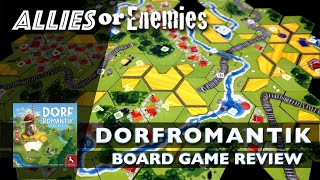
Tile placement is the heart of the game. On each turn a player draws a hexagonal tile, reveals it, and adds it to the shared map in a legal position. Meeple University explains that players may discuss where a tile should go, but the active player makes the final choice. Streams and railways must join continuously, so a waterway cannot end against a plain edge on a neighboring tile. Villages, forests and grain fields have no such restriction and can meet any edge. Allies or Enemies adds that the opening tiles must include landscape pieces and that new tiles must not block a river or train track.
The task system gives placement its tension. Each task requires a contiguous area or continuous path of a feature whose size exactly matches the number on its marker. Meeple University notes that a player may never place a task tile in a way that makes its own task impossible, yet a landscape tile may legally render an open task unreachable, in which case the marker is removed from the game. That asymmetry forces players to weigh whether a placement advances their own goals or quietly closes off a team objective.
Track Advancement Through the Campaign
The campaign track turns the score into progression. After tallying points, players compare their total against a campaign sheet, advance along a track by a set number of steps, and cross off achievements. Board Games for One describes how reaching a certain number of points allows players to open numbered boxes containing new tiles, special goals and rules. Meeple University explains that the track is filled in with white steps, while green hexagons on the path unlock new components. Because the rewards escalate, the track gives each session a clear purpose beyond the score of the moment.
The Dorfromantik: The Board Game Experience
Cozy and Relaxing
Nearly every reviewer returns to the word cozy. Foster the Meeple places the game among its best options for a chill mood, describing it as a game where a player simply places tiles and builds a town without needing to think too hard. Board Game Hangover describes the experience as a relaxing, chill game that the whole family can enjoy together, with tiles revealed and scored in turn. The pacing feels unhurried, and the pleasure comes from watching a small countryside take shape on the table.
Gentle Puzzle Tension
Beneath the calm surface, reviewers sense a real puzzle. Allies or Enemies compares the game favorably to Carcassonne, calling it a less mean version in which the map and the tile placement remain the centerpiece but without a competitive edge. Board Games for One says the game is approachable to learn and rarely needs the rulebook after the first couple of plays. The result is a light challenge that rewards planning ahead, particularly when a placement that completes one task may ruin another.
What Makes Dorfromantik: The Board Game Stand Out
A Campaign That Drip-Feeds Content
The most frequently praised feature is the way the campaign releases new material. Allies or Enemies notes that unlocking special goals and new buildings adds different rules at just the right pace, and that players keep returning because they want to finish every goal. Board Game Hangover describes the same pull, observing that players want to unlock everything. Reviewers consistently treat this drip feed as the reason the game holds attention long after its rules are mastered.
Flexible Player Count and Solo Play
Reviewers also value how well the game scales. Board Games for One emphasizes that the box lists one to six players, and that the cooperative structure means every turn belongs to the solo player when playing alone. Allies or Enemies reports that the game works solo, while still preferring a small group to share the puzzle. Foster the Meeple and Where There's A Wilz, There's a Play both highlight the game as a strong option for play at home, where a single player and a small family can each enjoy the same campaign.
Potential Drawbacks
Light Depth and Limited Stakes
The most common reservation concerns depth. Allies or Enemies warns that the game is light, so it suits players who want a comfort experience rather than a contest. The same reviewer observes that there is no real way to lose, only the possibility of winning less than you could have. Players who need a clear sense of victory or defeat may find the design unsatisfying, and those looking for tough strategic decisions may find the challenge modest for the length of the campaign.
Score Sheets and Player Count Limits
Physical production earns praise overall, but Allies or Enemies raises a practical complaint: the score sheets are too dark and hard to read while totaling points. The same review argues that the box's stated range of one to six players stretches the design, suggesting that groups larger than three or four can become too many cooks in the kitchen. These are minor issues, but they are the ones that reviewers point to when evaluating whether the game suits a particular table.
If You Enjoy Dorfromantik: The Board Game
Reviewers consistently compare the game to Carcassonne, the classic tile-laying title that shares its landscape-building focus. Allies or Enemies describes Dorfromantik as a less competitive cousin, keeping the satisfying map and tile placement while removing the rivalry. Board Game Hangover likewise compares it to Carcassonne but notes the difference in how players share the reveal and scoring. Players drawn to the Sakura version, which reviewers mention as a newer and more colorful companion to the original, will find a similar campaign structure. Anyone who enjoys tile-laying campaign games in general, where progress is unlocked across a series of sessions, should find the same satisfaction here.
What Reviewers Are Saying
"I said this is a game where you cannot lose, where you're trying to beat your own score by placing tiles and scoring them."
— Board Game Hangover
"This one hit us right in the sweet spot. It's super relaxing building a little tile countryside, but there's enough of a puzzle, and there's also just enough motivation pushing us to try to do that puzzle just a bit better each time."
— Allies or Enemies
"This is a calm, relaxing, easy to learn, but I would argue challenging as it progresses through the campaign game."
— Board Games for One